<?xml version="1.0" encoding="UTF-8"?><rss version="2.0"
	xmlns:content="http://purl.org/rss/1.0/modules/content/"
	xmlns:wfw="http://wellformedweb.org/CommentAPI/"
	xmlns:dc="http://purl.org/dc/elements/1.1/"
	xmlns:atom="http://www.w3.org/2005/Atom"
	xmlns:sy="http://purl.org/rss/1.0/modules/syndication/"
	xmlns:slash="http://purl.org/rss/1.0/modules/slash/"
	>

<channel>
	<title>Plannerly</title>
	<atom:link href="https://plannerly.com/feed/" rel="self" type="application/rss+xml" />
	<link>https://plannerly.com</link>
	<description>The Project Management Platform</description>
	<lastBuildDate>Tue, 17 Mar 2026 02:37:47 +0000</lastBuildDate>
	<language>en-US</language>
	<sy:updatePeriod>
	hourly	</sy:updatePeriod>
	<sy:updateFrequency>
	1	</sy:updateFrequency>
	<generator>https://wordpress.org/?v=6.9.4</generator>

<image>
	<url>https://plannerly.com/wp-content/uploads/2022/09/cropped-Plannerly-Favicon-32x32.png</url>
	<title>Plannerly</title>
	<link>https://plannerly.com</link>
	<width>32</width>
	<height>32</height>
</image> 
	<item>
		<title>Plannerly Launches Plannerly Saudi Arabia to Accelerate ISO 19650 + Information Management Across KSA</title>
		<link>https://plannerly.com/plannerly-saudi-arabia-launch/</link>
		
		<dc:creator><![CDATA[Clive Jordan]]></dc:creator>
		<pubDate>Tue, 17 Mar 2026 02:37:09 +0000</pubDate>
				<category><![CDATA[19650 BIM]]></category>
		<category><![CDATA[Arabic Templates]]></category>
		<category><![CDATA[bim]]></category>
		<category><![CDATA[Built Environment]]></category>
		<category><![CDATA[Construction Technology]]></category>
		<category><![CDATA[Digital Transformation]]></category>
		<category><![CDATA[IDC]]></category>
		<category><![CDATA[Information Management]]></category>
		<category><![CDATA[Integrated Dimensions Company]]></category>
		<category><![CDATA[ISO 19650]]></category>
		<category><![CDATA[Plannerly Saudi Arabia]]></category>
		<category><![CDATA[Press Release]]></category>
		<category><![CDATA[Saudi Arabia]]></category>
		<category><![CDATA[Strategic Partnership]]></category>
		<guid isPermaLink="false">https://plannerly.com/?p=92538</guid>

					<description><![CDATA[]]></description>
										<content:encoded><![CDATA[
<div class="et_pb_section et_pb_section_0 et_pb_fullwidth_section et_section_regular" >


				<div class="et_pb_module et_pb_fullwidth_code et_pb_fullwidth_code_0">


				<div class="et_pb_code_inner"><div class="plannerly-blog-article">

<!-- Header -->
<h1 class="plx-h1">Plannerly Launches Plannerly Saudi Arabia to Accelerate ISO&nbsp;19650 Information Management Across the Kingdom</h1>
<p class="subhead"><strong>For Immediate Release</strong> - Riyadh, Kingdom of Saudi Arabia - 10 February 2026</p> 

<!-- Lede -->
<p><strong>Riyadh, KSA</strong> - Plannerly, the global BIM and ISO 19650-aligned information management platform trusted by over 100,000 teams worldwide, today announced the launch of <strong>Plannerly Saudi Arabia</strong> through a strategic partnership with <strong><a href="https://idc-intl.com/" target="_blank" rel="noopener noreferrer">Integrated Dimensions Company</a></strong>, powered by Udayd Al Qimmah company, a leading Saudi-based BIM Company.</p> 

<p>The launch of Plannerly Saudi Arabia marks a significant step in directly supporting the Kingdom's growing demand for structured, auditable, and internationally aligned information management practices - particularly those aligned with the <a href="https://plannerly.com/what-is-iso-19650/" target="_blank" rel="noopener noreferrer">ISO 19650 standard</a> - across major infrastructure, real estate, and built environment programmes.</p> 

<!-- TL;DR card -->
<div class="tldr-card">
	<p class="tldr-title">What this partnership brings together</p> 
	<ul class="tldr">
		<li><strong>Plannerly Platform</strong> - BIM execution planning, information requirement management, automated verification, and structured documentation</li>
		<li><strong>IDC Local Expertise</strong> - Deep professional network, advisory, governance, and digital transformation services across the Kingdom</li>
		<li><strong>Plannerly Saudi Arabia</strong> - Platform access with localised implementation support, audit readiness services, and capability development for public and private sector organisations</li>
	</ul>
</div>

<!-- Section: Single environment -->
<h2 class="section-title nonum">A single environment for planning, creating, and verifying information</h2>

<p>Plannerly provides a single, cloud-based environment for planning, creating, and verifying information in line with ISO 19650 - reducing administrative burden, improving clarity, and enabling consistent, transparent collaboration across multidisciplinary project teams.</p> 

<p>Under the Plannerly Saudi Arabia brand, IDC will act as Plannerly's representative in the Kingdom, delivering not only access to the platform but also localised implementation support, education, audit readiness services, and long-term capability development for both public and private sector organisations.</p> 

<!-- Section: Quotes -->
<h2 class="section-title nonum">Leadership perspectives</h2>

<blockquote class="pull-quote outline">
	<p class="quote-text">"The launch of Plannerly Saudi Arabia is about more than software - it's about enabling confident, structured adoption of ISO 19650 across the Kingdom. Saudi Arabia is delivering some of the most ambitious projects in the world. By combining Plannerly's global experience with IDC's local leadership, we're helping organisations plan, manage, and verify information in a way that is scalable, auditable, and aligned with international best practice."</p> 
	<cite><a href="https://www.linkedin.com/in/clivejordan/" target="_blank" rel="noopener noreferrer">Clive Jordan</a> - CEO, Plannerly</cite>
</blockquote>

<blockquote class="pull-quote outline">
	<p class="quote-text">"Partnering with Plannerly allows us to bring a globally proven information management platform directly into the Saudi market. Through Plannerly Saudi Arabia, we can support organisations not only in meeting ISO 19650 requirements, but in fundamentally improving how information is planned, delivered, and governed across projects. This partnership enables Saudi teams to lead with confidence and global alignment."</p> 
	<cite><a href="https://www.linkedin.com/in/amjad-alomar/" target="_blank" rel="noopener noreferrer">Amjad Fathi Al Omar</a> - CEO, IDC</cite>
</blockquote>

<!-- Section: Supporting the Kingdom -->
<h2 class="section-title nonum">Supporting the Kingdom's built environment sector</h2>

<p>Plannerly Saudi Arabia will work closely with organisations to assess information management maturity, implement ISO 19650-aligned processes, provide targeted training, and support readiness for certification and audit - helping the Kingdom's built environment sector adopt international standards in a practical, sustainable way.</p> 

<p>This launch reflects a shared mission between Plannerly and IDC: to elevate information management practice, reduce waste and risk, and support structured, compliant, and efficient delivery across the full built asset lifecycle.</p> 

<!-- About sections -->
<h2 class="section-title nonum">About Plannerly</h2>

<p><a href="https://plannerly.com" target="_blank" rel="noopener noreferrer">Plannerly</a> is a cloud-based BIM and information management platform that helps architecture, engineering, construction, and owner organisations plan, create, and verify project information in alignment with <a href="https://plannerly.com/what-is-iso-19650/" target="_blank" rel="noopener noreferrer">ISO 19650</a> and other international frameworks. Trusted by tens of thousands of users across more than 100 countries, Plannerly enables structured documentation, visual scoping, automated compliance checks, and collaborative workflows that scale across projects and organisations.</p> 

<h2 class="section-title nonum">About IDC</h2>

<p>Integrated Dimensions Company, powered by Udayd Al Qimmah company, is a Saudi-based BIM company specialising in strategy development, Digital Project Management Services, Governance, Process engineering, <a href="https://idc-intl.com/bim-services/" target="_blank" rel="noopener noreferrer">BIM Services</a>, and Digital Transformation. IDC supports organisations across the Kingdom through the application of best practices, advanced methodologies, and a strong commitment to client success.</p> 

<!-- CTA buttons -->
<div class="main-cta">
	<a class="btn btn-primary" href="https://plannerly.com" target="_blank" rel="noopener noreferrer">Visit Plannerly</a>
	<a class="btn btn-ghost" href="https://app.plannerly.com/sign-up" target="_blank" rel="noopener noreferrer">Start Free on Plannerly</a>
</div>

</div>
</div>
			</div>
				
				
			</div>
]]></content:encoded>


			</item>
		<item>
		<title>Information Delivery Specification (IDS): The Complete Guide to Automating BIM Validation</title>
		<link>https://plannerly.com/information-delivery-specification-ids-the-complete-guide-to-automating-bim-validation/</link>
		
		<dc:creator><![CDATA[Clive Jordan]]></dc:creator>
		<pubDate>Tue, 10 Mar 2026 04:52:39 +0000</pubDate>
				<category><![CDATA[Information Delivery Specification (IDS)]]></category>
		<category><![CDATA[English BIM Blog]]></category>
		<category><![CDATA[IDS]]></category>
		<category><![CDATA[IDS XML]]></category>
		<category><![CDATA[BIM model validation]]></category>
		<category><![CDATA[BIM Process]]></category>
		<category><![CDATA[BIM quality assurance]]></category>
		<category><![CDATA[buildingSMART]]></category>
		<category><![CDATA[computer interpretable]]></category>
		<category><![CDATA[construction project]]></category>
		<category><![CDATA[IDS editor]]></category>
		<category><![CDATA[IFC]]></category>
		<category><![CDATA[Information Delivery Specification]]></category>
		<category><![CDATA[information requirements]]></category>
		<category><![CDATA[ISO 19650]]></category>
		<category><![CDATA[XML]]></category>
		<guid isPermaLink="false">https://plannerly.com/?p=92161</guid>

					<description><![CDATA[Learn what an Information Delivery Specification (IDS) is and how this buildingSMART standard automates BIM model validation using machine-readable XML files. Discover how IDS removes ambiguity from information requirements, integrates with ISO 19650 workflows, and helps teams deliver compliant IFC models on every construction project.]]></description>
										<content:encoded><![CDATA[
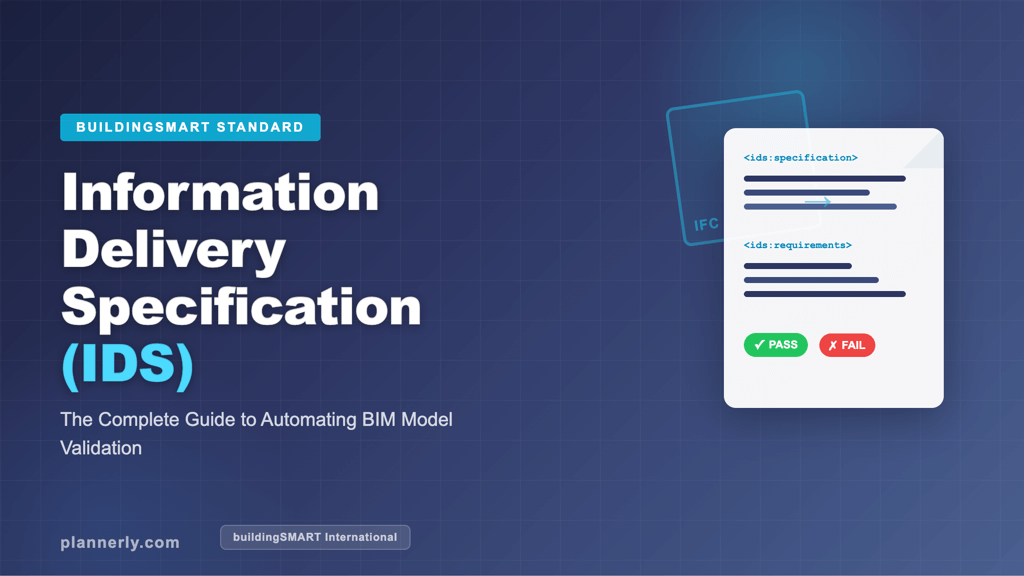
<figure class="wp-block-image aligncenter size-full"><img fetchpriority="high" decoding="async" width="1024" height="576" src="https://plannerly.com/wp-content/uploads/2026/03/IDS-Information-Delivery-Specification.png" alt="IDS Information Delivery Specification" class="wp-image-92163"/><figcaption class="wp-element-caption">Information Delivery Specification (IDS): Automating BIM Validation</figcaption></figure>


<h2>What Is an Information Delivery Specification (IDS)?</h2>

<p>An Information Delivery Specification (IDS) is a <a href="https://plannerly.com/category/buildingsmart/">buildingSMART</a> standard that defines how information requirements for BIM projects should be documented in a computer interpretable format. Unlike traditional spreadsheets or PDFs that describe what data is needed, an IDS creates a machine-readable XML file that can be used to automatically validate whether an <a href="https://plannerly.com/category/ifc/">IFC</a> model meets the specified requirements.</p>

<p>The IDS standard can have a massive benefit for the construction industry because it removes the ambiguity that has long plagued information delivery on BIM projects. With IDS, teams can clearly define what information is requested, what the allowed values are, and how that information should be structured within the BIM model. This clarity helps every stakeholder on a construction project understand exactly what is expected of them.</p>

<p>An Information Delivery Specification represents a shift from manual, document-based requirements to automated, computer-readable standards. By using an IDS instead of traditional documents, organizations can streamline their BIM process and ensure consistent information delivery across all project phases.</p>

<p>Want a quick visual overview of IDS and how it connects with the buildingSMART Data Dictionary (bSDD)? Watch this short introduction:</p>

<div class="video-embed" style="position: relative; max-width: 720px; margin: 30px auto; border-radius: 12px; overflow: hidden; box-shadow: 0 4px 20px rgba(0,0,0,0.15); transition: transform 0.3s ease, box-shadow 0.3s ease;" onmouseover="this.style.transform='translateY(-3px)'; this.style.boxShadow='0 8px 30px rgba(0,0,0,0.25)';" onmouseout="this.style.transform='translateY(0)'; this.style.boxShadow='0 4px 20px rgba(0,0,0,0.15)';">
  <div style="position: relative; padding-bottom: 56.25%; height: 0;">
    <iframe src="https://www.youtube.com/embed/o4L2wfsUr0E?rel=0" style="position: absolute; top: 0; left: 0; width: 100%; height: 100%; border: none; border-radius: 12px;" allowfullscreen></iframe>
  </div>
</div>
<p style="text-align: center; font-size: 14px; color: #666; margin-top: 10px; font-style: italic;">IDS Introduction — How Information Delivery Specifications combine with bSDD to power smarter BIM validation.</p>

<h2>Why the Information Delivery Specification Matters for BIM Projects</h2>

<p>In any BIM process, getting the right information at the right time is critical. Traditionally, information requirements have been documented in lengthy text-based documents that are open to interpretation. This often leads to misunderstandings, rework, and costly delays on construction projects.</p>

<p>The IDS standard solves this by providing a structured, computer interpretable way to specify exactly what information is needed. When you create an IDS, you define your requirements in a format that BIM tools and <a href="https://plannerly.com/category/ids-xml/">IDS</a> editors can read and validate automatically. This means you can check whether your IFC models contain all the requested information before files are even submitted.</p>

<p>For teams managing a large asset portfolio across multiple BIM projects, IDS brings consistency and automation to what was previously a manual, error-prone checking process. The importance of IDS in modern construction cannot be overstated, as it directly addresses the need for clearer information requirements throughout the BIM process.</p>

<h2>The Business Case for Implementing IDS in Your BIM Process</h2>

<p>Organizations adopting Information Delivery Specification standards report significant improvements in project efficiency and model quality. The business benefits of implementing IDS include reduced rework, faster approval cycles, and improved coordination among BIM teams. When information requirements are clearly defined and automatically validated, the entire construction project runs more smoothly.</p>

<p>The delivery specification approach enables BIM projects to track compliance in real time, providing objective metrics on whether deliverables meet stated requirements. This transparency helps project managers make faster decisions and identify issues before they become expensive problems.</p>

<h2>How IDS Works: The Technical Basics</h2>

<p>At its core, an Information Delivery Specification is an <a href="https://plannerly.com/category/ids-xml/">XML file</a> that follows the buildingSMART IDS schema. This XML file contains a set of specifications, where each specification defines requirements for specific elements within IFC models. Here is how IDS works in practice:</p>

<ul>
  <li><strong>Applicability:</strong> Each specification in the IDS defines which IFC elements it applies to (for example, all walls, all doors, or all spaces in the BIM model).</li>
  <li><strong>Requirements:</strong> For those applicable elements, the IDS defines what properties, classifications, materials, or attributes must be present and what their allowed values should be.</li>
  <li><strong>Validation:</strong> BIM tools that support the IDS standard can then automatically check each IFC model against these requirements, producing a pass/fail report for each specification.</li>
</ul>

<p>Because the IDS is written as a structured XML file, it eliminates the need for manual checking. The IDS can validate thousands of elements in seconds, identifying missing or incorrect information across your entire BIM model. This makes the IDS a powerful quality assurance tool for any construction project.</p>

<p>Understanding how IDS processes information requirements is essential for teams looking to upgrade their BIM process. The technical foundation of IDS enables rapid validation that would be impossible with traditional, manual approaches to checking.</p>

<h2>IDS vs. Traditional Information Requirements</h2>

<p>Before IDS, teams typically used spreadsheets, PDF documents, or text-based <a href="https://plannerly.com/category/bim-execution-plan/">BIM Execution Plans</a> to define their information requirements. While these approaches work, they have significant limitations in the BIM process:</p>

<ul>
  <li><strong>Manual checking:</strong> Someone has to manually verify that each IFC model meets the requirements, which is slow and error-prone.</li>
  <li><strong>Ambiguity:</strong> Text-based requirements leave room for interpretation. What one team considers &#8220;complete&#8221; information might not match another team&#8217;s expectations.</li>
  <li><strong>No automation:</strong> Traditional documents cannot be read by BIM tools, so there is no way to automate the validation process.</li>
</ul>

<p>The Information Delivery Specification addresses all of these issues. By encoding requirements in a computer interpretable XML file, the IDS enables automatic validation, removes ambiguity, and ensures that the information structure of every deliverable matches the project&#8217;s specifications exactly.</p>

<p>Making the transition from traditional methods to an IDS-based approach requires changing how teams define and communicate their delivery specification requirements. However, the shift is worthwhile given the substantial improvements in efficiency and accuracy.</p>

<h2>Key Components of an IDS File</h2>

<p>Every Information Delivery Specification (IDS) file contains several important components that define the information requirements for a construction project. Understanding these components is essential for anyone working with IDS on BIM projects:</p>

<h3>Specifications in an Information Delivery Specification</h3>
<p>A single IDS file can contain multiple specifications. Each specification targets a specific set of elements in the IFC models and defines what information those elements must contain. For example, one specification might require all walls to have a fire rating property, while another might require all spaces to include area calculations. These specifications form the backbone of how your delivery specification manages information requirements across the BIM model.</p>

<h3>Facets and Properties</h3>
<p>Facets are the building blocks of IDS requirements. They define the specific attributes, properties, classifications, or materials that must be present. Each facet can include constraints on allowed values, ensuring that the requested information meets the project&#8217;s standards. Using facets, teams can create granular, precise specifications for the IFC models that must be delivered.</p>

<h3>Optionality and Flexibility</h3>
<p>IDS allows you to mark separate requirements as either mandatory or optional. This flexibility is important because not every piece of information is equally critical at every stage of a construction project. Teams can define which requirements are essential for a particular delivery milestone and which are nice-to-have. This capability makes IDS particularly useful for phased BIM projects.</p>

<h2>Creating an Information Delivery Specification: Step-by-Step Guide</h2>

<p>Creating an IDS does not require programming knowledge. Several BIM tools and <a href="https://plannerly.com/category/ids/">IDS</a> editors now support the creation and editing of IDS files through user-friendly interfaces. Here is a typical workflow for creating an IDS:</p>

<ol>
  <li><strong>Identify your information needs:</strong> Review the project&#8217;s information requirements, including what data is needed from each discipline and at what stage of the BIM process.</li>
  <li><strong>Define specifications:</strong> For each requirement, create a specification in the IDS editor that identifies which IFC elements it applies to and what information those elements must contain.</li>
  <li><strong>Set allowed values:</strong> Where appropriate, define the permitted values for each property or attribute. For example, fire rating values might be restricted to specific classifications.</li>
  <li><strong>Export and share:</strong> Save your IDS as an XML file and distribute it to all project stakeholders so they can validate their BIM models before submission.</li>
</ol>

<p>Tools like <a href="https://plannerly.com/">Plannerly</a> make this process even simpler by integrating IDS creation into the broader BIM management workflow. With Plannerly, you can define your information requirements using an intuitive interface, export them as IDS files, and track compliance across your entire BIM project.</p>

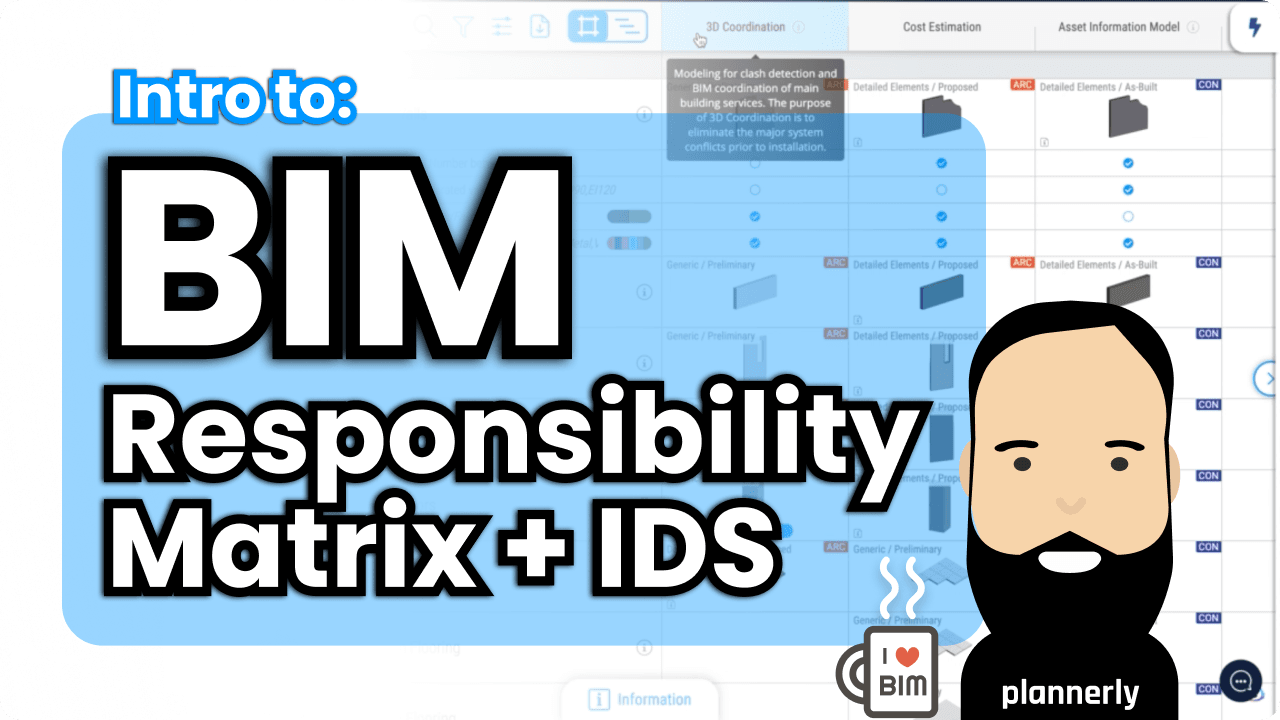
<p>In the video below, we walk through the full process of creating an IDS and a responsibility matrix from scratch — no coding required:</p>

<div class="video-embed" style="position: relative; max-width: 720px; margin: 30px auto; border-radius: 12px; overflow: hidden; box-shadow: 0 4px 20px rgba(0,0,0,0.15); transition: transform 0.3s ease, box-shadow 0.3s ease;" onmouseover="this.style.transform='translateY(-3px)'; this.style.boxShadow='0 8px 30px rgba(0,0,0,0.25)';" onmouseout="this.style.transform='translateY(0)'; this.style.boxShadow='0 4px 20px rgba(0,0,0,0.15)';">
  <div style="position: relative; padding-bottom: 56.25%; height: 0;">
    <iframe src="https://www.youtube.com/embed/ZYwtz841XEU?rel=0" style="position: absolute; top: 0; left: 0; width: 100%; height: 100%; border: none; border-radius: 12px;" allowfullscreen></iframe>
  </div>
</div>
<p style="text-align: center; font-size: 14px; color: #666; margin-top: 10px; font-style: italic;">How to Create an IDS (buildingSMART Information Delivery Specification) — a step-by-step walkthrough using Plannerly.</p>

<p>The process of building an effective delivery specification requires clear communication with your team about information requirements. When stakeholders understand how IDS will be used to validate their work, they can more easily adopt the required standards and procedures.</p>

<h2>Using IDS with IFC Models for Quality Assurance</h2>

<p>One of the most powerful applications of the Information Delivery Specification is automated quality assurance of IFC models. Once you have an IDS file, you can use it to <a href="https://plannerly.com/category/bim-checking/">check</a> any IFC model for compliance. This process works as follows:</p>

<p>The IDS validator reads the XML file and compares the requirements against the data in the IFC models. For each specification, it checks whether the applicable elements contain the requested information and whether the values fall within the allowed ranges. The result is a detailed report showing which requirements pass and which fail, along with specific details about any non-conformances.</p>

<p>This automated checking process is invaluable for construction projects because it catches errors early in the BIM process, before they become costly problems on site. It also provides an objective, repeatable way to assess model quality across different teams and disciplines.</p>

<p>By implementing IDS for quality checks, teams can significantly reduce the time spent on manual <a href="https://plannerly.com/category/bim-checking/">BIM checking</a> and focus on more strategic aspects of their BIM projects. The delivery specification becomes a living document that can be refined as lessons are learned.</p>

<p>To see IDS-based quality assurance in action, here is a demonstration of how Plannerly and Solibri work together to check BIM models against an IDS:</p>

<div class="video-embed" style="position: relative; max-width: 720px; margin: 30px auto; border-radius: 12px; overflow: hidden; box-shadow: 0 4px 20px rgba(0,0,0,0.15); transition: transform 0.3s ease, box-shadow 0.3s ease;" onmouseover="this.style.transform='translateY(-3px)'; this.style.boxShadow='0 8px 30px rgba(0,0,0,0.25)';" onmouseout="this.style.transform='translateY(0)'; this.style.boxShadow='0 4px 20px rgba(0,0,0,0.15)';">
  <div style="position: relative; padding-bottom: 56.25%; height: 0;">
    <iframe src="https://www.youtube.com/embed/9TD39ljImpg?rel=0" style="position: absolute; top: 0; left: 0; width: 100%; height: 100%; border: none; border-radius: 12px;" allowfullscreen></iframe>
  </div>
</div>
<p style="text-align: center; font-size: 14px; color: #666; margin-top: 10px; font-style: italic;">BIM Checking with buildingSMART IDS — using Plannerly and Solibri for automated model validation.</p>

<h2>IDS and Non-IFC Data</h2>

<p>While the Information Delivery Specification is primarily designed for validating IFC models, the principles behind IDS can also be applied to non IFC data. Many construction projects involve information that lives outside of BIM models, such as documents, schedules, and cost data. Teams can use the IDS framework as a reference for defining information requirements across all project deliverables, even if the automated checking is limited to IFC-based content.</p>

<p>BuildingSMART continues to develop the IDS standard, and future versions may extend support for validating non IFC data alongside traditional BIM model content. This evolution will make the delivery specification even more valuable for comprehensive project information management.</p>

<h2>IDS in the Context of ISO 19650 and BIM Standards</h2>

<p>The Information Delivery Specification fits naturally into the <a href="https://plannerly.com/category/iso-19650/">ISO 19650</a> framework for information management. <a href="https://plannerly.com/category/iso-19650-compliance/">ISO 19650 compliance</a> requires teams to define their information requirements at the start of a construction project and to verify that deliverables meet those requirements throughout the BIM process. IDS provides the technical mechanism to do exactly this.</p>

<p>When teams use IDS as part of their <a href="https://plannerly.com/category/iso-19650/">ISO 19650</a> workflow, they can automate the verification of information deliveries, track compliance across multiple BIM projects, and provide auditable evidence that requirements have been met. This is particularly valuable for organizations managing a large asset portfolio across multiple construction projects.</p>

<p>The relationship between IDS and <a href="https://plannerly.com/category/bim-standards/">BIM standards</a> is symbiotic: standards define the framework, and IDS provides the technical implementation. Together, they create a robust approach to information management in the BIM process.</p>

<h2>Popular IDS Editors and BIM Tools Supporting IDS</h2>

<p>Several IDS editors and BIM tools now support the IDS standard. Here are some of the most popular options for creating and validating Information Delivery Specifications:</p>

<ul>
  <li><strong>Plannerly:</strong> A comprehensive BIM management platform that integrates <a href="https://plannerly.com/ids-buildingsmart-creation/">IDS creation</a>, validation, and compliance tracking into a single workflow. Plannerly makes it easy to define your delivery specification, export IDS files, and verify IFC models against your requirements. For users of specific BIM tools, Plannerly also offers specialized features like <a href="https://plannerly.com/plannerly-ids-revit/">IDS Revit</a> integration and <a href="https://plannerly.com/buildingsmart-ids-archicad-plannerly/">buildingSMART IDS Archicad</a> compatibility.</li>
  <li><strong>buildingSMART IDS Editor:</strong> The official open-source IDS editor from <a href="https://plannerly.com/category/buildingsmart/">buildingSMART</a>, which provides a straightforward interface for creating and editing IDS files. This editor is freely available and forms the foundation for many other tools in the IDS ecosystem.</li>
  <li><strong>Various BIM Checking Tools:</strong> Several commercial BIM tools now include IDS validation capabilities through the checking tab or dedicated IDS modules, enabling teams to validate their IFC models directly within their existing workflows.</li>
</ul>

<p>The variety of available tools makes it easier for organizations to adopt IDS regardless of their existing BIM software stack. Whether you work with Revit, ArchiCAD, or other platforms, there is likely an IDS editor or validation tool that integrates with your current setup.</p>

<p>Wondering how Plannerly fits into the IDS ecosystem? This video explains how we tackled the common challenges teams face when adopting IDS on real projects:</p>

<div class="video-embed" style="position: relative; max-width: 720px; margin: 30px auto; border-radius: 12px; overflow: hidden; box-shadow: 0 4px 20px rgba(0,0,0,0.15); transition: transform 0.3s ease, box-shadow 0.3s ease;" onmouseover="this.style.transform='translateY(-3px)'; this.style.boxShadow='0 8px 30px rgba(0,0,0,0.25)';" onmouseout="this.style.transform='translateY(0)'; this.style.boxShadow='0 4px 20px rgba(0,0,0,0.15)';">
  <div style="position: relative; padding-bottom: 56.25%; height: 0;">
    <iframe src="https://www.youtube.com/embed/GZHoMiclOcY?rel=0" style="position: absolute; top: 0; left: 0; width: 100%; height: 100%; border: none; border-radius: 12px;" allowfullscreen></iframe>
  </div>
</div>
<p style="text-align: center; font-size: 14px; color: #666; margin-top: 10px; font-style: italic;">Solving the IDS Challenge with Plannerly — practical strategies for adopting IDS across your organisation.</p>

<h2>Getting Started with IDS on Your BIM Projects</h2>

<p>If you are ready to implement the Information Delivery Specification on your construction projects, here are the steps to get started:</p>

<ol>
  <li><strong>Learn the fundamentals:</strong> Familiarize yourself with the IDS standard, its structure, and how it integrates with your existing BIM process. <a href="https://plannerly.com/understanding-information-delivery-specifications-ids/">Understanding Information Delivery Specifications</a> and reviewing buildingSMART documentation will provide excellent foundational knowledge.</li>
  <li><strong>Choose your IDS tools:</strong> Select an <a href="https://plannerly.com/category/ids/">IDS</a> editor and validation platform that fits your team&#8217;s workflow. <a href="https://plannerly.com/how-to-implement-ids-from-buildingsmart/">How to implement IDS from buildingSMART</a> guides can help you make this decision. Plannerly offers an integrated solution that simplifies the entire process.</li>
  <li><strong>Start small:</strong> Begin by defining IDS requirements for a single discipline or a pilot construction project. This allows your team to build confidence with the standard before rolling it out across all BIM projects. Learn about <a href="https://plannerly.com/buildingsmart-ids-export-availability/">buildingSMART IDS export availability</a> to understand your options.</li>
  <li><strong>Iterate and improve:</strong> As your team gains experience, refine your IDS specifications based on lessons learned. The beauty of the IDS is that each XML file can be reused, adapted, and improved from project to project. Resources like the <a href="https://plannerly.com/ids-xml-how-to/">IDS XML how-to</a> guide can support your team&#8217;s learning journey.</li>
</ol>

<p>The Information Delivery Specification is rapidly becoming an essential standard for anyone involved in BIM projects. By adopting IDS, your team can automate quality checks, eliminate ambiguity in information requirements, and deliver better outcomes on every construction project.</p>

<p>Ready to create your first IDS file? This tutorial shows you exactly how to build a buildingSMART-compliant IDS file using Plannerly, from start to export:</p>

<div class="video-embed" style="position: relative; max-width: 720px; margin: 30px auto; border-radius: 12px; overflow: hidden; box-shadow: 0 4px 20px rgba(0,0,0,0.15); transition: transform 0.3s ease, box-shadow 0.3s ease;" onmouseover="this.style.transform='translateY(-3px)'; this.style.boxShadow='0 8px 30px rgba(0,0,0,0.25)';" onmouseout="this.style.transform='translateY(0)'; this.style.boxShadow='0 4px 20px rgba(0,0,0,0.15)';">
  <div style="position: relative; padding-bottom: 56.25%; height: 0;">
    <iframe src="https://www.youtube.com/embed/rpYRJVJNMTE?rel=0" style="position: absolute; top: 0; left: 0; width: 100%; height: 100%; border: none; border-radius: 12px;" allowfullscreen></iframe>
  </div>
</div>
<p style="text-align: center; font-size: 14px; color: #666; margin-top: 10px; font-style: italic;">How to Create an IDS buildingSMART File with Plannerly — from defining requirements to exporting your finished IDS.</p>

<h2>Additional Resources for IDS Implementation</h2>

<p>To deepen your understanding of IDS and its role in modern BIM practices, several resources are available to support your implementation journey. Learn more about <a href="https://plannerly.com/creating-responsibility-matrix-ids-raci/">creating responsibility matrix IDS RACI</a> to clarify roles and accountability. Explore how <a href="https://plannerly.com/bim-model-quality-verify-module/">BIM model quality verify</a> tools can complement your IDS validation strategy. For those interested in automation, discover <a href="https://plannerly.com/simplifying-bim-model-checking-automation/">simplifying BIM model checking automation</a> with integrated platforms.</p>

<p>Organizations can also benefit from structured training. Consider exploring our <a href="https://plannerly.com/courses/basic/">BIM training course</a> to build comprehensive skills in IDS, BIM standards, and information management. Additionally, the <a href="https://help.plannerly.com/en/article/124-how-plannerly-supports-bim-and-iso-19650-workflows-worldwide">help resources on how Plannerly supports BIM and ISO 19650 workflows worldwide</a> provide practical guidance for implementation.</p>

<p>For a deeper dive into the full implementation workflow, including how to bring bSDD classifications and IDS validation together in one platform, watch our step-by-step guide:</p>

<div class="video-embed" style="position: relative; max-width: 720px; margin: 30px auto; border-radius: 12px; overflow: hidden; box-shadow: 0 4px 20px rgba(0,0,0,0.15); transition: transform 0.3s ease, box-shadow 0.3s ease;" onmouseover="this.style.transform='translateY(-3px)'; this.style.boxShadow='0 8px 30px rgba(0,0,0,0.25)';" onmouseout="this.style.transform='translateY(0)'; this.style.boxShadow='0 4px 20px rgba(0,0,0,0.15)';">
  <div style="position: relative; padding-bottom: 56.25%; height: 0;">
    <iframe src="https://www.youtube.com/embed/Zz0PZNkMKXM?rel=0" style="position: absolute; top: 0; left: 0; width: 100%; height: 100%; border: none; border-radius: 12px;" allowfullscreen></iframe>
  </div>
</div>
<p style="text-align: center; font-size: 14px; color: #666; margin-top: 10px; font-style: italic;">How to Implement bSDD and IDS with Plannerly — a complete step-by-step guide to integrating both standards.</p>

<h2>The Future of Information Delivery Specifications in Construction</h2>

<p>As the construction industry continues to embrace digital transformation, the Information Delivery Specification is positioned to become increasingly central to how BIM projects are managed. The IDS standard will likely evolve to support more complex scenarios, including integration with other data formats and expanded capabilities for non IFC data validation.</p>

<p>Organizations that invest in mastering IDS now will gain a competitive advantage. By establishing clear delivery specification processes and automating information validation, teams can operate with greater efficiency, reduce costly errors, and deliver higher quality results on every construction project.</p>

<p>Ready to transform your approach to BIM information management? <a href="https://app.plannerly.com/sign-up">Try Plannerly for free</a> and see how easy it is to create, manage, and validate your Information Delivery Specifications. You can also explore <a href="https://help.plannerly.com/en/article/89-using-plannerly-as-a-common-data-environment-cde">using Plannerly as a common data environment (CDE)</a> to centralize all your BIM information requirements and project documentation in one place.</p>

]]></content:encoded>


			</item>
		<item>
		<title>Case Study: How One University ditched &#8220;Embarrassing&#8221; Spreadsheets for World-Class BIM Education</title>
		<link>https://plannerly.com/world-class-bim-education/</link>
		
		<dc:creator><![CDATA[Clive Jordan]]></dc:creator>
		<pubDate>Mon, 08 Dec 2025 06:21:51 +0000</pubDate>
				<category><![CDATA[BIM Education]]></category>
		<category><![CDATA[19650 BIM]]></category>
		<category><![CDATA[BIM Career]]></category>
		<category><![CDATA[BIM Manager]]></category>
		<category><![CDATA[ISO 19650 BIM]]></category>
		<guid isPermaLink="false">https://plannerly.com/?p=84412</guid>

					<description><![CDATA[]]></description>
										<content:encoded><![CDATA[<p><div class="et_pb_section et_pb_section_1 et_section_regular" >


				<div class="et_pb_row et_pb_row_0">
				<div class="et_pb_column et_pb_column_4_4 et_pb_column_0  et_pb_css_mix_blend_mode_passthrough et-last-child">


				<div class="et_pb_module et_pb_code et_pb_code_0">


				<div class="et_pb_code_inner"><!-- Plannerly Blog – Divi Code Module Template -->
<div class="plannerly-breakout pad-centered-880">
  <div class="plannerly-blog-article">

    <!-- Title + Subhead -->
    <div class="narrow-block">
      <h1 class="plx-h1">Case Study: How One University ditched "Embarrassing" Spreadsheets for World-Class BIM Education</h1>
      <p class="subhead">
        Discover how a leading Spanish university and
        <a href="https://thefactoryschool.com/" target="_blank" rel="noopener">The Factory School</a>
        transformed their BIM curriculum with Plannerly, ditching static PDFs for ISO 19650 workflows and producing job-ready graduates.
      </p> 
    </div>

    <!-- Top CTA (optional; left-gutter play icon via CSS) -->
    <div class="video-callout narrow-block icon-left icon-play">
      <a href="#video" class="video-callout-link" data-analytics="watch_top" aria-label="Watch the BIM education case study - See how Miguel teaches BIM management with Plannerly">
        <strong>Watch the BIM education case study</strong>
        <span>See how Miguel teaches BIM management with Plannerly</span>
      </a>
    </div>

    <!-- TL;DR / Key Outcomes -->
    <div class="narrow-block">
      <div class="tldr-card">
        <div class="tldr-title">Quick summary</div>
        <ul class="tldr">
          <li><strong>Static PDFs and messy spreadsheets</strong> made BIM management teaching feel outdated and “embarrassing”.</li>
          <li>By switching to <strong>Plannerly’s live BIM management workflows</strong>, students now build real BEPs, scopes, and ISO 19650 processes instead of just reading about them.</li>
          <li>Graduates leave with <strong>job-ready skills</strong> in BEPs, IDS, and model verification that employers actually recognize and value.</li>
          <li>The program, delivered with <strong><a href="https://thefactoryschool.com/" target="_blank" rel="noopener">The Factory School</a></strong>, has gained <strong>recognition in the BIM space</strong> by teaching with modern, industry-standard tools.</li>
        </ul>
      </div>
    </div>

    <!-- Video (click-to-play) -->
    <div id="video" class="video-embed narrow-block" data-youtube="Fh55440Vjqc"
         role="button" tabindex="0" aria-label="Play video: Case Study: How One University ditched "Embarrassing" Spreadsheets for World-Class BIM Education - Interview with Miguel Picado Filgueira from The Factory School">
      <img
        src="https://i.ytimg.com/vi/Fh55440Vjqc/hqdefault.jpg"
        width="1280" height="720" loading="eager" fetchpriority="high" decoding="async"
        alt="Case Study: How One University ditched "Embarrassing" Spreadsheets for World-Class BIM Education — interview with Miguel Picado Filgueira from The Factory School">
      <div class="video-play-center" aria-hidden="true">
        <div class="video-play-button"></div>
        <div class="video-play-text">Click to play</div>
      </div>
      <div class="video-overlay-cue" aria-hidden="true"><span>Click to play</span></div>
    </div>

    <!-- Below-video buttons -->
    <div class="narrow-block yt-row">
      <div class="yt-actions">
        <a id="click-to-play" class="btn btn-ghost btn-yt" href="#video">Click to play</a>
        <a class="btn btn-ghost btn-yt" href="https://youtu.be/Fh55440Vjqc?si=SwGnAhTN_EJDRwCp" target="_blank" rel="noopener">Open on YouTube</a>
      </div>
      <p class="video-meta">
        Interview with
        <a href="https://www.linkedin.com/in/miguelpicado/" target="_blank" rel="noopener">Miguel Picado Filgueira</a>,
        postgraduate BIM program leader at
        <a href="https://thefactoryschool.com/" target="_blank" rel="noopener">The Factory School</a>.
      </p> 
    </div>

    <!-- Intro section (between video and TOC) -->
    <section class="plx-section intro-section no-number">
      <div class="narrow-block">
        <h2 class="section-title nonum">Why this BIM education case study matters</h2>
        <p>
          In many universities, students learn how to model walls and slabs - but not how to <strong>manage BIM information</strong> the way real projects demand.
          This Spanish postgraduate program at
          <a href="https://thefactoryschool.com/" target="_blank" rel="noopener">The Factory School</a>
          decided to fix that gap by replacing <strong>“embarrassing” PDFs and spreadsheets</strong> with a live,
          ISO 19650-aligned BIM management workflow inside Plannerly.
        </p> 
        <p>
          Instead of just hearing about BEPs and Information Delivery Specifications, students now <strong>create, manage, and verify them</strong> in the same kind of
          environment used by leading AEC firms. This case study shows how that shift:
        </p> 
        <ul>
          <li>Aligned the curriculum with <strong>ISO 19650 best practices</strong></li>
          <li>Gave students <strong>hands-on experience</strong> with structured BIM management</li>
          <li>Helped the program and <strong><a href="https://thefactoryschool.com/" target="_blank" rel="noopener">The Factory School</a></strong> stand out as serious BIM education leaders</li>
        </ul>
      </div>
    </section>

    <!-- TOC -->
    <div class="toc-wrap">
      <div class="toc-disclosure" role="region" aria-label="Table of Contents">
        <button id="toc-toggle" class="toc-toggle-outline" aria-expanded="false">
          <span class="toc-label">Open Table of Contents</span>
          <svg id="toc-chevron" class="chev" width="22" height="22" viewBox="0 0 24 24" aria-hidden="true">
            <path fill="currentColor" d="M9 6l6 6l-6 6"></path>
          </svg>
        </button>
        <div id="toc-content" class="toc-content hidden" aria-hidden="true">
          <ol class="toc-list">
            <li><a href="#sec-1">The "Embarrassing" Reality of Legacy BIM Education</a></li>
            <li><a href="#sec-2">Implementing a "Game Changer" in the Curriculum</a></li>
            <li><a href="#sec-3">The Result: Job-Ready Graduates Who Get Hired</a></li>
            <li><a href="#sec-4">Gaining Recognition in the BIM Space</a></li>
            <li><a href="#sec-5">Why This Matters for the Future of BIM</a></li>
            <li><a href="#sec-6">Watch the Discussion</a></li>
            <li><a href="#sec-7">Ready to Transform Your Workflow?</a></li>
          </ol>
        </div>
      </div>
    </div>

    <!-- Sections -->
    <section class="plx-section" data-target="#sec-1">
      <h2 id="sec-1" class="section-title">The "Embarrassing" Reality of Legacy BIM Education</h2>
      <p>
        In the fast-evolving world of Architecture, Engineering, and Construction (AEC), the gap between <strong>academic theory</strong> and
        <strong>professional reality</strong> can feel like a canyon. Students often learn how to model in Revit or Archicad - but miss the
        critical <em>management</em> layer that actually gets projects built and keeps information under control.
      </p> 
      <p>
        Before Plannerly, Miguel’s postgraduate BIM program at
        <a href="https://thefactoryschool.com/" target="_blank" rel="noopener">The Factory School</a>
        relied on what he calls <strong>“Spreadsheet Spaghetti”</strong>. Scopes were defined
        in static PDFs, BIM Execution Plans (BEPs) lived in huge Word files, and tracking progress meant juggling
        Excel documents that were <strong>out of date the moment they were saved</strong>.
      </p> 
      <p>
        That created a disconnect. Students were learning modern design tools while the management side was stuck with
        archaic processes. For an educator trying to prepare true BIM Managers, relying on these tools felt contradictory -
        especially when the industry is moving toward <strong>structured, ISO 19650-aligned workflows</strong>. If you are still catching up on
        the standard itself, this primer on <a href="https://plannerly.com/what-is-iso-19650/" target="_blank" rel="noopener">what ISO 19650 is and why it matters</a> can help.
      </p> 

      <!-- Pull-quote -->
      <blockquote class="pull-quote outline">
        <p class="quote-text">
          <strong>"Before Plannerly, we were working with PDFs and Excel sheets. For me, it was almost embarrassing - we don't have to use these now. For us, Plannerly was a game changer."</strong>
        </p> 
        <cite>
          - <a href="https://www.linkedin.com/in/miguelpicado/" target="_blank" rel="noopener">Miguel Picado Filgueira</a>,
          postgraduate BIM program leader at
          <a href="https://thefactoryschool.com/" target="_blank" rel="noopener">The Factory School</a>
        </cite>
      </blockquote>

      <p>
        Miguel’s experience echoes a wider industry problem: many teams call themselves “digital” while still managing
        their most important BIM data in <strong>disconnected files</strong>. The university and The Factory School decided it was time
        for their learning environment to match real-world <strong>BIM management best practice</strong>.
      </p> 
    </section>

    <section class="plx-section" data-target="#sec-2">
      <h2 id="sec-2" class="section-title">Implementing a "Game Changer" in the Curriculum</h2>
      <p>
        The shift wasn’t just about swapping software; it was about changing mindset. The goal was to move students from
        <em>document-centric</em> thinking (files, versions, email attachments) to <em>data-centric</em> thinking
        (<strong>live scopes, tracked tasks, verified information</strong>).
      </p> 
      <p>
        The program integrated Plannerly directly into the master’s coursework so that students could work the way
        modern BIM teams do. Instead of reading about workflows in a slide deck, they now <strong>build and manage them</strong> inside a
        central platform.
      </p> 

      <h3>1. From Static PDFs to Live BEPs</h3>
      <p>
        Instead of just reading about a BIM Execution Plan in a textbook, students now <strong>create a live BEP</strong> in Plannerly.
        Using BEP templates that align with ISO 19650, they learn that a BEP is not just a PDF to be filed away - it’s a
        <strong>living agreement</strong> that guides information delivery across the project. For more on structuring BEPs, see this
        <a href="https://plannerly.com/guide-bim-and-bep/" target="_blank" rel="noopener">guide to BIM Execution Plans</a> or the Spanish version
        <a href="https://plannerly.com/guia-bim-bep/" target="_blank" rel="noopener">Guía BIM + BEP</a>.
      </p> 

      <h3>2. Visual Scope Management</h3>
      <p>
        Concepts like <strong>Level of Information Need (LOIN)</strong> can feel abstract in a classroom. With Plannerly’s visual scope modules,
        students drag-and-drop requirements, assign information to specific model elements, and clearly see
        <em>who</em> needs to do <em>what</em> and <em>when</em>. This helps them understand LOIN in a practical, visual way - you can
        dive deeper into the concept in this article on
        <a href="https://plannerly.com/level-of-information-need-loin-bim/" target="_blank" rel="noopener">Level of Information Need in BIM</a>.
      </p> 

      <h3>3. Real-World ISO 19650 Workflows</h3>
      <p>
        Perhaps the biggest win is that students now <strong>learn ISO 19650 by doing it</strong>. Instead of memorizing clauses, they
        follow a structured workflow baked into Plannerly: managing tasks in a Common Data Environment, approving
        deliverables, and verifying that data meets defined requirements. For programs planning their own journey,
        this guide on <a href="https://plannerly.com/how-to-get-iso-19650-compliant/" target="_blank" rel="noopener">how to get ISO 19650 compliant</a>
        is a useful reference.
      </p> 

      <a href="https://plannerly.com/learn-iso-19650/" class="info-card info-card-blue icon-left icon-bolt" role="button" aria-label="Teach ISO 19650 the simple way">
        <div class="info-card-icon"></div>
        <div class="info-card-body">
          <span class="info-head">Teach ISO 19650 the simple way</span>
          <span class="info-sub">Plug free ISO 19650 lessons and templates straight into your BIM curriculum.</span>
        </div>
      </a>
    </section>

    <section class="plx-section" data-target="#sec-3">
      <h2 id="sec-3" class="section-title">The Result: Job-Ready Graduates Who Get Hired</h2>
      <p>
        The impact went far beyond classroom exercises. By training on Plannerly, students weren’t just learning a tool;
        they were learning <strong>the workflows used by leading BIM teams worldwide</strong> - from digital BEPs to automated checks.
      </p> 
      <p>
        In a competitive job market, firms don’t have time to spend six months teaching a new hire how to read and manage
        a BIM Execution Plan. They want people who can <strong>hit the ground running</strong> with real information management skills.
      </p> 
      <p>
        By the time Miguel’s students graduate, they have hands-on experience in:
      </p> 
      <ul>
        <li><strong>Creating and managing digital BEPs</strong> that stay live throughout the project.</li>
        <li>Defining clear <strong>Information Delivery Specifications (IDS)</strong> and responsibility matrices.</li>
        <li><strong>Verifying models automatically</strong> against agreed information requirements.</li>
      </ul>
      <p>
        Industry feedback has been immediate: companies actively seek out graduates from this program because they
        understand BIM as a <strong>complete management process</strong>, not just geometry. For those building a similar path,
        this <a href="https://plannerly.com/bim-management-guide/" target="_blank" rel="noopener">BIM management guide</a> and
        <a href="https://plannerly.com/mastering-bim-project-management/" target="_blank" rel="noopener">BIM project management overview</a> are good companions.
      </p> 

      <a href="https://plannerly.com/training/" class="info-card info-card-green icon-left icon-star" role="button" aria-label="Get free BIM + ISO 19650 training">
        <div class="info-card-icon"></div>
        <div class="info-card-body">
          <span class="info-head">Get free BIM + ISO 19650 training</span>
          <span class="info-sub">Earn certificates and bring the same workflows into your classroom.</span>
        </div>
      </a>
    </section>

    <section class="plx-section" data-target="#sec-4">
      <h2 id="sec-4" class="section-title">Gaining Recognition in the BIM Space</h2>
      <p>
        For the university and <a href="https://thefactoryschool.com/" target="_blank" rel="noopener">The Factory School</a>, adopting Plannerly became a powerful <strong>differentiator</strong>.
        In a crowded education market, offering training on cutting-edge, industry-standard tools sends a clear message:
        this program is serious about <strong>real-world BIM management</strong>, not just theory.
      </p> 
      <p>
        Miguel highlights the reputational boost:
      </p> 
      <blockquote class="pull-quote outline">
        <p class="quote-text">
          <strong>"Teaching Plannerly to our students helped us to gain some recognition in the BIM space."</strong>
        </p> 
        <cite>- <a href="https://www.linkedin.com/in/miguelpicado/" target="_blank" rel="noopener">Miguel Picado Filgueira</a>, The Factory School</cite>
      </blockquote>
      <p>
        The program is no longer just an academic observer of digital transformation. It is now an
        <strong>active participant in modern BIM workflows</strong>, showing that it understands where the industry is going:
        away from administrative chaos and toward <strong>structured, verified, database-driven information</strong>.
      </p> 
    </section>

    <section class="plx-section" data-target="#sec-5">
      <h2 id="sec-5" class="section-title">Why This Matters for the Future of BIM</h2>
      <p>
        This case study is a snapshot of a wider shift. Just as Miguel felt “embarrassed” by Excel and PDF-based workflows
        in a classroom, many BIM Managers feel the same about their day-to-day project processes. The good news:
        <strong>better tools lead to better understanding</strong>.
      </p> 
      <ol>
        <li>
          <strong>Better tools lead to better understanding.</strong>
          Complex standards like ISO 19650 become intuitive when taught inside a structured framework instead of a flat PDF.
        </li>
        <li>
          <strong>Standardization is a skill.</strong>
          Learning to work in a consistent, rules-based environment is just as important as learning modeling tools.
        </li>
        <li>
          <strong>The future is database-driven.</strong>
          The days of managing million-dollar projects with disconnected spreadsheets are numbered; live information
          models and <strong>smart Common Data Environments</strong> are taking over. For a taste of what that looks like, see this
          intro to Plannerly’s <a href="https://plannerly.com/intro-clever-data-environment-cde/" target="_blank" rel="noopener">Clever Data Environment (CDE)</a>.
        </li>
      </ol>
      <p>
        When universities teach these skills early, they help create a generation of professionals who expect - and demand -
        <strong>better BIM workflows</strong> from day one.
      </p> 
    </section>

    <section class="plx-section" data-target="#sec-6">
      <h2 id="sec-6" class="section-title">Watch the Discussion</h2>
      <p>
        Want to hear Miguel’s story in his own words? In this recorded session, he walks through:
      </p> 
      <ul>
        <li>How he moved from <strong>disconnected spreadsheets</strong> to a single BIM management hub</li>
        <li>Exactly how students use Plannerly in their coursework</li>
        <li>What industry partners say about the program’s graduates</li>
      </ul>
      <p>
        Click the video at the top of this page or open it directly on
        <a href="https://youtu.be/Fh55440Vjqc?si=SwGnAhTN_EJDRwCp" target="_blank" rel="noopener">YouTube</a>
        to watch the full discussion with
        <a href="https://www.linkedin.com/in/miguelpicado/" target="_blank" rel="noopener">Miguel Picado Filgueira</a>
        from <a href="https://thefactoryschool.com/" target="_blank" rel="noopener">The Factory School</a>.
      </p> 
    </section>

    <section class="plx-section" data-target="#sec-7">
      <h2 id="sec-7" class="section-title">Ready to Transform Your Workflow?</h2>
      <p>
        Whether you are an educator shaping the next generation of BIM professionals or a BIM Manager leading active
        projects, the lesson is the same: <strong>the tools you choose define the processes you follow</strong>.
      </p> 
      <p>
        You don’t have to keep teaching or managing BIM with fragile spreadsheets and static PDFs. Thousands of
        professionals have already moved to <strong>simple, structured, ISO 19650-aligned workflows</strong> with Plannerly.
      </p> 
      <p>
        If you’re planning a course or program and want to align it with international standards, you might also like
        the ISO 19650 and OpenBIM masterclass with ZIGURAT:
        <a href="https://plannerly.com/iso-19650-openbim-masterclass/" target="_blank" rel="noopener">ISO 19650 + OpenBIM Masterclass</a>.
      </p> 
    </section>

    <!-- About The Factory School -->
    <section class="plx-section no-number" data-target="#factory-school">
      <h2 id="factory-school" class="section-title nonum">About The Factory School</h2>
      <p>
        <a href="https://thefactoryschool.com/" target="_blank" rel="noopener">The Factory School</a> is a pioneering online school
        specialised in the architectural field, with three core training lines: BIM, Architectural Visualization, and
        Virtual Reality for Architecture. Its mission is simple:
        <em>“Lo que aprendes hoy, lo aplicas mañana en el trabajo.”</em>
      </p> 
      <ul>
        <li>Associated with <strong>Universidad Rey Juan Carlos</strong>, one of Spain’s most innovative public universities, providing academic backing and official certification.</li>
        <li>Recognised as a <strong>buildingSMART</strong>-associated training centre, aligning BIM education with the highest international standards.</li>
        <li>Ranked in the <strong>Top 5 schools worldwide</strong> for Architectural Visualization in the 2024 <em>The Rookies</em> Global School Rankings.</li>
        <li>Official BIM training provider for <strong>COAM – Colegio Oficial de Arquitectos de Madrid</strong>.</li>
        <li>Collaborating partner of <strong>INMERSIVA XR</strong>, supporting research, outreach, and training in Virtual, Augmented, and Mixed Reality for the Spanish XR industry.</li>
        <li>Associated training centre of <strong>Ancypel</strong>, Spain’s leading e-learning and distance education business association.</li>
        <li>Rated <strong>5/5 stars on Google Reviews</strong> by its students.</li>
      </ul>
      <p>
        You can also follow The Factory School on LinkedIn:
        <a href="https://www.linkedin.com/school/the-factory-school/" target="_blank" rel="noopener">The Factory School on LinkedIn</a>.
      </p> 
    </section>
    
<!-- Case Study PDF Section -->
<section class="plx-section no-number" data-target="#case-study-pdf">
  <h2 id="case-study-pdf" class="section-title nonum">Download the full case study PDF</h2>
  <p>
    Prefer a nicely formatted, shareable version? You can read or download the full PDF:
    <em>"Enhancing BIM Education in Spain Through Structured Information Management by The Factory School and Plannerly"</em>.
  </p> 

  <div class="pdf-card">
    <!-- Embedded PDF preview -->
    <div class="pdf-embed">
      <iframe
        src="https://plannerly.com/wp-content/uploads/2025/12/Enhancing-BIM-Education-in-Spain-Through-Structured-Information-Management-by-The-Factory-School-and-Plannerly.pdf#view=FitH"
        width="100%"
        height="600"
        loading="lazy"
        title="Enhancing BIM Education in Spain - The Factory School and Plannerly case study PDF">
      </iframe>
    </div>

    <!-- Download / open actions -->
    <div class="pdf-actions" style="margin-top:1rem; display:flex; flex-wrap:wrap; gap:0.75rem;">
      <a class="btn btn-primary" href="https://plannerly.com/wp-content/uploads/2025/12/Enhancing-BIM-Education-in-Spain-Through-Structured-Information-Management-by-The-Factory-School-and-Plannerly.pdf" download>
        Download case study PDF
      </a>
      <a class="btn btn-ghost" href="https://plannerly.com/wp-content/uploads/2025/12/Enhancing-BIM-Education-in-Spain-Through-Structured-Information-Management-by-The-Factory-School-and-Plannerly.pdf" target="_blank" rel="noopener">
        Open in new tab
      </a> 
    </div> 
  </div> 
</section><p></p>  

    <!-- Related resources (boxed) -->
    <section class="plx-section no-number related-box" data-target="#related">
      <h2 id="related" class="section-title nonum">Related resources</h2>
      <ul>
        <li><a href="https://plannerly.com/what-is-iso-19650/" target="_blank" rel="noopener">What is ISO 19650?</a></li>
        <li><a href="https://plannerly.com/bim-management-guide/" target="_blank" rel="noopener">BIM Management Guide</a></li>
        <li><a href="https://plannerly.com/guide-bim-and-bep/" target="_blank" rel="noopener">Guide: BIM and BEP</a></li>
        <li><a href="https://plannerly.com/iso-19650-openbim-masterclass/" target="_blank" rel="noopener">ISO 19650 + OpenBIM Masterclass</a></li>
        <li><a href="https://plannerly.com/mastering-bim-project-management/" target="_blank" rel="noopener">Mastering BIM Project Management</a></li>
        <li><a href="https://thefactoryschool.com/" target="_blank" rel="noopener">The Factory School - BIM, Visualization & VR training</a></li>
        <li><a href="https://www.linkedin.com/school/the-factory-school/" target="_blank" rel="noopener">The Factory School on LinkedIn</a></li>
      </ul>
    </section>

    <!-- FAQs -->
    <section id="faq" class="plx-section no-number" data-target="#faq">
      <h2 class="section-title nonum">FAQs</h2>
      <div class="faq">
        <details>
          <summary>
            <span>What was the main problem this BIM program had before using Plannerly?</span>
            <svg class="chev" width="22" height="22" viewBox="0 0 24 24" aria-hidden="true"><path fill="currentColor" d="M9 6l6 6l-6 6"></path></svg>
          </summary>
          <div class="faq-body">
            <p>
              The program relied on <strong>static PDFs, Word documents, and Excel spreadsheets</strong> to manage BIM scopes,
              BEPs, and requirements. This created “Spreadsheet Spaghetti” - disconnected files that were hard to update,
              difficult for students to follow, and out of sync with how modern BIM projects are actually managed.
            </p> 
          </div>
        </details>

        <details>
          <summary>
            <span>How does Plannerly help students understand ISO 19650 in practice?</span>
            <svg class="chev" width="22" height="22" viewBox="0 0 24 24" aria-hidden="true"><path fill="currentColor" d="M9 6l6 6l-6 6"></path></svg>
          </summary>
          <div class="faq-body">
            <p>
              Instead of reading ISO 19650 as pure theory, students <strong>work inside an ISO 19650-aligned workflow</strong>.
              They build BEPs, define information requirements, manage approvals, and verify data in a structured environment.
              This makes the standard feel practical and intuitive rather than abstract.
            </p> 
          </div>
        </details>

        <details>
          <summary>
            <span>What do students actually build inside Plannerly during the course?</span>
            <svg class="chev" width="22" height="22" viewBox="0 0 24 24" aria-hidden="true"><path fill="currentColor" d="M9 6l6 6l-6 6"></path></svg>
          </summary>
          <div class="faq-body">
            <p>
              Students create and manage <strong>digital BIM Execution Plans</strong>, define <strong>Information Delivery Specifications (IDS)</strong>,
              assign responsibilities, and run <strong>model verification checks</strong> against their requirements.
              In other words, they practice the same workflows they will be expected to use in professional BIM roles.
            </p> 
          </div>
        </details>

        <details>
          <summary>
            <span>How does this approach improve student employability?</span>
            <svg class="chev" width="22" height="22" viewBox="0 0 24 24" aria-hidden="true"><path fill="currentColor" d="M9 6l6 6l-6 6"></path></svg>
          </summary>
          <div class="faq-body">
            <p>
              Employers need people who can <strong>run BIM processes, not just model in 3D</strong>. Graduates from this program
              arrive with real experience in BEPs, IDS, and model checking inside a modern BIM management platform,
              which means they require far less onboarding and can contribute value much faster.
            </p> 
          </div>
        </details>

        <details>
          <summary>
            <span>Can other universities or training providers use Plannerly for BIM education?</span>
            <svg class="chev" width="22" height="22" viewBox="0 0 24 24" aria-hidden="true"><path fill="currentColor" d="M9 6l6 6l-6 6"></path></svg>
          </summary>
          <div class="faq-body">
            <p>
              Yes. Plannerly offers programs specifically for <strong>universities and BIM trainers</strong> that want to bring
              structured BIM and ISO 19650 workflows into their teaching. Educators can onboard cohorts of students,
              share standardized templates, and track progress all in one place.
            </p> 
          </div>
        </details>
      </div>
    </section>

    <!-- Bottom CTA -->
    <section class="plx-section no-number" data-target="#training">
      <h2 id="training" class="section-title nonum center">Bring world-class BIM management into your classroom</h2>
      <p class="centered-lede">
        Train your students and teams using the same <strong>ISO 19650-ready workflows</strong> that leading BIM professionals use every day.
      </p> 
      <div class="main-cta">
        <a href="https://plannerly.com/training/" class="btn btn-primary">Start Free Training</a>
        <a class="btn btn-ghost" href="https://calendly.com/lodplanner/30min" target="_blank" rel="noopener">Book Live Demo</a>
      </div>
      <div class="wide-arrow" aria-hidden="true">
        <img decoding="async" src="https://plannerly.com/wp-content/uploads/2025/10/Down-Arrow.svg" alt="Case Study: How One University ditched &quot;Embarrassing&quot; Spreadsheets for World-Class BIM Education Down Arrow">
      </div>
    </section>

  </div>
</div>

<!-- Per-page FAQ Schema (keep this in sync with visible FAQs) -->
<script type="application/ld+json">
{
  "@context":"https://schema.org",
  "@type":"FAQPage",
  "mainEntity":[
    {
      "@type":"Question",
      "name":"What was the main problem this BIM program had before using Plannerly?",
      "acceptedAnswer":{
        "@type":"Answer",
        "text":"The program relied on static PDFs, Word documents, and Excel spreadsheets to manage BIM scopes, BEPs, and requirements. This created disconnected files that were hard to update, difficult for students to follow, and out of sync with how modern BIM projects are actually managed."
      }
    },
    {
      "@type":"Question",
      "name":"How does Plannerly help students understand ISO 19650 in practice?",
      "acceptedAnswer":{
        "@type":"Answer",
        "text":"Instead of reading ISO 19650 as pure theory, students work inside an ISO 19650-aligned workflow. They build BEPs, define information requirements, manage approvals, and verify data in a structured environment, which makes the standard feel practical and intuitive."
      }
    },
    {
      "@type":"Question",
      "name":"What do students actually build inside Plannerly during the course?",
      "acceptedAnswer":{
        "@type":"Answer",
        "text":"Students create and manage digital BIM Execution Plans, define Information Delivery Specifications (IDS), assign responsibilities, and run model verification checks against their requirements - mirroring the workflows they will be expected to use in professional BIM roles."
      }
    },
    {
      "@type":"Question",
      "name":"How does this approach improve student employability?",
      "acceptedAnswer":{
        "@type":"Answer",
        "text":"Employers need people who can run BIM processes, not just model in 3D. Graduates from this program arrive with real experience in BEPs, IDS, and model checking inside a modern BIM management platform, so they require far less onboarding and can contribute value much faster."
      }
    },
    {
      "@type":"Question",
      "name":"Can other universities or training providers use Plannerly for BIM education?",
      "acceptedAnswer":{
        "@type":"Answer",
        "text":"Yes. Plannerly offers programs specifically for universities and BIM trainers that want to bring structured BIM and ISO 19650 workflows into their teaching. Educators can onboard cohorts of students, share standardized templates, and track progress all in one place."
      }
    }
  ]
}
</script>
</script>

<!-- Tiny per-page JS: YT click-to-play, TOC toggle, copy-link for sections + quotes -->
<script>
(function () {
  const $ = (s, c=document) => c.querySelector(s);
  const $$ = (s, c=document) => Array.from(c.querySelectorAll(s));
  const slugify = (str) => (str||"").toLowerCase().trim().replace(/[\s\W-]+/g,"-").replace(/^-+|-+$/g,"");

  const copyText = async (text) => {
    try { await navigator.clipboard.writeText(text); return true; }
    catch {
      const ta=document.createElement("textarea");
      ta.value=text; ta.style.position = "fixed"; ta.style.opacity = "0";
      document.body.appendChild(ta); ta.select();
      let ok=false; try{ok=document.execCommand("copy");}catch{}
      ta.remove(); return ok;
    }
  };

  const showSnackbar = (msg) => {
    let bar = $('.plannerly-blog-article .copy-snackbar');
    if (!bar) {
      bar = document.createElement('div');
      bar.className = 'copy-snackbar';
      bar.setAttribute('role','status');
      bar.setAttribute('aria-live','polite');
      $('.plannerly-blog-article')?.appendChild(bar);
    }
    bar.textContent = msg || 'Link copied';
    bar.classList.add('show');
    setTimeout(() => bar.classList.remove('show'), 1600);
  };

  function initYouTube() {
    const block = $('.video-embed[data-youtube]');
    if (!block) return;
    const id = block.getAttribute('data-youtube');
    const url = 'https://www.youtube-nocookie.com/embed/' + encodeURIComponent(id) + '?autoplay=1&modestbranding=1&rel=0&playsinline=1';
    const play = () => {
      block.innerHTML = '<iframe width="100%" height="100%" style="aspect-ratio:16/9;border:0;" src="'+url+'" title="YouTube video" allow="accelerometer;autoplay;clipboard-write;encrypted-media;gyroscope;picture-in-picture;web-share" allowfullscreen></iframe>';
      $('iframe', block)?.focus?.();
    };
    block.addEventListener('click', play);
    block.addEventListener('keydown', e => { if (e.key==="Enter"||e.key===" ") { e.preventDefault(); play(); }});
    $('#click-to-play')?.addEventListener('click', e => { e.preventDefault(); play(); });
  }

  function initTOC() {
    const btn = $('#toc-toggle'), panel = $('#toc-content');
    if (!btn || !panel) return;
    const set = (open) => {
      btn.setAttribute('aria-expanded', String(open));
      panel.classList.toggle('hidden', !open);
      panel.setAttribute('aria-hidden', String(!open));
      btn.classList.toggle('open', open);
    };
    set(false);
    btn.addEventListener('click', () => set(btn.getAttribute('aria-expanded') !== 'true'));
  }

  function ensureIdFor(el, baseHint) {
    if (!el.id || !el.id.trim()) {
      const base = slugify(baseHint || el.textContent || 'section');
      let id = base, i = 2;
      while (document.getElementById(id)) id = base + '-' + i++;
      el.id = id;
    }
    return el.id;
  }

  function injectCopyButton(targetEl, hashId, tipText) {
    if (!targetEl || $('.copy-link-btn', targetEl)) return;
    const btn = document.createElement('button');
    btn.className = 'copy-link-btn';
    btn.type = 'button';
    btn.setAttribute('aria-label', tipText || 'Copy link');
    btn.setAttribute('data-tip', tipText || 'Copy link');
    const img = document.createElement('img');
    img.src = 'https://plannerly.com/wp-content/uploads/2025/10/Link-Icon.svg';
    img.alt = '';
    btn.appendChild(img);
    targetEl.appendChild(btn);

    btn.addEventListener('click', async (e) => {
      e.stopPropagation();
      const url = location.origin + location.pathname + '#' + hashId;
      const ok = await copyText(url);
      if (ok) {
        btn.classList.add('copied');
        btn.setAttribute('data-tip','Copied!');
        showSnackbar('Link copied');
        setTimeout(() => { btn.classList.remove('copied'); btn.setAttribute('data-tip','Copy link'); }, 1200);
      }
    });
  }

  function initCopyLinks() {
    // Section titles (skip .nonum for unnumbered sections)
    $$('.plannerly-blog-article .plx-section h2.section-title').forEach(h => {
      if (h.classList.contains('nonum')) return;
      const id = ensureIdFor(h);
      injectCopyButton(h, id, 'Copy link to section');
    });

    // Blockquotes (copy link on the quote)
    $$('.plannerly-blog-article blockquote').forEach(bq => {
      const firstText = (bq.querySelector('.quote-text')?.textContent || bq.textContent || 'quote').trim();
      const anchorId = ensureIdFor(bq, firstText);
      injectCopyButton(bq.querySelector('.quote-text') || bq, anchorId, 'Copy link to quote');
    });
  }

  document.addEventListener('DOMContentLoaded', function () {
    initYouTube();
    initTOC();
    initCopyLinks();
  });
})();
</script></div>
			</div><div class="et_pb_module et_pb_code et_pb_code_1">


				<div class="et_pb_code_inner"><!-- ===== Courses GRID-look Carousel (cards = your grid markup, behavior = your carousel) ===== -->
<style>
  /* ---------- design tokens ---------- */
  :root{
    --c-card:#fff;
    --c-text:#0e1e3d;
    --c-sub:#5b6b88;
    --c-accent:#009ef5;
    --c-muted:#c9d3e3;
    --c-border:#e6ebf3;
    --radius:22px;

    --shadow-lg: 0 24px 60px rgba(14,30,61,.12), 0 10px 26px rgba(14,30,61,.08);
    --shadow-md: 0 14px 34px rgba(14,30,61,.12), 0 6px 18px rgba(14,30,61,.08);

    --peek:28px;
    --thumb-radius:10px;
    --focus: 0 0 0 3px rgba(0,158,245,.35);
  }

  /* ---------- frame ---------- */
  .plx-fullbleed{ width:100vw; position:relative; left:50%; right:50%; margin-left:-50vw; margin-right:-50vw; padding:clamp(8px,2.5vw,24px) 0; overflow-x:clip; }
  .plx-carousel{ width:min(1400px,92vw); margin:0 auto; position:relative; }
  .plx-viewport{ position:relative; overflow:visible; padding-inline:var(--peek); margin-inline:calc(var(--peek) * -1); outline:0; touch-action:pan-y; }
  .plx-viewport:focus-visible{ box-shadow:var(--focus); border-radius:14px; }
  .is-dragging .plx-viewport{ user-select:none; -webkit-user-select:none; }
  .plx-viewport img, .plx-viewport svg, .plx-viewport a{ -webkit-user-drag:none; }

  /* ---------- track / slides ---------- */
  .plx-track{
    display:grid; grid-auto-flow:column; grid-auto-columns:100%;
    transition:transform .5s ease; will-change:transform; backface-visibility:hidden;
  }
  @media (min-width:900px){ .plx-track{ grid-auto-columns:50%; } }
  @media (min-width:1200px){ .plx-track{ grid-auto-columns:33.3334%; } }
  .plx-slide{ padding:clamp(8px,1.6vw,16px); display:flex; }

  /* ---------- GRID CARD LOOK (namespaced) ---------- */
  .crs-card{
    background:#fff;border:1px solid var(--c-border);border-radius:22px;
    box-shadow:var(--shadow-lg);
    display:grid;grid-template-rows:auto auto 1fr auto;gap:14px;overflow:hidden;
    width:100%;
    transition:transform .2s ease, box-shadow .2s ease;
    cursor:grab;
  }
  .crs-card:hover{ transform:translateY(-1px); box-shadow:var(--shadow-md); }
  .is-dragging .crs-card, .is-dragging .crs-card *{ cursor:grabbing !important; }

  /* Banner */
  .crs-banner{
    --banner:#1e96ff; --banner-border:#0f6fd0;
    width:100%;background:var(--banner);border-bottom:1px solid var(--banner-border);color:#fff;
    font:900 .86rem/1.1 system-ui;text-transform:uppercase;letter-spacing:.3px;
    display:grid;place-items:center;padding:9px 14px
  }
  .crs-banner-soon{ background:#fff7ea; border-bottom:1px solid #ffe2b3; color:#a56600 }

  /* Inner pad */
  .crs-pad{padding:clamp(18px,2.0vw,24px);padding-top:14px;display:grid;gap:12px}

  /* Title / desc */
  .crs-title{margin:0;font-weight:800;color:var(--c-text);font-size:clamp(1.05rem,1.1vw + .9rem,1.3rem);line-height:1.2}
  .crs-title a{color:inherit;text-decoration:underline; cursor:pointer}
  .crs-desc{margin:0;color:var(--c-sub);font:600 .98rem/1.42 system-ui}

  /* Figure */
  .crs-fig{position:relative;border-radius:10px;overflow:hidden;aspect-ratio:16/9;background:#f8fafc}
  .crs-fig img{width:100%;height:100%;object-fit:cover;display:block;transform:translateZ(0);transition:transform .25s ease;clip-path: inset(0 round 10px)}
  .crs-fig::after{content:"";position:absolute;inset:0;border-radius:10px;box-shadow:0 0 0 1px var(--c-border) inset;pointer-events:none}
  .crs-figlink{ display:block; width:100%; height:100%; cursor:pointer; }
  .crs-figlink:hover img{ transform:scale(1.02); }

  /* Meta rows */
  .crs-meta{display:grid;gap:8px}
  .crs-row{display:flex;align-items:center;gap:10px;font:.98rem system-ui;color:#2b2b2b;justify-content:space-between}
  .crs-left{display:flex;align-items:center;gap:10px}
  .crs-stars{display:inline-flex;gap:4px} .crs-stars svg{width:18px;height:18px;display:block}
  .crs-dur{display:flex;align-items:center;gap:8px;color:#5b6b88;font-size:.95rem}
  .crs-dur svg{width:18px;height:18px;display:block}

  /* Actions */
  .crs-actions{display:grid;gap:10px;padding:0 clamp(18px,2.0vw,24px) clamp(18px,2.0vw,24px)}
  .crs-btn{
    display:inline-grid;place-items:center;width:100%;
    padding:14px 16px;border-radius:10px;
    background:var(--c-text);color:#fff;border:1.5px solid var(--c-text);
    box-shadow:0 10px 26px rgba(14,30,61,.25);
    font:800 1.02rem/1 system-ui;text-decoration:none;transition:transform .05s ease, background .2s, color .2s
  }
  .crs-btn:hover{transform:translateY(-1px);background:#fff;color:var(--c-text)}

  /* Utils row */
  .crs-util{display:flex;gap:10px;justify-content:space-between;align-items:center}
  .crs-mini{
    display:inline-grid;grid-auto-flow:column;gap:8px;align-items:center;
    padding:8px 12px;border-radius:10px;border:1.5px solid #e6ebf3;background:#fff;color:#0e1e3d;
    font:800 .9rem/1 system-ui;cursor:pointer;text-decoration:none;transition:border-color .2s,color .2s,transform .06s
  }
  .crs-mini:hover{border-color:#009ef5;color:#009ef5;transform:translateY(-1px)}
  .crs-mini svg{width:16px;height:16px;display:block;fill:currentColor}

  /* Toast */
  .crs-toast{position:fixed;left:50%;bottom:18px;transform:translateX(-50%);background:#0e1e3d;color:#fff;padding:10px 14px;border-radius:12px;font:800 .95rem/1 system-ui;box-shadow:0 10px 26px rgba(14,30,61,.22);opacity:0;pointer-events:none;transition:opacity .25s;z-index:9999}
  .crs-toast.show{opacity:1}

  /* ---------- arrows ---------- */
  .plx-arrow{
    position:absolute; top:50%; transform:translateY(-50%);
    width:68px; height:68px; border-radius:999px; border:none;
    background:var(--c-text); box-shadow:0 6px 20px rgba(14,30,61,.35), var(--shadow-md);
    display:grid; place-items:center; touch-action:manipulation; z-index:5; cursor:pointer;
    transition:opacity .2s ease, transform .15s ease, box-shadow .15s ease, background-color .15s ease;
  }
  .plx-arrow.left { left: calc(4px - var(--peek)); }
  .plx-arrow.right{ right: calc(4px - var(--peek)); }
  .plx-arrow svg{ width:26px; height:26px; fill:#fff; }
  .plx-arrow:hover{ box-shadow:0 10px 30px rgba(14,30,61,.45); transform:translateY(-50%) scale(1.08); background:#1a2d52; }
  .plx-arrow:focus-visible{ outline:3px solid rgba(14,30,61,.45); outline-offset:2px; }
  .plx-arrow[disabled]{ opacity:.35; filter:saturate(.75); cursor:not-allowed; }
  .at-start .plx-arrow.left[disabled]{ opacity:.2; }
  @media (max-width:899.98px){
    .at-start .plx-arrow.left[disabled]{ opacity:0; pointer-events:none; transform:translateY(-50%) translateX(-6px); }
  }

  /* ---------- dots ---------- */
  .plx-dots{ display:flex; gap:12px; justify-content:center; margin-top:clamp(34px,4.2vw,60px); }
  .plx-dot{
    width:14px; height:14px; border-radius:999px; border:0;
    background:var(--c-muted); cursor:pointer; transition: background .25s, transform .25s;
    touch-action:manipulation;
  }
  .plx-dot[aria-current="true"]{ background:#fff; box-shadow:0 0 0 2.5px var(--c-accent); transform:scale(1.2); }
  .plx-dot:hover{ background:var(--c-accent); transform:scale(1.1); }
  .plx-dot:focus-visible{ outline:2px solid var(--c-accent); outline-offset:3px; }

  /* ---------- edge fades (disabled) ---------- */
  .plx-fade{ display:none !important; }
  
  /* ---------- motion nudge ---------- */
  @keyframes plx-nudge { 0%{transform:translateX(0)} 30%{transform:translateX(-14px)} 60%{transform:translateX(0)} 100%{transform:translateX(0)} }
  .nudge-x{ animation: plx-nudge .35s ease; }

  @media (prefers-reduced-motion:reduce){
    .plx-track{ transition:none; }
    .plx-arrow:hover{ transform:translateY(-50%); }
  }

  /* ---------- small tweaks ---------- */
  @media (max-width:899.98px){
    .plx-arrow{ width:56px; height:56px; }
    .plx-arrow svg{ width:24px; height:24px; }
    .plx-arrow.left { left: 4px; }
    .plx-arrow.right{ right: 4px; }
  }
  @media (max-width:480px){
    :root{ --peek:18px; }
    .plx-arrow{ width:52px; height:52px; }
    .plx-arrow svg{ width:22px; height:22px; }
    .plx-dot{ width:16px; height:16px; }
  }

  /* Prevent back/forward swipe from hijacking horizontal gestures */
  .plx-viewport{ overscroll-behavior-x: contain; }
</style>

<div class="plx-fullbleed" id="crs-root">

  <!-- Reusable SVG sprite: Share icon -->
  <svg xmlns="https://www.w3.org/2000/svg" style="position:absolute;width:0;height:0;overflow:hidden" aria-hidden="true" focusable="false">
    <symbol id="ico-share" viewBox="0 0 24 24">
      <path d="M10.6 13.4a3 3 0 0 0 4.24 0l3.76-3.76a3 3 0 1 0-4.24-4.24l-1.17 1.17a1 1 0 1 1-1.41-1.41l1.17-1.17a5 5 0 1 1 7.07 7.07l-3.76 3.76a5 5 0 0 1-7.07 0 1 1 0 0 1 1.41-1.41Zm-7.07 7.07a5 5 0 0 1 0-7.07l3.76-3.76a5 5 0 0 1 7.07 0 1 1 0 1 1-1.41 1.41 3 3 0 0 0-4.24 0L4.75 14.8a3 3 0 0 0 4.24 4.24l1.17-1.17a1 1 0 1 1 1.41 1.41l-1.17 1.17a5 5 0 0 1-7.07 0Z"/>
    </symbol>
  </svg>

  <section class="plx-carousel" id="plx-courses-gridlook" aria-roledescription="carousel" aria-live="polite">
    <div class="plx-viewport" tabindex="0" role="group" aria-label="Plannerly courses">
      <div class="plx-track">

        <!-- ===== SLIDE 1: Level 1 ===== -->
        <article class="plx-slide">
          <article class="crs-card" data-tags="level-1 beginner">
            <div class="crs-banner">Free training</div>
            <div class="crs-pad">
              <h3 class="crs-title"><a href="https://plannerly.com/courses/basic/">Level 1: BIM Management Basics</a></h3>
              <p class="crs-desc">Enhance your BIM Management awareness and boost your career potential.
              <a class="crs-figlink" href="https://plannerly.com/courses/basic/">
                <figure class="crs-fig"><picture><source srcset="https://plannerly.com/wp-content/uploads/2023/02/BIM-Information-Manager-Training_Basics-Course.webp" type="image/webp" /><img decoding="async" src="https://plannerly.com/wp-content/uploads/2023/02/BIM-Information-Manager-Training_Basics-Course.jpg" alt="Level 1 Basics"></picture></figure>
              </a>
              <div class="crs-meta">
                <div class="crs-row" aria-label="Five star rating">
                  <div class="crs-left">
                    <span class="crs-stars" aria-hidden="true">
                      <svg viewBox="0 0 24 24" fill="#f59e0b"><path d="M12 2l3.09 6.26L22 9.27l-5 4.87L18.18 22 12 18.6 5.82 22 7 14.14l-5-4.87 6.91-1.01L12 2z"/></svg><svg viewBox="0 0 24 24" fill="#f59e0b"><path d="M12 2l3.09 6.26L22 9.27l-5 4.87L18.18 22 12 18.6 5.82 22 7 14.14l-5-4.87 6.91-1.01L12 2z"/></svg><svg viewBox="0 0 24 24" fill="#f59e0b"><path d="M12 2l3.09 6.26L22 9.27l-5 4.87L18.18 22 12 18.6 5.82 22 7 14.14l-5-4.87 6.91-1.01L12 2z"/></svg><svg viewBox="0 0 24 24" fill="#f59e0b"><path d="M12 2l3.09 6.26L22 9.27l-5 4.87L18.18 22 12 18.6 5.82 22 7 14.14l-5-4.87 6.91-1.01L12 2z"/></svg><svg viewBox="0 0 24 24" fill="#f59e0b"><path d="M12 2l3.09 6.26L22 9.27l-5 4.87L18.18 22 12 18.6 5.82 22 7 14.14l-5-4.87 6.91-1.01L12 2z"/></svg>
                    </span>
                    <strong>4.95</strong> <span class="rating-count">(1,434)</span>
                  </div>
                  <div class="crs-dur" aria-label="Duration 1 hour 9 minutes">
                    <svg viewBox="0 0 24 24" fill="currentColor" aria-hidden="true"><path d="M12 20a8 8 0 1 0 0-16 8 8 0 0 0 0 16Zm.75-12h-1.5v5l4.25 2.55.75-1.23-3.5-2.07V8Z"/></svg>
                    <span>1h 9m</span>
                  </div>
                </div>
              </div>
            </div>
            <div class="crs-actions">
              <a class="crs-btn" href="https://plannerly.com/courses/basic/">Get certified free</a>
              <div class="crs-util">
                <button class="crs-mini crs-copy" type="button" data-url="https://plannerly.com/courses/basic/">
                  <svg aria-hidden="true"><use href="#ico-share"></use></svg>
                  Share this course
                </button>
                <a class="crs-mini" href="https://plannerly.com/courses/basic/" target="_blank" rel="noopener">Open &#8599;</a>
              </div>
            </div>
          </article>
        </article>

        <!-- ===== SLIDE 2: Level 2 ===== -->
        <article class="plx-slide">
          <article class="crs-card" data-tags="level-2 intermediate">
            <div class="crs-banner">Free training</div>
            <div class="crs-pad">
              <h3 class="crs-title"><a href="https://plannerly.com/courses/advanced/">Level 2: Advanced BIM Workflows</a></h3>
              <p class="crs-desc">Perfect your Information Management processes and implementation skills.
              <a class="crs-figlink" href="https://plannerly.com/courses/advanced/">
                <figure class="crs-fig"><picture><source srcset="https://plannerly.com/wp-content/uploads/2025/06/Information-Manager-Training-Course-Advanced.webp" type="image/webp" /><img decoding="async" src="https://plannerly.com/wp-content/uploads/2025/06/Information-Manager-Training-Course-Advanced.jpg" alt="Level 2 Advanced"></picture></figure>
              </a>
              <div class="crs-meta">
                <div class="crs-row" aria-label="Five star rating">
                  <div class="crs-left">
                    <span class="crs-stars" aria-hidden="true">
                      <svg viewBox="0 0 24 24" fill="#f59e0b"><path d="M12 2l3.09 6.26L22 9.27l-5 4.87L18.18 22 12 18.6 5.82 22 7 14.14l-5-4.87 6.91-1.01L12 2z"/></svg><svg viewBox="0 0 24 24" fill="#f59e0b"><path d="M12 2l3.09 6.26L22 9.27l-5 4.87L18.18 22 12 18.6 5.82 22 7 14.14l-5-4.87 6.91-1.01L12 2z"/></svg><svg viewBox="0 0 24 24" fill="#f59e0b"><path d="M12 2l3.09 6.26L22 9.27l-5 4.87L18.18 22 12 18.6 5.82 22 7 14.14l-5-4.87 6.91-1.01L12 2z"/></svg><svg viewBox="0 0 24 24" fill="#f59e0b"><path d="M12 2l3.09 6.26L22 9.27l-5 4.87L18.18 22 12 18.6 5.82 22 7 14.14l-5-4.87 6.91-1.01L12 2z"/></svg><svg viewBox="0 0 24 24" fill="#f59e0b"><defs><clipPath id="b92-adv-crs"><rect x="0" y="0" width="92%" height="100%"/></clipPath></defs><path clip-path="url(#b92-adv-crs)" d="M12 2l3.09 6.26L22 9.27l-5 4.87L18.18 22 12 18.6 5.82 22 7 14.14l-5-4.87 6.91-1.01L12 2z" /></svg>
                    </span>
                    <strong>4.92</strong> <span class="rating-count">(217)</span>
                  </div>
                  <div class="crs-dur" aria-label="Duration 1 hour 3 minutes">
                    <svg viewBox="0 0 24 24" fill="currentColor" aria-hidden="true"><path d="M12 20a8 8 0 1 0 0-16 8 8 0 0 0 0 16Zm.75-12h-1.5v5l4.25 2.55.75-1.23-3.5-2.07V8Z"/></svg>
                    <span>1h 3m</span>
                  </div>
                </div>
              </div>
            </div>
            <div class="crs-actions">
              <a class="crs-btn" href="https://plannerly.com/courses/advanced/">Get certified free</a>
              <div class="crs-util">
                <button class="crs-mini crs-copy" type="button" data-url="https://plannerly.com/courses/advanced/">
                  <svg aria-hidden="true"><use href="#ico-share"></use></svg>
                  Share this course
                </button>
                <a class="crs-mini" href="https://plannerly.com/courses/advanced/" target="_blank" rel="noopener">Open &#8599;</a>
              </div>
            </div>
          </article>
        </article>

        <!-- ===== SLIDE 3: Level 3 ===== -->
        <article class="plx-slide">
          <article class="crs-card" data-tags="level-3 advanced">
            <div class="crs-banner">Free training</div>
            <div class="crs-pad">
              <h3 class="crs-title"><a href="https://plannerly.com/courses/expert/">Level 3: ISO 19650 Expert</a></h3>
              <p class="crs-desc">Master ISO 19650 compliance requirements and earn a coveted individual certification.
              <a class="crs-figlink" href="https://plannerly.com/courses/expert/">
                <figure class="crs-fig"><picture><source srcset="https://plannerly.com/wp-content/uploads/2025/04/ISO-19650-Certification-BIM-Information-Manager-Training-Expert-Course-2.webp" type="image/webp" /><img decoding="async" src="https://plannerly.com/wp-content/uploads/2025/04/ISO-19650-Certification-BIM-Information-Manager-Training-Expert-Course-2.jpg" alt="Level 3 Expert"></picture></figure>
              </a>
              <div class="crs-meta">
                <div class="crs-row" aria-label="Five star rating">
                  <div class="crs-left">
                    <span class="crs-stars" aria-hidden="true">
                      <svg viewBox="0 0 24 24" fill="#f59e0b"><path d="M12 2l3.09 6.26L22 9.27l-5 4.87L18.18 22 12 18.6 5.82 22 7 14.14l-5-4.87 6.91-1.01L12 2z"/></svg><svg viewBox="0 0 24 24" fill="#f59e0b"><path d="M12 2l3.09 6.26L22 9.27l-5 4.87L18.18 22 12 18.6 5.82 22 7 14.14l-5-4.87 6.91-1.01L12 2z"/></svg><svg viewBox="0 0 24 24" fill="#f59e0b"><path d="M12 2l3.09 6.26L22 9.27l-5 4.87L18.18 22 12 18.6 5.82 22 7 14.14l-5-4.87 6.91-1.01L12 2z"/></svg><svg viewBox="0 0 24 24" fill="#f59e0b"><path d="M12 2l3.09 6.26L22 9.27l-5 4.87L18.18 22 12 18.6 5.82 22 7 14.14l-5-4.87 6.91-1.01L12 2z"/></svg><svg viewBox="0 0 24 24" fill="#f59e0b"><defs><clipPath id="b95-exp-crs"><rect x="0" y="0" width="95%" height="100%"/></clipPath></defs><path clip-path="url(#b95-exp-crs)" d="M12 2l3.09 6.26L22 9.27l-5 4.87L18.18 22 12 18.6 5.82 22 7 14.14l-5-4.87 6.91-1.01L12 2z"/></svg>
                    </span>
                    <strong>4.95</strong> <span class="rating-count">(865)</span>
                  </div>
                  <div class="crs-dur" aria-label="Duration 2 hours 30 minutes">
                    <svg viewBox="0 0 24 24" fill="currentColor" aria-hidden="true"><path d="M12 20a8 8 0 1 0 0-16 8 8 0 0 0 0 16Zm.75-12h-1.5v5l4.25 2.55.75-1.23-3.5-2.07V8Z"/></svg>
                    <span>2h 30m</span>
                  </div>
                </div>
              </div>
            </div>
            <div class="crs-actions">
              <a class="crs-btn" href="https://plannerly.com/courses/expert/">Get certified free</a>
              <div class="crs-util">
                <button class="crs-mini crs-copy" type="button" data-url="https://plannerly.com/courses/expert/">
                  <svg aria-hidden="true"><use href="#ico-share"></use></svg>
                  Share this course
                </button>
                <a class="crs-mini" href="https://plannerly.com/courses/expert/" target="_blank" rel="noopener">Open &#8599;</a>
              </div>
            </div>
          </article>
        </article>

        <!-- ===== SLIDE 4: ISO 19650 for Companies (moved earlier) ===== -->
        <article class="plx-slide">
          <article class="crs-card" data-tags="company intermediate advanced">
            <div class="crs-banner">Free training</div>
            <div class="crs-pad">
              <h3 class="crs-title"><a href="https://plannerly.com/courses/iso19650/">ISO 19650 for Companies</a></h3>
              <p class="crs-desc">Get an audit-proof ISO 19650 checklist + processes to drive company-wide compliance.
              <a class="crs-figlink" href="https://plannerly.com/courses/iso19650/">
                <figure class="crs-fig"><picture><source srcset="https://plannerly.com/wp-content/uploads/2025/01/ISO-19650-Certification-for-Companies-2.webp" type="image/webp" /><img decoding="async" src="https://plannerly.com/wp-content/uploads/2025/01/ISO-19650-Certification-for-Companies-2.png" alt="ISO 19650 for Companies"></picture></figure>
              </a>
              <div class="crs-meta">
                <div class="crs-row" aria-label="Five star rating">
                  <div class="crs-left">
                    <span class="crs-stars" aria-hidden="true">
                      <svg viewBox="0 0 24 24" fill="#f59e0b"><path d="M12 2l3.09 6.26L22 9.27l-5 4.87L18.18 22 12 18.6 5.82 22 7 14.14l-5-4.87 6.91-1.01L12 2z"/></svg><svg viewBox="0 0 24 24" fill="#f59e0b"><path d="M12 2l3.09 6.26L22 9.27l-5 4.87L18.18 22 12 18.6 5.82 22 7 14.14l-5-4.87 6.91-1.01L12 2z"/></svg><svg viewBox="0 0 24 24" fill="#f59e0b"><path d="M12 2l3.09 6.26L22 9.27l-5 4.87L18.18 22 12 18.6 5.82 22 7 14.14l-5-4.87 6.91-1.01L12 2z"/></svg><svg viewBox="0 0 24 24" fill="#f59e0b"><path d="M12 2l3.09 6.26L22 9.27l-5 4.87L18.18 22 12 18.6 5.82 22 7 14.14l-5-4.87 6.91-1.01L12 2z"/></svg><svg viewBox="0 0 24 24" fill="#f59e0b"><defs><clipPath id="b93-co-crs"><rect x="0" y="0" width="93%" height="100%"/></clipPath></defs><path clip-path="url(#b93-co-crs)" d="M12 2l3.09 6.26L22 9.27l-5 4.87L18.18 22 12 18.6 5.82 22 7 14.14l-5-4.87 6.91-1.01L12 2z"/></svg>
                    </span>
                    <strong>4.93</strong> <span class="rating-count">(299)</span>
                  </div>
                  <div class="crs-dur" aria-label="Duration 51 minutes">
                    <svg viewBox="0 0 24 24" fill="currentColor" aria-hidden="true"><path d="M12 20a8 8 0 1 0 0-16 8 8 0 0 0 0 16Zm.75-12h-1.5v5l4.25 2.55.75-1.23-3.5-2.07V8Z"/></svg>
                    <span>51m</span>
                  </div>
                </div>
              </div>
            </div>
            <div class="crs-actions">
              <a class="crs-btn" href="https://plannerly.com/courses/iso19650/">Audit-Proof Your Team</a>
              <div class="crs-util">
                <button class="crs-mini crs-copy" type="button" data-url="https://plannerly.com/courses/iso19650/">
                  <svg aria-hidden="true"><use href="#ico-share"></use></svg>
                  Share this course
                </button>
                <a class="crs-mini" href="https://plannerly.com/courses/iso19650/" target="_blank" rel="noopener">Open &#8599;</a>
              </div>
            </div>
          </article>
        </article>

        <!-- ===== SLIDE 5: BIM Boot Camp (moved later) ===== -->
        <article class="plx-slide">
          <article class="crs-card" data-tags="bootcamp beginner">
            <div class="crs-banner">Free training</div>
            <div class="crs-pad">
              <h3 class="crs-title"><a href="https://plannerly.com/courses/bim-boot-camp/">BIM Boot Camp</a></h3>
              <p class="crs-desc">Your fun, demo-packed course on BIM & ISO 19650 - practical and full of real project examples.
              <a class="crs-figlink" href="https://plannerly.com/courses/bim-boot-camp/">
                <figure class="crs-fig"><picture><source srcset="https://plannerly.com/wp-content/uploads/2025/09/BIM-Boot-Camp-Orientation-for-learning-BIM-and-ISO-19650.webp" type="image/webp" /><img decoding="async" src="https://plannerly.com/wp-content/uploads/2025/09/BIM-Boot-Camp-Orientation-for-learning-BIM-and-ISO-19650.jpg" alt="BIM Boot Camp"></picture></figure>
              </a>
              <div class="crs-meta">
                <div class="crs-row" aria-label="Five star reviews">
                  <div class="crs-left">
                    <span class="crs-stars" aria-hidden="true">
                      <svg viewBox="0 0 24 24" fill="#f59e0b"><path d="M12 2l3.09 6.26L22 9.27l-5 4.87L18.18 22 12 18.6 5.82 22 7 14.14l-5-4.87 6.91-1.01L12 2z"/></svg><svg viewBox="0 0 24 24" fill="#f59e0b"><path d="M12 2l3.09 6.26L22 9.27l-5 4.87L18.18 22 12 18.6 5.82 22 7 14.14l-5-4.87 6.91-1.01L12 2z"/></svg><svg viewBox="0 0 24 24" fill="#f59e0b"><path d="M12 2l3.09 6.26L22 9.27l-5 4.87L18.18 22 12 18.6 5.82 22 7 14.14l-5-4.87 6.91-1.01L12 2z"/></svg><svg viewBox="0 0 24 24" fill="#f59e0b"><path d="M12 2l3.09 6.26L22 9.27l-5 4.87L18.18 22 12 18.6 5.82 22 7 14.14l-5-4.87 6.91-1.01L12 2z"/></svg><svg viewBox="0 0 24 24" fill="#f59e0b"><path d="M12 2l3.09 6.26L22 9.27l-5 4.87L18.18 22 12 18.6 5.82 22 7 14.14l-5-4.87 6.91-1.01L12 2z"/></svg>
                    </span>
                  </div>
                  <div class="crs-dur" aria-label="Duration 3 hours 53 minutes">
                    <svg viewBox="0 0 24 24" fill="currentColor" aria-hidden="true"><path d="M12 20a8 8 0 1 0 0-16 8 8 0 0 0 0 16Zm.75-12h-1.5v5l4.25 2.55.75-1.23-3.5-2.07V8Z"/></svg>
                    <span>3h 53m</span>
                  </div>
                </div>
              </div>
            </div>
            <div class="crs-actions">
              <a class="crs-btn" href="https://plannerly.com/courses/bim-boot-camp/">Start Boot Camp</a>
              <div class="crs-util">
                <button class="crs-mini crs-copy" type="button" data-url="https://plannerly.com/courses/bim-boot-camp/">
                  <svg aria-hidden="true"><use href="#ico-share"></use></svg>
                  Share this course
                </button>
                <a class="crs-mini" href="https://plannerly.com/courses/bim-boot-camp/" target="_blank" rel="noopener">Open &#8599;</a>
              </div>
            </div>
          </article>
        </article>

        <!-- ===== SLIDE 6: Digital Troublemaker ===== -->
        <article class="plx-slide">
          <article class="crs-card" data-tags="troublemaker">
            <div class="crs-banner">Free training</div>
            <div class="crs-pad">
              <h3 class="crs-title"><a href="https://plannerly.com/courses/troublemaker/">Digital Troublemaker</a></h3>
              <p class="crs-desc">Your step-by-step guide to lead a digital transformation with a clear action plan.
              <a class="crs-figlink" href="https://plannerly.com/courses/troublemaker/">
                <figure class="crs-fig"><picture><source srcset="https://plannerly.com/wp-content/uploads/2025/04/Certified-Digital-Troublemaker-for-BIM-and-Information-Management-3.webp" type="image/webp" /><img decoding="async" src="https://plannerly.com/wp-content/uploads/2025/04/Certified-Digital-Troublemaker-for-BIM-and-Information-Management-3.jpg" alt="Digital Troublemaker"></picture></figure>
              </a>
              <div class="crs-meta">
                <div class="crs-row" aria-label="Five star rating">
                  <div class="crs-left">
                    <span class="crs-stars" aria-hidden="true">
                      <svg viewBox="0 0 24 24" fill="#f59e0b"><path d="M12 2l3.09 6.26L22 9.27l-5 4.87L18.18 22 12 18.6 5.82 22 7 14.14l-5-4.87 6.91-1.01L12 2z"/></svg><svg viewBox="0 0 24 24" fill="#f59e0b"><path d="M12 2l3.09 6.26L22 9.27l-5 4.87L18.18 22 12 18.6 5.82 22 7 14.14l-5-4.87 6.91-1.01L12 2z"/></svg><svg viewBox="0 0 24 24" fill="#f59e0b"><path d="M12 2l3.09 6.26L22 9.27l-5 4.87L18.18 22 12 18.6 5.82 22 7 14.14l-5-4.87 6.91-1.01L12 2z"/></svg><svg viewBox="0 0 24 24" fill="#f59e0b"><path d="M12 2l3.09 6.26L22 9.27l-5 4.87L18.18 22 12 18.6 5.82 22 7 14.14l-5-4.87 6.91-1.01L12 2z"/></svg><svg viewBox="0 0 24 24" fill="#f59e0b"><defs><clipPath id="b95-dt-crs"><rect x="0" y="0" width="95%" height="100%"/></clipPath></defs><path clip-path="url(#b95-dt-crs)" d="M12 2l3.09 6.26L22 9.27l-5 4.87L18.18 22 12 18.6 5.82 22 7 14.14l-5-4.87 6.91-1.01L12 2z"/></svg>
                    </span>
                    <strong>4.95</strong> <span class="rating-count">(154)</span>
                  </div>
                  <div class="crs-dur" aria-label="Duration 45 minutes">
                    <svg viewBox="0 0 24 24" fill="currentColor" aria-hidden="true"><path d="M12 20a8 8 0 1 0 0-16 8 8 0 0 0 0 16Zm.75-12h-1.5v5l4.25 2.55.75-1.23-3.5-2.07V8Z"/></svg>
                    <span>45m</span>
                  </div>
                </div>
              </div>
            </div>
            <div class="crs-actions">
              <a class="crs-btn" href="https://plannerly.com/courses/troublemaker/">Start Free</a>
              <div class="crs-util">
                <button class="crs-mini crs-copy" type="button" data-url="https://plannerly.com/courses/troublemaker/">
                  <svg aria-hidden="true"><use href="#ico-share"></use></svg>
                  Share this course
                </button>
                <a class="crs-mini" href="https://plannerly.com/courses/troublemaker/" target="_blank" rel="noopener">Open &#8599;</a>
              </div>
            </div>
          </article>
        </article>

        <!-- ===== SLIDE 7: Master Practitioner (Coming soon) ===== -->
        <article class="plx-slide">
          <article class="crs-card" data-tags="soon practitioner">
            <div class="crs-banner crs-banner-soon">Coming soon</div>
            <div class="crs-pad">
              <h3 class="crs-title">Master Practitioner</h3>
              <p class="crs-desc">Register for any course - we&#39;ll notify you when <b>Master Practitioner</b> is live.
              <figure class="crs-fig"><img decoding="async" src="https://plannerly.com/wp-content/uploads/2025/10/Master-Practitioner-Coming-Soon.svg" alt="Master Practitioner Coming Soon"></figure>
              <div class="crs-meta">
                <div class="crs-row"><div class="crs-left" style="color:#5b6b88">Hands-on path to confidently lead smooth, scalable delivery.</div></div>
              </div>
            </div>
            <div class="crs-actions">
              <span class="crs-btn" aria-disabled="true" style="pointer-events:none;background:#e6ebf3;border-color:#e6ebf3;color:#8898aa;box-shadow:none;">Coming soon</span>
            </div>
          </article>
        </article>

        <!-- ===== SLIDE 8: Workspace Admin & Governance (Coming soon) ===== -->
        <article class="plx-slide">
          <article class="crs-card" data-tags="soon admin setup deep">
            <div class="crs-banner crs-banner-soon">Coming soon</div>
            <div class="crs-pad">
              <h3 class="crs-title">Workspace Admin & Governance</h3>
              <p class="crs-desc">Register for any course - we&#39;ll notify you when <b>Workspace Admin & Governance</b> is live.
              <figure class="crs-fig"><img decoding="async" src="https://plannerly.com/wp-content/uploads/2025/09/Workspace-Admin-and-Governance-Coming-Soon.svg" alt="Workspace Admin & Governance Coming Soon"></figure>
              <div class="crs-meta">
                <div class="crs-row"><div class="crs-left" style="color:#5b6b88">Set up accounts, workspaces, projects, roles & permissions the right way.</div></div>
              </div>
            </div>
            <div class="crs-actions">
              <span class="crs-btn" aria-disabled="true" style="pointer-events:none;background:#e6ebf3;border-color:#e6ebf3;color:#8898aa;box-shadow:none;">Coming soon</span>
            </div>
          </article>
        </article>

      </div>
      <!-- Arrows (inside viewport so they center on cards, not on cards+dots) -->
      <button class="plx-arrow left" aria-label="Previous slide" type="button">
        <svg viewBox="0 0 24 24" aria-hidden="true"><path d="M15.41 7.41 14 6l-6 6 6 6 1.41-1.41L10.83 12z"/></svg>
      </button>
      <button class="plx-arrow right" aria-label="Next slide" type="button">
        <svg viewBox="0 0 24 24" aria-hidden="true"><path d="m8.59 16.59 1.41 1.41 6-6-6-6-1.41 1.41L13.17 12z"/></svg>
      </button>
    </div>

    <!-- Dots -->
    <div class="plx-dots" role="tablist" aria-label="Slide navigation"></div>
  </section>

  <!-- shared toast -->
  <div class="crs-toast" id="crs-toast" role="status" aria-live="polite">Link copied!</div>
</div>

<script>
/* ===== Carousel behavior (fixed drag - no mouse inertia) ===== */
(function () {
  const root = document.getElementById('plx-courses-gridlook');
  if (!root) return;

  const viewport = root.querySelector('.plx-viewport');
  const track    = root.querySelector('.plx-track');
  const prevBtn  = root.querySelector('.plx-arrow.left');
  const nextBtn  = root.querySelector('.plx-arrow.right');
  const dotsWrap = root.querySelector('.plx-dots');

  const getSpv = () => window.innerWidth >= 1200 ? 3 : window.innerWidth >= 900 ? 2 : 1;
  const clamp = (v, min, max) => Math.min(Math.max(v, min), max);

  let slides = Array.from(track.children);
  let spv = getSpv();
  let maxIndex = Math.max(0, slides.length - spv);
  let index = 0;
  let dots = [];
  let swiped = false;

  // Continuous offset (in %) for smooth wheel/trackpad scrolling.
  let offsetPct = 0;
  let wheelSnapTimer = null;

  // Drag state
  let isDown = false;
  let startX = 0, startY = 0;
  let dragStartOffsetPct = 0;
  let axisLock = null; // 'x' | 'y' | null

  const DRAG_INTENT_PX = 6;   // distance before deciding x vs y
  const SWIPE_CLICK_PX = 8;   // suppress click if moved more than this
  // On mobile (1 card), a full-width swipe = 1 card feels too heavy.
  // Multiplier makes ~40% of screen width = 1 card.
  function dragMultiplier(){ return spv === 1 ? 2.5 : 1; }

  function shiftPct(){ return 100 / spv; }
  function maxPct(){ return maxIndex * shiftPct(); }

  function applyTransform({ animate = true, syncUI = true } = {}){
    track.classList.toggle('nudge-x', false);
    track.style.transition = animate ? "transform .45s ease" : "none";
    track.style.transform = `translate3d(calc(-${offsetPct}%),0,0)`;

    if (!syncUI) return;

    const nearest = Math.round(offsetPct / shiftPct());
    index = clamp(nearest, 0, maxIndex);
    updateDots();
    updateStateClasses();
  }

  function jumpToIndex(newIndex, animate = true){
    index = clamp(newIndex, 0, maxIndex);
    offsetPct = index * shiftPct();
    applyTransform({ animate, syncUI: true });
  }

  function buildDots(){
    dotsWrap.innerHTML = '';
    const count = maxIndex + 1;
    for (let i = 0; i < count; i++){
      const b = document.createElement('button');
      b.className = 'plx-dot';
      b.type = 'button';
      b.setAttribute('role','tab');
      b.setAttribute('aria-label', `Go to position ${i+1}`);
      b.addEventListener('click', ()=> jumpToIndex(i, true));
      dotsWrap.appendChild(b);
    }
    dots = [...dotsWrap.querySelectorAll('.plx-dot')];
    updateDots();
  }

  function updateDots(){
    dots.forEach((d,i)=>d.setAttribute('aria-current', i === index ? 'true' : 'false'));
  }

  function updateStateClasses(){
    const atStart = index <= 0;
    const atEnd = index >= maxIndex;
    root.classList.toggle('at-start', atStart);
    root.classList.toggle('at-end', atEnd);
    prevBtn.disabled = atStart;
    nextBtn.disabled = atEnd;
  }

  function nudgeAtEnd(){
    track.classList.remove('nudge-x');
    void track.offsetWidth;
    track.classList.add('nudge-x');
  }

  nextBtn.addEventListener('click', ()=>{
    if (index < maxIndex){ jumpToIndex(index + 1, true); }
    else { nudgeAtEnd(); }
  });

  prevBtn.addEventListener('click', ()=>{
    if (index > 0){ jumpToIndex(index - 1, true); }
  });

  // Keyboard
  viewport.addEventListener('keydown', (e)=>{
    if (e.key === 'ArrowRight'){ e.preventDefault(); nextBtn.click(); }
    if (e.key === 'ArrowLeft'){  e.preventDefault(); prevBtn.click(); }
  });

  // Prevent native drag ghost
  viewport.querySelectorAll('img,svg').forEach(el=>el.setAttribute('draggable','false'));
  viewport.addEventListener('dragstart',e=>e.preventDefault());

  function isControl(el){
    return !!el.closest('.plx-arrow, .plx-dot, button, input, select, textarea, [role="button"], [contenteditable], .no-drag');
  }

  function startDrag(x, y){
    isDown = true;
    swiped = false;
    axisLock = null;

    startX = x;
    startY = y;
    dragStartOffsetPct = offsetPct;

    root.classList.add('is-dragging');

    if (window.getSelection) {
      const sel = window.getSelection();
      if (sel && sel.removeAllRanges) sel.removeAllRanges();
    }

    if (wheelSnapTimer){ clearTimeout(wheelSnapTimer); wheelSnapTimer = null; }
  }

  function cancelDrag(){
    isDown = false;
    axisLock = null;
    root.classList.remove('is-dragging');
  }

  function moveDrag(x, y, e){
    if (!isDown) return;

    const dx = x - startX;
    const dy = y - startY;

    // decide axis intent once
    if (!axisLock){
      if (Math.abs(dx) + Math.abs(dy) < DRAG_INTENT_PX) return;
      axisLock = (Math.abs(dy) > Math.abs(dx)) ? 'y' : 'x';

      if (axisLock === 'y'){
        cancelDrag(); // allow vertical scroll
        return;
      }
    }

    if (axisLock !== 'x') return;

    if (e && e.cancelable) e.preventDefault();

    const dxPct = (dx / viewport.clientWidth) * 100 * dragMultiplier();
    offsetPct = clamp(dragStartOffsetPct - dxPct, 0, maxPct());

    // IMPORTANT: do not update index while dragging (prevents "dragging more than one card" feeling)
    applyTransform({ animate: false, syncUI: false });

    if (Math.abs(dx) > SWIPE_CLICK_PX) swiped = true;
  }

  function endDrag(){
    if (!isDown) return;
    cancelDrag();

    // snap to nearest slide and sync UI once
    jumpToIndex(Math.round(offsetPct / shiftPct()), true);
  }

  // Mouse
  viewport.addEventListener('mousedown', (e)=>{
    if (isControl(e.target)) return;
    startDrag(e.clientX, e.clientY);
  }, { passive: true });

  window.addEventListener('mousemove', (e)=>moveDrag(e.clientX, e.clientY, e), { passive: false });
  window.addEventListener('mouseup', endDrag, { passive: true });

  // Touch
  viewport.addEventListener('touchstart', (e)=>{
    if (isControl(e.target)) return;
    const t = e.touches[0];
    if (t) startDrag(t.clientX, t.clientY);
  }, { passive: true });

  viewport.addEventListener('touchmove', (e)=>{
    const t = e.touches[0];
    if (t) moveDrag(t.clientX, t.clientY, e);
  }, { passive: false });

  viewport.addEventListener('touchend', endDrag, { passive: true });
  viewport.addEventListener('touchcancel', endDrag, { passive: true });

  // Wheel / trackpad horizontal scroll
  function normalizeDelta(val, mode){
    if (mode === 1) return val * 16;
    if (mode === 2) return val * 800;
    return val;
  }

  function handleWheel(e){
    if (!viewport.contains(e.target)) return;

    const dxRaw = normalizeDelta(e.deltaX, e.deltaMode);
    const dyRaw = normalizeDelta(e.deltaY, e.deltaMode);

    const horizontalIntent =
      Math.abs(dxRaw) >= Math.abs(dyRaw) ||
      (e.shiftKey && Math.abs(dyRaw) > Math.abs(dxRaw));

    if (!horizontalIntent) return;

    e.preventDefault();

    const dx = (Math.abs(dxRaw) >= Math.abs(dyRaw)) ? dxRaw : (e.shiftKey ? dyRaw : dxRaw);
    const dxPct = (dx / viewport.clientWidth) * 100;

    track.style.transition = "none";
    offsetPct = clamp(offsetPct + dxPct, 0, maxPct());

    // wheel keeps UI in sync (ok)
    applyTransform({ animate: false, syncUI: true });

    if (wheelSnapTimer){ clearTimeout(wheelSnapTimer); }
    wheelSnapTimer = setTimeout(()=>{
      wheelSnapTimer = null;
      jumpToIndex(Math.round(offsetPct / shiftPct()), true);
    }, 120);
  }

  root.addEventListener('wheel', handleWheel, { passive:false, capture:true });

  // Suppress click right after swipe
  viewport.addEventListener('click', (e)=>{
    if (swiped){
      e.preventDefault();
      e.stopPropagation();
      swiped = false;
    }
  }, true);

  function recompute(){
    spv = getSpv();
    maxIndex = Math.max(0, slides.length - spv);
    index = Math.min(index, maxIndex);
    offsetPct = index * shiftPct();
    buildDots();
    applyTransform({ animate: false, syncUI: true });
  }

  let resizeTimer = null;
  window.addEventListener('resize', () => {
    clearTimeout(resizeTimer);
    resizeTimer = setTimeout(recompute, 100);
  }, { passive:true });

  // Init
  buildDots();
  jumpToIndex(0, false);
})();

/* ===== Copy link + shared toast for grid-look cards ===== */
(function(){
  const root=document.getElementById('crs-root'); if(!root) return;
  const toast=root.querySelector('#crs-toast');
  const show=()=>{toast.classList.add('show'); setTimeout(()=>toast.classList.remove('show'),1400);};
  root.addEventListener('click',async e=>{
    const btn=e.target.closest('.crs-copy'); if(!btn) return;
    const url=btn.getAttribute('data-url');
    try{
      if(navigator.clipboard && window.isSecureContext){
        await navigator.clipboard.writeText(url);
      }else{
        const i=document.createElement('input'); i.value=url; document.body.appendChild(i);
        i.select(); document.execCommand('copy'); i.remove();
      }
    }catch(_){}
    show();
  });
})();
</script></div>
			</div>
			</div>


			</div>
				
				
			</div></p>
]]></content:encoded>


			</item>
		<item>
		<title>ISO 19650 and openBIM Masterclass with Zigurat [Simplifying Information Management with Plannerly]</title>
		<link>https://plannerly.com/iso-19650-openbim-masterclass/</link>
		
		<dc:creator><![CDATA[Clive Jordan]]></dc:creator>
		<pubDate>Thu, 09 Oct 2025 09:32:26 +0000</pubDate>
				<category><![CDATA[19650 BIM]]></category>
		<category><![CDATA[BIM Benefits]]></category>
		<category><![CDATA[BIM Checklist]]></category>
		<category><![CDATA[BIM DEMO]]></category>
		<category><![CDATA[BIM Education]]></category>
		<category><![CDATA[BIM Execution Plan]]></category>
		<category><![CDATA[BIM Execution Plan BEP]]></category>
		<category><![CDATA[BIM Implementation]]></category>
		<category><![CDATA[BIM Management]]></category>
		<category><![CDATA[BIM Technology]]></category>
		<category><![CDATA[BIM Training]]></category>
		<category><![CDATA[Building Information Modeling]]></category>
		<category><![CDATA[English BIM Blog]]></category>
		<category><![CDATA[ISO 19650]]></category>
		<category><![CDATA[ISO 19650 BIM]]></category>
		<category><![CDATA[Level of Detail]]></category>
		<category><![CDATA[Level of Development]]></category>
		<category><![CDATA[Level of Information Need]]></category>
		<guid isPermaLink="false">https://plannerly.com/?p=81769</guid>

					<description><![CDATA[Learn ISO 19650 and OpenBIM in this practical masterclass by Plannerly and ZIGURAT. Simplify BIM, automate workflows, and get ISO 19650 certified free.]]></description>
										<content:encoded><![CDATA[<p><div class="et_pb_section et_pb_section_2 et_section_regular" >


				<div class="et_pb_row et_pb_row_1">
				<div class="et_pb_column et_pb_column_4_4 et_pb_column_1  et_pb_css_mix_blend_mode_passthrough et-last-child">


				<div class="et_pb_module et_pb_code et_pb_code_2">


				<div class="et_pb_code_inner"><!-- ISO 19650 & openBIM Masterclass — TOC width synced to content, wide down chevron below CTAs -->
<link rel="preconnect" href="https://www.youtube.com">
<link rel="preconnect" href="https://i.ytimg.com">

<div class="plannerly-breakout pad-centered-880">
  <div class="plannerly-blog-article">

    <!-- Title -->
    <div class="narrow-block">
      <h1 class="plx-h1">ISO 19650 & openBIM Masterclass - Without the Snooze</h1>
      <p class="subhead">
        Hosted by <a href="https://www.linkedin.com/school/ziguratinstitute/" target="_blank" rel="noopener">ZIGURAT Institute of Technology</a> x
        <a href="https://www.linkedin.com/company/plannerly/" target="_blank" rel="noopener">Plannerly</a>
      </p> 
    </div>

    <!-- Top CTA (not numbered, not in TOC) -->
    <div class="video-callout narrow-block">
      <a href="#video" class="video-callout-link" data-analytics="watch_top">
        <svg width="22" height="22" viewBox="0 0 24 24" aria-hidden="true"><path fill="#009ef5" d="M8 5v14l11 -7z"/></svg>
        <strong>Watch the masterclass now</strong>
        <span>Click play to start the session</span>
      </a>
    </div>

    <!-- Quick summary -->
    <div class="narrow-block">
      <div class="tldr-card">
        <div class="tldr-title">Quick summary</div>
        <ul class="tldr">
          <li><a href="https://youtu.be/eO2_m_087sQ" target="_blank" rel="noopener">ISO 19650 standards framework</a> provides shared rules for information delivery.</li>
          <li><a href="https://plannerly.com/what-is-openbim/">openBIM</a> keeps handoffs clean and vendor neutral.</li>
          <li>Follow the loop: scope → agree → deliver → verify (and prove).</li>
          <li>See how Plannerly uses automation & AI to remove admin and make checks repeatable.</li>
        </ul>
      </div>
    </div>

    <!-- Video -->
    <div id="video" class="video-embed narrow-block" data-youtube="pCrETgx3Pqg"
         role="button" tabindex="0" aria-label="Play video: ISO 19650 & openBIM Masterclass">
      <img src="https://i.ytimg.com/vi/pCrETgx3Pqg/hqdefault.jpg"
           width="1280" height="720" loading="eager" fetchpriority="high" decoding="async"
           alt="ISO 19650 & openBIM Masterclass thumbnail"
           style="width:100%; display:block; aspect-ratio:16/9; object-fit:cover;">
      <div class="video-play-center" aria-hidden="true">
        <div class="video-play-button">
          <svg viewBox="0 0 24 24" aria-hidden="true"><path d="M8 5v14l11-7z"></path></svg>
        </div>
        <div class="video-play-text">Click to play</div>
      </div>
      <div class="video-overlay-cue">
        <svg width="16" height="16" viewBox="0 0 24 24" aria-hidden="true"><path fill="#fff" d="M8 5v14l11 -7z"/></svg>
        <span>Click to play</span>
      </div>
    </div>

    <!-- Below-video buttons -->
    <div class="narrow-block yt-row">
      <div class="yt-actions">
        <a id="click-to-play" class="btn btn-ghost btn-yt" href="#video" data-analytics="click_to_play">Click to play</a>
        <a class="btn btn-ghost btn-yt" href="https://youtu.be/pCrETgx3Pqg" target="_blank" rel="noopener">Open on YouTube</a>
      </div>
    </div>

    <!-- TOC (width matches content closed & open) -->
    <div class="toc-wrap">
      <div class="toc-disclosure" role="region" aria-label="Table of Contents">
        <button id="toc-toggle" class="toc-toggle-outline" aria-expanded="false">
          <span class="toc-label">Open Table of Contents</span>
          <svg id="toc-chevron" class="chev" width="22" height="22" viewBox="0 0 24 24" aria-hidden="true">
            <path fill="currentColor" d="M9 6l6 6l-6 6"/>
          </svg>
        </button>
        <div id="toc-content" class="toc-content hidden" aria-hidden="true">
          <ol class="toc-list">
            <li><a href="#overview">Overview - What we cover</a></li>
            <li><a href="#why">Why ISO 19650 and openBIM Matter</a></li>
            <li><a href="#clarity">Clarity, Accountability, and Evidence</a></li>
            <li><a href="#beyond">Beyond BIM - Information Management for All</a></li>
            <li><a href="#framework">Breaking Down the ISO 19650 Framework</a></li>
            <li><a href="#level">Level of Information Need - Made Simple</a></li>
            <li><a href="#openbim">How openBIM Powers Collaboration</a></li>
            <li><a href="#automation">Automation and AI in Plannerly</a></li>
          </ol>
        </div>
      </div>
    </div>

    <!-- Sections -->
    <section class="plx-section" data-target="#overview">
      <h2 id="overview" class="section-title">Overview - What we cover</h2>
      <p>
        This masterclass connects the <a href="https://youtu.be/eO2_m_087sQ" target="_blank" rel="noopener">ISO 19650 standards framework</a> with <a href="https://plannerly.com/what-is-openbim/">openBIM</a> - a practical way for teams to exchange information seamlessly.
        We set the context, explain why it matters, and walk a simple loop: scope what you need, agree on it, deliver it, and prove it. Along the way, you see how Plannerly uses
        <strong>automation and AI</strong> to shrink admin, fix formatting, and make verification repeatable.
      </p> 
      <p class="quote-intro">Here’s a line that sums up the spirit of the session:</p> 
      <blockquote class="pull-quote outline">
        <p class="quote-text">"We need clarity, we need accountability, and we need evidence to show that we’re actually following up on the tasks that we’ve set everyone."</p> 
        <cite>- Clive Jordan, Co-founder at Plannerly</cite>
      </blockquote>
    </section>

    <section class="plx-section" data-target="#why">
      <h2 id="why" class="section-title">Why ISO 19650 and openBIM Matter</h2>
      <p>
        Think of ISO 19650 as the <em>rules of the road</em> - a shared code for who delivers which information, when, and why.
        <a href="https://plannerly.com/what-is-openbim/">openBIM</a> keeps the traffic flowing by making exchanges vendor neutral and machine readable.
        Together, you get fewer surprises, faster decisions, and confidence that the right people have the right information at the right time.
      </p> 

      <!-- Quick start (blue) -->
      <a href="https://plannerly.com/training/"
         class="info-card info-card-blue" role="button" aria-label="Quick start - Plannerly Certified Training" data-analytics="quickstart_card">
        <div class="info-card-icon">
          <svg width="28" height="28" viewBox="0 0 24 24"><path fill="#077fd0" d="M13 2L3 14h7l -1 8l10 -12h -7z"/></svg>
        </div>
        <div class="info-card-body">
          <strong>Quick start:</strong> Learn ISO 19650 step by step with our free <span class="underline">Plannerly Certified Training</span>.
        </div>
      </a>
    </section>

    <section class="plx-section" data-target="#clarity">
      <h2 id="clarity" class="section-title">Clarity, Accountability, and Evidence</h2>
      <p>
        In the <a href="#video">video</a>, we reference research showing roughly <strong>90% of project data is unstructured</strong> and <strong>96% isn’t used</strong>.<br />
        <strong>The fix is structure</strong> and a shared process: ISO 19650 provides the standards and records; <a href="https://plannerly.com/what-is-openbim/">openBIM</a> makes the handoffs work.
        For sources and context, see the references embedded in the slides within the <a href="#video">video</a>.
      </p> 
    </section>

    <section class="plx-section" data-target="#beyond">
      <h2 id="beyond" class="section-title">Beyond BIM - Information Management for All</h2>
      <p>
        This isn’t only a <a href="https://plannerly.com/bim-coordinators-responsibilities/">BIM Manager</a> conversation. Owners, designers, contractors, and consultants all benefit when expectations are explicit and verifiable.
        With a common framework and open exchange, "what does done look like?" becomes clear and measurable - not a debate.
      </p> 
    </section>

    <section class="plx-section" data-target="#framework">
      <h2 id="framework" class="section-title">Breaking Down the ISO 19650 Framework</h2>
      <p>
        ISO 19650 can feel heavy, so we turn it into a loop: define what you need, agree on it, deliver against it, and prove it.
        Plannerly’s <a href="https://plannerly.com/60days/">ISO 19650 Checklist</a> keeps that loop tight - from drafting
        <a href="https://plannerly.com/courses/expert/lesson/eir-exchange-information-requirements/">Exchange Information Requirements (EIRs)</a> to verification in the Verify Module.
        The goal isn’t paperwork - it’s predictable delivery.
      </p> 
    </section>

    <section class="plx-section" data-target="#level">
      <h2 id="level" class="section-title">Level of Information Need - Made Simple</h2>
      <p>
        This is the specification layer. Instead of debating spreadsheets, you state the geometry, attributes, and documents required - at the right time - and why they matter.
        That shared specification speeds approvals and makes model coordination far less dramatic.
      </p> 

      <!-- Green card -->
      <a href="https://plannerly.com/training/"
         class="info-card info-card-green" role="button" aria-label="BIM Management Basics Course" data-analytics="basics_card">
        <div class="info-card-icon">
          <svg width="28" height="28" viewBox="0 0 24 24"><path fill="#207a4f" d="M12 2l2.9 6.1L21 9l-4.5 4.3L17.8 21L12 17.8L6.2 21l1.3-7.7L3 9l6.1-.9z"/></svg>
        </div>
        <div class="info-card-body">
          <strong>New?</strong> Try the <span class="underline">BIM Management Basics course</span> and earn your first certificate in under an hour.
        </div>
      </a>
    </section>

    <section class="plx-section" data-target="#openbim">
      <h2 id="openbim" class="section-title">How openBIM Powers Collaboration</h2>
      <p>
        <a href="https://plannerly.com/what-is-openbim/">openBIM</a> makes the transfers work: IFC, IDS, and the <a href="https://plannerly.com/building-smart-data-dictionary-bSDD/">bSDD</a>
        keep terminology aligned and exchanges machine readable. That means fewer format fights and a cleaner path from intent to delivery across teams and tools.
      </p> 
    </section>

    <section class="plx-section" data-target="#automation">
      <h2 id="automation" class="section-title">Automation and AI in Plannerly</h2>
      <p>
        Automation makes the standards stick. The Docs, Scope, and File Manager modules handle versioning, naming, and verification so compliance becomes a by-product of your process - not an afterthought.
      </p> 
    </section>

    <!-- Watch CTA (not numbered, not in TOC) -->
    <h2 id="cta-watch" class="visually-hidden">Watch the masterclass</h2>
    <div class="video-callout bottom narrow-block">
      <a href="#video" class="video-callout-link" data-analytics="watch_bottom">
        <svg width="22" height="22" viewBox="0 0 24 24" aria-hidden="true"><path fill="#009ef5" d="M8 5v14l11 -7z"/></svg>
        <strong>Watch the masterclass now</strong>
        <span>Click play to start the session</span>
      </a>
    </div>

    <!-- FAQs (not numbered, not in TOC) -->
    <section id="faq" class="plx-section no-number" data-target="#faq">
      <h2 class="section-title nonum">FAQs</h2>
      <div class="faq">
        <details>
          <summary>
            <span>Is ISO 19650 only for BIM managers?</span>
            <svg class="chev" width="22" height="22" viewBox="0 0 24 24" aria-hidden="true"><path fill="currentColor" d="M9 6l6 6l-6 6"/></svg>
          </summary>
          <div class="faq-body"><p>No - owners, designers, contractors, and consultants all benefit because it clarifies who delivers what information, when, and why.</p> </div>
        </details>
        <details>
          <summary>
            <span>How does openBIM help?</span>
            <svg class="chev" width="22" height="22" viewBox="0 0 24 24" aria-hidden="true"><path fill="currentColor" d="M9 6l6 6l-6 6"/></svg>
          </summary>
          <div class="faq-body"><p>It keeps exchanges vendor neutral and machine readable, so information moves cleanly between teams and tools.</p> </div>
        </details>
        <details>
          <summary>
            <span>Where do I start if I’m new to ISO 19650?</span>
            <svg class="chev" width="22" height="22" viewBox="0 0 24 24" aria-hidden="true"><path fill="currentColor" d="M9 6l6 6l-6 6"/></svg>
          </summary>
          <div class="faq-body"><p>Try the free <a href="https://plannerly.com/courses/expert/">ISO 19650 Basics Course</a> to earn your first certificate in under an hour.</p> </div>
        </details>
      </div>
    </section>

    <!-- Get Certified (not numbered, centered, with wide down chevron below) -->
    <section class="plx-section no-number" data-target="#training">
      <h2 id="training" class="section-title nonum center">Get Certified and Keep Learning</h2>
      <p class="centered-lede">
        Ready to get everyone on the same page? Our <a href="https://plannerly.com/training/">free ISO 19650 training programs</a>
        walk you through essential and advanced workflows - with practical exercises you can take straight to your projects.
      </p> 
      <div class="main-cta">
        <a href="https://plannerly.com/training/" class="btn btn-primary" data-analytics="start_free_bottom">Start Free Training</a>
        <a class="btn btn-ghost" href="https://calendly.com/lodplanner/30min?hide_event_type_details=1&#038;hide_gdpr_banner=1&#038;primary_color=009ef5" rel="noopener" data-analytics="book_demo_bottom" target="_blank">Book live demo</a>
      </div>

      <!-- Wide rounded down chevron -->
      <div class="wide-arrow" aria-hidden="true">
        <svg viewBox="0 0 160 70" width="160" height="70" role="img" focusable="false">
          <!-- make a broad, rounded "V" -->
          <path d="M12 16 L80 58 L148 16" fill="none" stroke="var(--blue)" stroke-width="10" stroke-linecap="round" stroke-linejoin="round"/>
        </svg>
      </div>
    </section>

  </div>
</div>

<!-- FAQ Schema -->
<script type="application/ld+json">
{"@context":"https://schema.org","@type":"FAQPage","mainEntity":[
{"@type":"Question","name":"Is ISO 19650 only for BIM managers?","acceptedAnswer":{"@type":"Answer","text":"No - owners, designers, contractors, and consultants all benefit because it clarifies who delivers what information, when, and why."}},
{"@type":"Question","name":"How does openBIM help?","acceptedAnswer":{"@type":"Answer","text":"It keeps exchanges vendor neutral and machine readable, so information moves cleanly between teams and tools."}},
{"@type":"Question","name":"Where do I start if I’m new to ISO 19650?","acceptedAnswer":{"@type":"Answer","text":"Try the free ISO 19650 Basics Course to earn your first certificate in under an hour."}}
]}
</script>

<style>
:root{
  --blue:#009ef5; --blue-dark:#077fd0; --navy:#0e1e3d;
  --green:#2f9e67; --green-dark:#207a4f;
  --card-blue-bg:#f0f8ff; --card-blue-border:#d9efff;
}

/* Centering: main 880px, narrow 800px */
.plannerly-breakout.pad-centered-880{width:100vw;position:relative;left:50%;transform:translateX(-50%);
  padding-left:calc((100vw - 880px)/2);padding-right:calc((100vw - 880px)/2);}
.plannerly-blog-article{max-width:880px;margin:0 auto;width:100%;box-sizing:border-box;
  font-family:"Inter",system-ui,-apple-system,Segoe UI,Roboto,"Helvetica Neue",Arial,sans-serif;color:#222;line-height:1.68;}
.narrow-block{max-width:800px;margin:0 auto;}

/* Numbered sections */
body{counter-reset:secNum;}
.section-title{display:flex; align-items:center; gap:.5rem; position:relative;}
.section-title::before{counter-increment:secNum; content: counter(secNum, decimal-leading-zero) " "; color:#9cb3c9;font-weight:800;margin-right:.1rem;}
.section-title.nonum::before{content:""; counter-increment:none; display:none;}
.section-title.center{justify-content:center}

/* Mobile: numbers above titles + hide link icons */
@media (max-width:768px){
  .section-title{flex-direction:column; align-items:flex-start; gap:.25rem;}
  .section-title::before{order:-1; margin:0 0 .1rem 0; font-size:14px;}
  .section-title.nonum::before{display:none}
  .copy-link-btn{display:none !important;}
}

/* Headings + link styles */
.plx-h1{margin:1.2rem 0 .6rem;font-size:2.5rem;color:#0d2742;line-height:1.2;font-weight:900;}
.subhead{margin:0 0 1.1rem;color:#4a5568;}
h2{margin:1.3rem 0 .55rem;scroll-margin-top:140px;}
.plannerly-blog-article p{margin:0 0 1.05rem;}
.plannerly-blog-article a{color:var(--blue);text-decoration:underline;}
.plannerly-blog-article a:hover{text-decoration:none;}
.visually-hidden{position:absolute!important;height:1px;width:1px;overflow:hidden;clip:rect(1px,1px,1px,1px);white-space:nowrap;}

/* Top CTA */
.video-callout{display:flex;align-items:center;gap:.65rem;background:var(--card-blue-bg);
  border:1px solid var(--card-blue-border);border-radius:12px;padding:12px 16px;margin:0 auto .9rem;}
.video-callout.bottom{margin-top:1.2rem;}
.video-callout-link{display:inline-flex;align-items:center;gap:.65rem;color:#0d2742;text-decoration:none;}

/* TLDR card */
.tldr-card{border:2px solid var(--navy); border-radius:14px; padding:14px 18px; margin:0 auto 16px; max-width:800px;}
.tldr-title{font-weight:900;color:#0e1e3d;margin:2px 0 8px;}
.tldr{margin:0; padding:0 0 0 20px;}
.tldr li{margin:.28rem 0;}
.tldr li:last-child{margin-bottom:0;}

/* Video */
.video-embed{margin:0 auto 18px;position:relative;border-radius:12px;overflow:hidden;
  box-shadow:0 6px 18px rgba(13,39,66,.08);background:transparent;cursor:pointer;}
.video-embed img{transition:transform .25s ease,filter .25s ease;}
.video-embed:hover img{transform:scale(1.02);filter:brightness(0.85);}
.video-play-center{position:absolute;inset:0;display:flex;flex-direction:column;align-items:center;justify-content:center;pointer-events:none;}
.video-play-button{position:relative;z-index:2;pointer-events:none;width:100px;height:100px;border-radius:50%;
  background:rgba(0,0,0,.7);border:2px solid rgba(255,255,255,.9);display:flex;align-items:center;justify-content:center;
  box-shadow:0 10px 25px rgba(0,0,0,.4);}
.video-play-button::after{content:"";position:absolute;inset:-10px;border:2px solid rgba(255,255,255,.5);
  border-radius:50%;animation:plx-pulse 1.8s ease-out infinite;pointer-events:none;}
.video-play-button svg{width:46px;height:46px}
.video-play-button svg path{fill:#fff}
@keyframes plx-pulse{0%{transform:scale(0.9);opacity:.6;}70%{transform:scale(1.3);opacity:0;}100%{transform:scale(1.3);opacity:0;}}
.video-play-text{margin-top:14px;color:#fff;font-weight:800;letter-spacing:.2px;text-shadow:0 2px 8px rgba(0,0,0,.45);}
.video-overlay-cue{position:absolute;right:10px;bottom:10px;display:flex;align-items:center;gap:.4rem;background:rgba(0,0,0,.6);
  color:#fff;padding:8px 10px;border-radius:10px;font-size:12px;}
.yt-row{margin:10px auto 26px;}
.yt-actions{display:flex;gap:10px;justify-content:flex-end}
.btn-yt{padding:10px 14px;font-weight:800;border-radius:12px}

/* Buttons */
.btn{display:inline-flex;align-items:center;justify-content:center;gap:8px;padding:18px 24px;border-radius:12px;border:1px solid transparent;
  font-weight:900;font-size:16px;line-height:1;text-decoration:none;white-space:nowrap;transition:.18s ease transform,.18s ease background,.18s ease color,.18s ease border-color;cursor:pointer;-webkit-tap-highlight-color:transparent;}
.btn:focus-visible{outline:3px solid rgba(0,158,245,.35);outline-offset:2px;border-color:transparent}
.plannerly-blog-article .btn.btn-primary{background:var(--blue);color:#fff !important;border-color:var(--blue)}
.plannerly-blog-article .btn.btn-primary:hover{background:#fff;color:var(--blue) !important;border-color:var(--blue)}
.btn-primary:active{transform:translateY(1px)}
.btn-ghost{background:#fff;color:#0e1e3d;border:1px solid #d7dfec}
.btn-ghost:hover{background:#0e1e3d;color:#fff;border-color:#0e1e3d}
.btn-ghost:active{transform:translateY(1px)}
.main-cta{display:flex;gap:12px;flex-wrap:wrap;justify-content:center;margin:1.6rem 0 1.2rem}

/* TOC — width equals main content (880px), closed & open */
.toc-wrap{max-width:880px;margin:0 auto 22px;}
.toc-disclosure{margin:0;}
.toc-toggle-outline{width:100%;display:flex;align-items:center;justify-content:space-between;gap:12px;
  padding:16px;background:#fff;color:var(--blue);border:1px solid var(--blue);border-radius:12px;
  font-weight:900;font-size:16px;line-height:1;cursor:pointer;transition:.18s ease background,.18s ease color,.18s ease border-color, box-shadow .18s;}
.toc-toggle-outline:hover{background:var(--blue);color:#fff;border-color:var(--blue);}
.toc-toggle-outline.open{border-bottom-left-radius:0;border-bottom-right-radius:0;}
.toc-content{padding:2px 0 6px;background:#fff;border:1px solid var(--blue);border-top:none;border-radius:0 0 12px 12px;margin-top:0;}
.toc-content.hidden{display:none;}
.toc-list{counter-reset:toc; list-style:none; margin:0; padding:6px 10px 8px 16px;}
.toc-list li{display:grid; grid-template-columns: 28px 1fr; align-items:center; padding:7px 8px; border-radius:10px;}
.toc-list li::before{counter-increment:toc; content: counter(toc, decimal-leading-zero); color:#9cb3c9; font-weight:900; font-size:14px;}
.toc-list a{display:block; text-decoration:none; color:#0e1e3d; font-weight:800; font-size:15px; line-height:1.4; padding:4px 8px 4px 4px; border-radius:8px;}
.toc-list li:hover{background:#f3f9ff;}
.toc-list a:focus-visible{outline:3px solid rgba(0,158,245,.35);}

/* Quote */
.quote-intro{font-weight:700;color:#0e1e3d;margin:.2rem 0 .3rem;}
.pull-quote.outline{position:relative;width:100%;max-width:100%;margin:1.0rem 0;padding:22px 24px 24px 72px;background:#fff;color:#0e1e3d;border:2px solid #0e1e3d;border-radius:12px;}
.pull-quote.outline::before{content:"“";position:absolute;left:20px;top:6px;font-size:82px;line-height:1;color:#0e1e3d;opacity:.15;font-weight:900;}
.pull-quote.outline::after{content:"”";position:absolute;right:18px;bottom:-14px;font-size:82px;line-height:1;color:#0e1e3d;opacity:.12;font-weight:900;}
.pull-quote.outline .quote-text{margin:0 0 10px;font-size:1.25rem;line-height:1.6;}
.pull-quote.outline cite{display:block;font-style:normal;font-weight:700;}

/* Info cards */
.info-card{display:flex;align-items:center;gap:12px;text-decoration:none !important;padding:16px;border-radius:12px;margin:0 0 1.0rem;border:1px solid transparent;transition:box-shadow .18s ease,transform .18s ease,border-color .18s ease,background .18s ease}
.info-card .underline{text-decoration:underline}
.info-card-icon{flex:0 0 auto;display:flex;align-items:center;justify-content:center}
.info-card-blue{background:var(--card-blue-bg);border:1px solid var(--card-blue-border)}
.info-card-blue .info-card-icon svg path{fill:var(--blue-dark)}
.info-card-blue:hover{background:#e9f5ff;border-color:#cbe6ff;transform:translateY(-1px);box-shadow:0 8px 24px rgba(0,158,245,.12)}
.info-card-green{background:#e3f4ec;border:1px solid #bfe6d3}
.info-card-green .info-card-icon svg path{fill:var(--green-dark)}
.info-card-green:hover{background:#eaf6f0;border-color:#bfe6d3;transform:translateY(-1px);box-shadow:0 8px 24px rgba(47,158,103,.12)}

/* FAQ */
.faq{margin:.8rem 0 1.6rem}
.faq details{border:1px solid #e3e8f0;border-radius:12px;margin:0 0 12px;background:#fff;transition:border-color .18s,box-shadow .18s}
.faq details:hover{border-color:#cdd7e6;box-shadow:0 6px 16px rgba(14,30,61,.06)}
.faq details[open]{border-color:var(--blue);box-shadow:0 10px 26px rgba(0,158,245,.12)}
.faq summary{cursor:pointer;list-style:none;font-weight:800;color:#0e1e3d;display:flex;align-items:center;justify-content:space-between;gap:12px;padding:16px 18px}
.faq summary::-webkit-details-marker{display:none}
.faq .chev{transition:transform .18s ease}
.faq details[open] .chev{transform:rotate(90deg)}
.faq .faq-body{padding:0 18px 16px 18px}

/* Copy-link button — right end of H2 (tooltip above) */
.copy-link-btn{
  position:relative;
  margin-left:auto;
  width:36px;height:36px;border-radius:10px;border:1px solid #e3e8f0;background:#fff;
  display:flex;align-items:center;justify-content:center;transition:.18s;background .18s, border-color .18s, transform .12s; cursor:pointer;
}
.copy-link-btn:hover{ transform:translateY(-1px); }
.copy-link-btn svg{width:22px;height:22px;stroke:#0e1e3d;fill:none;stroke-width:2}
.copy-link-btn.copied{background:var(--blue);border-color:var(--blue);}
.copy-link-btn.copied svg{stroke:#fff;}
.copy-link-btn[data-tip]::after{
  content:attr(data-tip); position:absolute; left:50%; bottom:100%; transform:translate(-50%,-6px);
  background:#0b1a34; color:#eaf2ff; border:1px solid #0b1a34; border-radius:8px; padding:6px 10px; font-size:12px; line-height:1.3;
  white-space:nowrap; opacity:0; pointer-events:none; transition:opacity .14s, transform .14s; z-index:999;
}
@media (hover:hover){ .copy-link-btn:hover::after{ opacity:1; transform:translate(-50%,-8px);} }

/* Snackbar */
.copy-snackbar{
  position:fixed; left:50%; bottom:18px; transform:translateX(-50%);
  background:#0b1a34; color:#eaf2ff; border-radius:10px;
  padding:10px 14px; font-weight:800; font-size:14px; z-index:9999;
  opacity:0; transition:opacity .18s, transform .18s;
}
.copy-snackbar.show{ opacity:1; transform:translateX(-50%) translateY(-2px); }

/* Centered lede in training section */
.centered-lede{max-width:980px;margin:0 auto 1.1rem; text-align:center;}

/* Wide down chevron */
.wide-arrow{display:flex;justify-content:center; margin:6px 0 4px;}
.wide-arrow svg{display:block; max-width:220px; width:28vw; height:auto}

/* Mobile: a touch more side space and 90% max width */
@media (max-width:768px){
  .plannerly-breakout.pad-centered-880{padding-left:18px;padding-right:18px}
  .plannerly-blog-article{max-width:90vw}
  .plx-h1{font-size:1.9rem}
  .narrow-block{max-width:100%}
  .video-play-button{width:80px;height:80px}
  .video-play-button svg{width:38px;height:38px}
  .video-play-text{font-size:14px}
}
</style>

<script>
/* Lite YouTube */
(function(){
  var v=document.querySelector('#video[data-youtube]');
  if(!v) return;
  function activate(){
    if(v.getAttribute('data-active')==='1') return;
    var id=v.getAttribute('data-youtube');
    var i=document.createElement('iframe');
    i.src="https://www.youtube.com/embed/"+id+"?autoplay=1&rel=0";
    i.title="ISO 19650 and openBIM Masterclass - Without the Snooze";
    i.allowFullscreen=true;i.loading="lazy";
    i.style="width:100%;aspect-ratio:16/9;height:auto;display:block;border:0;background:#000;";
    v.innerHTML=""; v.appendChild(i); v.setAttribute('data-active','1');
    window.dataLayer && dataLayer.push({event:'video_play', video:id});
  }
  window.playVideo = activate;
  v.addEventListener('click', activate, {once:true});
  v.addEventListener('keydown', function(e){
    if(e.key==='Enter'||e.key===' '||e.keyCode===13||e.keyCode===32){e.preventDefault(); activate();}
  }, {once:true});
})();

/* TOC toggle */
(function(){
  var btn=document.getElementById('toc-toggle');
  var content=document.getElementById('toc-content');
  var chev=document.getElementById('toc-chevron');
  var label=document.querySelector('.toc-label');
  if(!btn||!content||!chev||!label) return;
  btn.addEventListener('click', function(){
    var isHidden=content.classList.contains('hidden');
    content.classList.toggle('hidden');
    btn.classList.toggle('open', isHidden);
    btn.setAttribute('aria-expanded', String(isHidden));
    content.setAttribute('aria-hidden', String(!isHidden));
    label.textContent=isHidden?'Close Table of Contents':'Open Table of Contents';
    chev.style.transform=isHidden?'rotate(90deg)':'rotate(0deg)';
  });
})();

/* FAQ row click (except links) */
(function(){
  document.querySelectorAll('.faq details').forEach(function(d){
    d.addEventListener('click', function(e){
      if(e.target.closest('a')) return;
      if(e.target.tagName.toLowerCase() !== 'summary'){
        e.preventDefault(); d.open = !d.open;
      }
    });
  });
})();

/* Below-video "Click to play" triggers video */
(function(){
  var ctp=document.getElementById('click-to-play');
  if(!ctp) return;
  ctp.addEventListener('click', function(){
    setTimeout(function(){ if(window.playVideo) window.playVideo(); }, 60);
  });
})();

/* Copy-link buttons — append inside each numbered H2 (right end), invert on click + snackbar */
(function ensureCopyLinks(){
  function inject(){
    document.querySelectorAll('.plx-section').forEach(function(sec){
      var h2 = sec.querySelector('.section-title');
      var nonum = h2 && h2.classList.contains('nonum');
      var target = sec.getAttribute('data-target');
      if(!h2 || !target || nonum) return; // skip non-numbered sections
      if(h2.querySelector('.copy-link-btn')) return;

      var btn = document.createElement('button');
      btn.className = 'copy-link-btn';
      btn.setAttribute('aria-label','Copy link to Section');
      btn.setAttribute('data-tip','Copy link to Section');
      btn.innerHTML = '<svg viewBox="0 0 24 24" aria-hidden="true"><path d="M10 14l-1 1a4 4 0 1 1-6-6l3-3a4 4 0 0 1 6 6l-1 1"/><path d="M14 10l1-1a4 4 0 1 1 6 6l-3 3a4 4 0 0 1-6-6l1-1"/></svg>';
      btn.addEventListener('click', function(e){
        e.preventDefault();
        var url = location.origin + location.pathname + target;
        if(navigator.clipboard){ navigator.clipboard.writeText(url); }
        history.replaceState(null,'',target);
        btn.classList.add('copied');
        showSnack('Link copied');
        setTimeout(function(){ btn.classList.remove('copied'); }, 900);
      });
      h2.appendChild(btn);
    });
  }
  function showSnack(msg){
    var el = document.querySelector('.copy-snackbar');
    if(!el){
      el = document.createElement('div');
      el.className = 'copy-snackbar';
      document.body.appendChild(el);
    }
    el.textContent = msg;
    el.classList.add('show');
    clearTimeout(showSnack.t);
    showSnack.t = setTimeout(function(){ el.classList.remove('show'); }, 1200);
  }
  if (document.readyState === 'loading') document.addEventListener('DOMContentLoaded', inject); else inject();
  window.addEventListener('load', function(){ setTimeout(inject, 50); });
  new MutationObserver(inject).observe(document.documentElement, {childList:true, subtree:true});
})();
</script></div>
			</div>
			</div>


			</div><div class="et_pb_row et_pb_row_2">
				<div class="et_pb_column et_pb_column_4_4 et_pb_column_2  et_pb_css_mix_blend_mode_passthrough et-last-child">


				<div class="et_pb_module et_pb_code et_pb_code_3">


				<div class="et_pb_code_inner"><!-- ===== Courses GRID-look Carousel (cards = your grid markup, behavior = your carousel) ===== -->
<style>
  /* ---------- design tokens ---------- */
  :root{
    --c-card:#fff;
    --c-text:#0e1e3d;
    --c-sub:#5b6b88;
    --c-accent:#009ef5;
    --c-muted:#c9d3e3;
    --c-border:#e6ebf3;
    --radius:22px;

    --shadow-lg: 0 24px 60px rgba(14,30,61,.12), 0 10px 26px rgba(14,30,61,.08);
    --shadow-md: 0 14px 34px rgba(14,30,61,.12), 0 6px 18px rgba(14,30,61,.08);

    --peek:28px;
    --thumb-radius:10px;
    --focus: 0 0 0 3px rgba(0,158,245,.35);
  }

  /* ---------- frame ---------- */
  .plx-fullbleed{ width:100vw; position:relative; left:50%; right:50%; margin-left:-50vw; margin-right:-50vw; padding:clamp(8px,2.5vw,24px) 0; overflow-x:clip; }
  .plx-carousel{ width:min(1400px,92vw); margin:0 auto; position:relative; }
  .plx-viewport{ position:relative; overflow:visible; padding-inline:var(--peek); margin-inline:calc(var(--peek) * -1); outline:0; touch-action:pan-y; }
  .plx-viewport:focus-visible{ box-shadow:var(--focus); border-radius:14px; }
  .is-dragging .plx-viewport{ user-select:none; -webkit-user-select:none; }
  .plx-viewport img, .plx-viewport svg, .plx-viewport a{ -webkit-user-drag:none; }

  /* ---------- track / slides ---------- */
  .plx-track{
    display:grid; grid-auto-flow:column; grid-auto-columns:100%;
    transition:transform .5s ease; will-change:transform; backface-visibility:hidden;
  }
  @media (min-width:900px){ .plx-track{ grid-auto-columns:50%; } }
  @media (min-width:1200px){ .plx-track{ grid-auto-columns:33.3334%; } }
  .plx-slide{ padding:clamp(8px,1.6vw,16px); display:flex; }

  /* ---------- GRID CARD LOOK (namespaced) ---------- */
  .crs-card{
    background:#fff;border:1px solid var(--c-border);border-radius:22px;
    box-shadow:var(--shadow-lg);
    display:grid;grid-template-rows:auto auto 1fr auto;gap:14px;overflow:hidden;
    width:100%;
    transition:transform .2s ease, box-shadow .2s ease;
    cursor:grab;
  }
  .crs-card:hover{ transform:translateY(-1px); box-shadow:var(--shadow-md); }
  .is-dragging .crs-card, .is-dragging .crs-card *{ cursor:grabbing !important; }

  /* Banner */
  .crs-banner{
    --banner:#1e96ff; --banner-border:#0f6fd0;
    width:100%;background:var(--banner);border-bottom:1px solid var(--banner-border);color:#fff;
    font:900 .86rem/1.1 system-ui;text-transform:uppercase;letter-spacing:.3px;
    display:grid;place-items:center;padding:9px 14px
  }
  .crs-banner-soon{ background:#fff7ea; border-bottom:1px solid #ffe2b3; color:#a56600 }

  /* Inner pad */
  .crs-pad{padding:clamp(18px,2.0vw,24px);padding-top:14px;display:grid;gap:12px}

  /* Title / desc */
  .crs-title{margin:0;font-weight:800;color:var(--c-text);font-size:clamp(1.05rem,1.1vw + .9rem,1.3rem);line-height:1.2}
  .crs-title a{color:inherit;text-decoration:underline; cursor:pointer}
  .crs-desc{margin:0;color:var(--c-sub);font:600 .98rem/1.42 system-ui}

  /* Figure */
  .crs-fig{position:relative;border-radius:10px;overflow:hidden;aspect-ratio:16/9;background:#f8fafc}
  .crs-fig img{width:100%;height:100%;object-fit:cover;display:block;transform:translateZ(0);transition:transform .25s ease;clip-path: inset(0 round 10px)}
  .crs-fig::after{content:"";position:absolute;inset:0;border-radius:10px;box-shadow:0 0 0 1px var(--c-border) inset;pointer-events:none}
  .crs-figlink{ display:block; width:100%; height:100%; cursor:pointer; }
  .crs-figlink:hover img{ transform:scale(1.02); }

  /* Meta rows */
  .crs-meta{display:grid;gap:8px}
  .crs-row{display:flex;align-items:center;gap:10px;font:.98rem system-ui;color:#2b2b2b;justify-content:space-between}
  .crs-left{display:flex;align-items:center;gap:10px}
  .crs-stars{display:inline-flex;gap:4px} .crs-stars svg{width:18px;height:18px;display:block}
  .crs-dur{display:flex;align-items:center;gap:8px;color:#5b6b88;font-size:.95rem}
  .crs-dur svg{width:18px;height:18px;display:block}

  /* Actions */
  .crs-actions{display:grid;gap:10px;padding:0 clamp(18px,2.0vw,24px) clamp(18px,2.0vw,24px)}
  .crs-btn{
    display:inline-grid;place-items:center;width:100%;
    padding:14px 16px;border-radius:10px;
    background:var(--c-text);color:#fff;border:1.5px solid var(--c-text);
    box-shadow:0 10px 26px rgba(14,30,61,.25);
    font:800 1.02rem/1 system-ui;text-decoration:none;transition:transform .05s ease, background .2s, color .2s
  }
  .crs-btn:hover{transform:translateY(-1px);background:#fff;color:var(--c-text)}

  /* Utils row */
  .crs-util{display:flex;gap:10px;justify-content:space-between;align-items:center}
  .crs-mini{
    display:inline-grid;grid-auto-flow:column;gap:8px;align-items:center;
    padding:8px 12px;border-radius:10px;border:1.5px solid #e6ebf3;background:#fff;color:#0e1e3d;
    font:800 .9rem/1 system-ui;cursor:pointer;text-decoration:none;transition:border-color .2s,color .2s,transform .06s
  }
  .crs-mini:hover{border-color:#009ef5;color:#009ef5;transform:translateY(-1px)}
  .crs-mini svg{width:16px;height:16px;display:block;fill:currentColor}

  /* Toast */
  .crs-toast{position:fixed;left:50%;bottom:18px;transform:translateX(-50%);background:#0e1e3d;color:#fff;padding:10px 14px;border-radius:12px;font:800 .95rem/1 system-ui;box-shadow:0 10px 26px rgba(14,30,61,.22);opacity:0;pointer-events:none;transition:opacity .25s;z-index:9999}
  .crs-toast.show{opacity:1}

  /* ---------- arrows ---------- */
  .plx-arrow{
    position:absolute; top:50%; transform:translateY(-50%);
    width:68px; height:68px; border-radius:999px; border:none;
    background:var(--c-text); box-shadow:0 6px 20px rgba(14,30,61,.35), var(--shadow-md);
    display:grid; place-items:center; touch-action:manipulation; z-index:5; cursor:pointer;
    transition:opacity .2s ease, transform .15s ease, box-shadow .15s ease, background-color .15s ease;
  }
  .plx-arrow.left { left: calc(4px - var(--peek)); }
  .plx-arrow.right{ right: calc(4px - var(--peek)); }
  .plx-arrow svg{ width:26px; height:26px; fill:#fff; }
  .plx-arrow:hover{ box-shadow:0 10px 30px rgba(14,30,61,.45); transform:translateY(-50%) scale(1.08); background:#1a2d52; }
  .plx-arrow:focus-visible{ outline:3px solid rgba(14,30,61,.45); outline-offset:2px; }
  .plx-arrow[disabled]{ opacity:.35; filter:saturate(.75); cursor:not-allowed; }
  .at-start .plx-arrow.left[disabled]{ opacity:.2; }
  @media (max-width:899.98px){
    .at-start .plx-arrow.left[disabled]{ opacity:0; pointer-events:none; transform:translateY(-50%) translateX(-6px); }
  }

  /* ---------- dots ---------- */
  .plx-dots{ display:flex; gap:12px; justify-content:center; margin-top:clamp(34px,4.2vw,60px); }
  .plx-dot{
    width:14px; height:14px; border-radius:999px; border:0;
    background:var(--c-muted); cursor:pointer; transition: background .25s, transform .25s;
    touch-action:manipulation;
  }
  .plx-dot[aria-current="true"]{ background:#fff; box-shadow:0 0 0 2.5px var(--c-accent); transform:scale(1.2); }
  .plx-dot:hover{ background:var(--c-accent); transform:scale(1.1); }
  .plx-dot:focus-visible{ outline:2px solid var(--c-accent); outline-offset:3px; }

  /* ---------- edge fades (disabled) ---------- */
  .plx-fade{ display:none !important; }
  
  /* ---------- motion nudge ---------- */
  @keyframes plx-nudge { 0%{transform:translateX(0)} 30%{transform:translateX(-14px)} 60%{transform:translateX(0)} 100%{transform:translateX(0)} }
  .nudge-x{ animation: plx-nudge .35s ease; }

  @media (prefers-reduced-motion:reduce){
    .plx-track{ transition:none; }
    .plx-arrow:hover{ transform:translateY(-50%); }
  }

  /* ---------- small tweaks ---------- */
  @media (max-width:899.98px){
    .plx-arrow{ width:56px; height:56px; }
    .plx-arrow svg{ width:24px; height:24px; }
    .plx-arrow.left { left: 4px; }
    .plx-arrow.right{ right: 4px; }
  }
  @media (max-width:480px){
    :root{ --peek:18px; }
    .plx-arrow{ width:52px; height:52px; }
    .plx-arrow svg{ width:22px; height:22px; }
    .plx-dot{ width:16px; height:16px; }
  }

  /* Prevent back/forward swipe from hijacking horizontal gestures */
  .plx-viewport{ overscroll-behavior-x: contain; }
</style>

<div class="plx-fullbleed" id="crs-root">

  <!-- Reusable SVG sprite: Share icon -->
  <svg xmlns="https://www.w3.org/2000/svg" style="position:absolute;width:0;height:0;overflow:hidden" aria-hidden="true" focusable="false">
    <symbol id="ico-share" viewBox="0 0 24 24">
      <path d="M10.6 13.4a3 3 0 0 0 4.24 0l3.76-3.76a3 3 0 1 0-4.24-4.24l-1.17 1.17a1 1 0 1 1-1.41-1.41l1.17-1.17a5 5 0 1 1 7.07 7.07l-3.76 3.76a5 5 0 0 1-7.07 0 1 1 0 0 1 1.41-1.41Zm-7.07 7.07a5 5 0 0 1 0-7.07l3.76-3.76a5 5 0 0 1 7.07 0 1 1 0 1 1-1.41 1.41 3 3 0 0 0-4.24 0L4.75 14.8a3 3 0 0 0 4.24 4.24l1.17-1.17a1 1 0 1 1 1.41 1.41l-1.17 1.17a5 5 0 0 1-7.07 0Z"/>
    </symbol>
  </svg>

  <section class="plx-carousel" id="plx-courses-gridlook" aria-roledescription="carousel" aria-live="polite">
    <div class="plx-viewport" tabindex="0" role="group" aria-label="Plannerly courses">
      <div class="plx-track">

        <!-- ===== SLIDE 1: Level 1 ===== -->
        <article class="plx-slide">
          <article class="crs-card" data-tags="level-1 beginner">
            <div class="crs-banner">Free training</div>
            <div class="crs-pad">
              <h3 class="crs-title"><a href="https://plannerly.com/courses/basic/">Level 1: BIM Management Basics</a></h3>
              <p class="crs-desc">Enhance your BIM Management awareness and boost your career potential.
              <a class="crs-figlink" href="https://plannerly.com/courses/basic/">
                <figure class="crs-fig"><picture><source srcset="https://plannerly.com/wp-content/uploads/2023/02/BIM-Information-Manager-Training_Basics-Course.webp" type="image/webp" /><img decoding="async" src="https://plannerly.com/wp-content/uploads/2023/02/BIM-Information-Manager-Training_Basics-Course.jpg" alt="Level 1 Basics"></picture></figure>
              </a>
              <div class="crs-meta">
                <div class="crs-row" aria-label="Five star rating">
                  <div class="crs-left">
                    <span class="crs-stars" aria-hidden="true">
                      <svg viewBox="0 0 24 24" fill="#f59e0b"><path d="M12 2l3.09 6.26L22 9.27l-5 4.87L18.18 22 12 18.6 5.82 22 7 14.14l-5-4.87 6.91-1.01L12 2z"/></svg><svg viewBox="0 0 24 24" fill="#f59e0b"><path d="M12 2l3.09 6.26L22 9.27l-5 4.87L18.18 22 12 18.6 5.82 22 7 14.14l-5-4.87 6.91-1.01L12 2z"/></svg><svg viewBox="0 0 24 24" fill="#f59e0b"><path d="M12 2l3.09 6.26L22 9.27l-5 4.87L18.18 22 12 18.6 5.82 22 7 14.14l-5-4.87 6.91-1.01L12 2z"/></svg><svg viewBox="0 0 24 24" fill="#f59e0b"><path d="M12 2l3.09 6.26L22 9.27l-5 4.87L18.18 22 12 18.6 5.82 22 7 14.14l-5-4.87 6.91-1.01L12 2z"/></svg><svg viewBox="0 0 24 24" fill="#f59e0b"><path d="M12 2l3.09 6.26L22 9.27l-5 4.87L18.18 22 12 18.6 5.82 22 7 14.14l-5-4.87 6.91-1.01L12 2z"/></svg>
                    </span>
                    <strong>4.95</strong> <span class="rating-count">(1,434)</span>
                  </div>
                  <div class="crs-dur" aria-label="Duration 1 hour 9 minutes">
                    <svg viewBox="0 0 24 24" fill="currentColor" aria-hidden="true"><path d="M12 20a8 8 0 1 0 0-16 8 8 0 0 0 0 16Zm.75-12h-1.5v5l4.25 2.55.75-1.23-3.5-2.07V8Z"/></svg>
                    <span>1h 9m</span>
                  </div>
                </div>
              </div>
            </div>
            <div class="crs-actions">
              <a class="crs-btn" href="https://plannerly.com/courses/basic/">Get certified free</a>
              <div class="crs-util">
                <button class="crs-mini crs-copy" type="button" data-url="https://plannerly.com/courses/basic/">
                  <svg aria-hidden="true"><use href="#ico-share"></use></svg>
                  Share this course
                </button>
                <a class="crs-mini" href="https://plannerly.com/courses/basic/" target="_blank" rel="noopener">Open &#8599;</a>
              </div>
            </div>
          </article>
        </article>

        <!-- ===== SLIDE 2: Level 2 ===== -->
        <article class="plx-slide">
          <article class="crs-card" data-tags="level-2 intermediate">
            <div class="crs-banner">Free training</div>
            <div class="crs-pad">
              <h3 class="crs-title"><a href="https://plannerly.com/courses/advanced/">Level 2: Advanced BIM Workflows</a></h3>
              <p class="crs-desc">Perfect your Information Management processes and implementation skills.
              <a class="crs-figlink" href="https://plannerly.com/courses/advanced/">
                <figure class="crs-fig"><picture><source srcset="https://plannerly.com/wp-content/uploads/2025/06/Information-Manager-Training-Course-Advanced.webp" type="image/webp" /><img decoding="async" src="https://plannerly.com/wp-content/uploads/2025/06/Information-Manager-Training-Course-Advanced.jpg" alt="Level 2 Advanced"></picture></figure>
              </a>
              <div class="crs-meta">
                <div class="crs-row" aria-label="Five star rating">
                  <div class="crs-left">
                    <span class="crs-stars" aria-hidden="true">
                      <svg viewBox="0 0 24 24" fill="#f59e0b"><path d="M12 2l3.09 6.26L22 9.27l-5 4.87L18.18 22 12 18.6 5.82 22 7 14.14l-5-4.87 6.91-1.01L12 2z"/></svg><svg viewBox="0 0 24 24" fill="#f59e0b"><path d="M12 2l3.09 6.26L22 9.27l-5 4.87L18.18 22 12 18.6 5.82 22 7 14.14l-5-4.87 6.91-1.01L12 2z"/></svg><svg viewBox="0 0 24 24" fill="#f59e0b"><path d="M12 2l3.09 6.26L22 9.27l-5 4.87L18.18 22 12 18.6 5.82 22 7 14.14l-5-4.87 6.91-1.01L12 2z"/></svg><svg viewBox="0 0 24 24" fill="#f59e0b"><path d="M12 2l3.09 6.26L22 9.27l-5 4.87L18.18 22 12 18.6 5.82 22 7 14.14l-5-4.87 6.91-1.01L12 2z"/></svg><svg viewBox="0 0 24 24" fill="#f59e0b"><defs><clipPath id="b92-adv-crs"><rect x="0" y="0" width="92%" height="100%"/></clipPath></defs><path clip-path="url(#b92-adv-crs)" d="M12 2l3.09 6.26L22 9.27l-5 4.87L18.18 22 12 18.6 5.82 22 7 14.14l-5-4.87 6.91-1.01L12 2z" /></svg>
                    </span>
                    <strong>4.92</strong> <span class="rating-count">(217)</span>
                  </div>
                  <div class="crs-dur" aria-label="Duration 1 hour 3 minutes">
                    <svg viewBox="0 0 24 24" fill="currentColor" aria-hidden="true"><path d="M12 20a8 8 0 1 0 0-16 8 8 0 0 0 0 16Zm.75-12h-1.5v5l4.25 2.55.75-1.23-3.5-2.07V8Z"/></svg>
                    <span>1h 3m</span>
                  </div>
                </div>
              </div>
            </div>
            <div class="crs-actions">
              <a class="crs-btn" href="https://plannerly.com/courses/advanced/">Get certified free</a>
              <div class="crs-util">
                <button class="crs-mini crs-copy" type="button" data-url="https://plannerly.com/courses/advanced/">
                  <svg aria-hidden="true"><use href="#ico-share"></use></svg>
                  Share this course
                </button>
                <a class="crs-mini" href="https://plannerly.com/courses/advanced/" target="_blank" rel="noopener">Open &#8599;</a>
              </div>
            </div>
          </article>
        </article>

        <!-- ===== SLIDE 3: Level 3 ===== -->
        <article class="plx-slide">
          <article class="crs-card" data-tags="level-3 advanced">
            <div class="crs-banner">Free training</div>
            <div class="crs-pad">
              <h3 class="crs-title"><a href="https://plannerly.com/courses/expert/">Level 3: ISO 19650 Expert</a></h3>
              <p class="crs-desc">Master ISO 19650 compliance requirements and earn a coveted individual certification.
              <a class="crs-figlink" href="https://plannerly.com/courses/expert/">
                <figure class="crs-fig"><picture><source srcset="https://plannerly.com/wp-content/uploads/2025/04/ISO-19650-Certification-BIM-Information-Manager-Training-Expert-Course-2.webp" type="image/webp" /><img decoding="async" src="https://plannerly.com/wp-content/uploads/2025/04/ISO-19650-Certification-BIM-Information-Manager-Training-Expert-Course-2.jpg" alt="Level 3 Expert"></picture></figure>
              </a>
              <div class="crs-meta">
                <div class="crs-row" aria-label="Five star rating">
                  <div class="crs-left">
                    <span class="crs-stars" aria-hidden="true">
                      <svg viewBox="0 0 24 24" fill="#f59e0b"><path d="M12 2l3.09 6.26L22 9.27l-5 4.87L18.18 22 12 18.6 5.82 22 7 14.14l-5-4.87 6.91-1.01L12 2z"/></svg><svg viewBox="0 0 24 24" fill="#f59e0b"><path d="M12 2l3.09 6.26L22 9.27l-5 4.87L18.18 22 12 18.6 5.82 22 7 14.14l-5-4.87 6.91-1.01L12 2z"/></svg><svg viewBox="0 0 24 24" fill="#f59e0b"><path d="M12 2l3.09 6.26L22 9.27l-5 4.87L18.18 22 12 18.6 5.82 22 7 14.14l-5-4.87 6.91-1.01L12 2z"/></svg><svg viewBox="0 0 24 24" fill="#f59e0b"><path d="M12 2l3.09 6.26L22 9.27l-5 4.87L18.18 22 12 18.6 5.82 22 7 14.14l-5-4.87 6.91-1.01L12 2z"/></svg><svg viewBox="0 0 24 24" fill="#f59e0b"><defs><clipPath id="b95-exp-crs"><rect x="0" y="0" width="95%" height="100%"/></clipPath></defs><path clip-path="url(#b95-exp-crs)" d="M12 2l3.09 6.26L22 9.27l-5 4.87L18.18 22 12 18.6 5.82 22 7 14.14l-5-4.87 6.91-1.01L12 2z"/></svg>
                    </span>
                    <strong>4.95</strong> <span class="rating-count">(865)</span>
                  </div>
                  <div class="crs-dur" aria-label="Duration 2 hours 30 minutes">
                    <svg viewBox="0 0 24 24" fill="currentColor" aria-hidden="true"><path d="M12 20a8 8 0 1 0 0-16 8 8 0 0 0 0 16Zm.75-12h-1.5v5l4.25 2.55.75-1.23-3.5-2.07V8Z"/></svg>
                    <span>2h 30m</span>
                  </div>
                </div>
              </div>
            </div>
            <div class="crs-actions">
              <a class="crs-btn" href="https://plannerly.com/courses/expert/">Get certified free</a>
              <div class="crs-util">
                <button class="crs-mini crs-copy" type="button" data-url="https://plannerly.com/courses/expert/">
                  <svg aria-hidden="true"><use href="#ico-share"></use></svg>
                  Share this course
                </button>
                <a class="crs-mini" href="https://plannerly.com/courses/expert/" target="_blank" rel="noopener">Open &#8599;</a>
              </div>
            </div>
          </article>
        </article>

        <!-- ===== SLIDE 4: ISO 19650 for Companies (moved earlier) ===== -->
        <article class="plx-slide">
          <article class="crs-card" data-tags="company intermediate advanced">
            <div class="crs-banner">Free training</div>
            <div class="crs-pad">
              <h3 class="crs-title"><a href="https://plannerly.com/courses/iso19650/">ISO 19650 for Companies</a></h3>
              <p class="crs-desc">Get an audit-proof ISO 19650 checklist + processes to drive company-wide compliance.
              <a class="crs-figlink" href="https://plannerly.com/courses/iso19650/">
                <figure class="crs-fig"><picture><source srcset="https://plannerly.com/wp-content/uploads/2025/01/ISO-19650-Certification-for-Companies-2.webp" type="image/webp" /><img decoding="async" src="https://plannerly.com/wp-content/uploads/2025/01/ISO-19650-Certification-for-Companies-2.png" alt="ISO 19650 for Companies"></picture></figure>
              </a>
              <div class="crs-meta">
                <div class="crs-row" aria-label="Five star rating">
                  <div class="crs-left">
                    <span class="crs-stars" aria-hidden="true">
                      <svg viewBox="0 0 24 24" fill="#f59e0b"><path d="M12 2l3.09 6.26L22 9.27l-5 4.87L18.18 22 12 18.6 5.82 22 7 14.14l-5-4.87 6.91-1.01L12 2z"/></svg><svg viewBox="0 0 24 24" fill="#f59e0b"><path d="M12 2l3.09 6.26L22 9.27l-5 4.87L18.18 22 12 18.6 5.82 22 7 14.14l-5-4.87 6.91-1.01L12 2z"/></svg><svg viewBox="0 0 24 24" fill="#f59e0b"><path d="M12 2l3.09 6.26L22 9.27l-5 4.87L18.18 22 12 18.6 5.82 22 7 14.14l-5-4.87 6.91-1.01L12 2z"/></svg><svg viewBox="0 0 24 24" fill="#f59e0b"><path d="M12 2l3.09 6.26L22 9.27l-5 4.87L18.18 22 12 18.6 5.82 22 7 14.14l-5-4.87 6.91-1.01L12 2z"/></svg><svg viewBox="0 0 24 24" fill="#f59e0b"><defs><clipPath id="b93-co-crs"><rect x="0" y="0" width="93%" height="100%"/></clipPath></defs><path clip-path="url(#b93-co-crs)" d="M12 2l3.09 6.26L22 9.27l-5 4.87L18.18 22 12 18.6 5.82 22 7 14.14l-5-4.87 6.91-1.01L12 2z"/></svg>
                    </span>
                    <strong>4.93</strong> <span class="rating-count">(299)</span>
                  </div>
                  <div class="crs-dur" aria-label="Duration 51 minutes">
                    <svg viewBox="0 0 24 24" fill="currentColor" aria-hidden="true"><path d="M12 20a8 8 0 1 0 0-16 8 8 0 0 0 0 16Zm.75-12h-1.5v5l4.25 2.55.75-1.23-3.5-2.07V8Z"/></svg>
                    <span>51m</span>
                  </div>
                </div>
              </div>
            </div>
            <div class="crs-actions">
              <a class="crs-btn" href="https://plannerly.com/courses/iso19650/">Audit-Proof Your Team</a>
              <div class="crs-util">
                <button class="crs-mini crs-copy" type="button" data-url="https://plannerly.com/courses/iso19650/">
                  <svg aria-hidden="true"><use href="#ico-share"></use></svg>
                  Share this course
                </button>
                <a class="crs-mini" href="https://plannerly.com/courses/iso19650/" target="_blank" rel="noopener">Open &#8599;</a>
              </div>
            </div>
          </article>
        </article>

        <!-- ===== SLIDE 5: BIM Boot Camp (moved later) ===== -->
        <article class="plx-slide">
          <article class="crs-card" data-tags="bootcamp beginner">
            <div class="crs-banner">Free training</div>
            <div class="crs-pad">
              <h3 class="crs-title"><a href="https://plannerly.com/courses/bim-boot-camp/">BIM Boot Camp</a></h3>
              <p class="crs-desc">Your fun, demo-packed course on BIM & ISO 19650 - practical and full of real project examples.
              <a class="crs-figlink" href="https://plannerly.com/courses/bim-boot-camp/">
                <figure class="crs-fig"><picture><source srcset="https://plannerly.com/wp-content/uploads/2025/09/BIM-Boot-Camp-Orientation-for-learning-BIM-and-ISO-19650.webp" type="image/webp" /><img decoding="async" src="https://plannerly.com/wp-content/uploads/2025/09/BIM-Boot-Camp-Orientation-for-learning-BIM-and-ISO-19650.jpg" alt="BIM Boot Camp"></picture></figure>
              </a>
              <div class="crs-meta">
                <div class="crs-row" aria-label="Five star reviews">
                  <div class="crs-left">
                    <span class="crs-stars" aria-hidden="true">
                      <svg viewBox="0 0 24 24" fill="#f59e0b"><path d="M12 2l3.09 6.26L22 9.27l-5 4.87L18.18 22 12 18.6 5.82 22 7 14.14l-5-4.87 6.91-1.01L12 2z"/></svg><svg viewBox="0 0 24 24" fill="#f59e0b"><path d="M12 2l3.09 6.26L22 9.27l-5 4.87L18.18 22 12 18.6 5.82 22 7 14.14l-5-4.87 6.91-1.01L12 2z"/></svg><svg viewBox="0 0 24 24" fill="#f59e0b"><path d="M12 2l3.09 6.26L22 9.27l-5 4.87L18.18 22 12 18.6 5.82 22 7 14.14l-5-4.87 6.91-1.01L12 2z"/></svg><svg viewBox="0 0 24 24" fill="#f59e0b"><path d="M12 2l3.09 6.26L22 9.27l-5 4.87L18.18 22 12 18.6 5.82 22 7 14.14l-5-4.87 6.91-1.01L12 2z"/></svg><svg viewBox="0 0 24 24" fill="#f59e0b"><path d="M12 2l3.09 6.26L22 9.27l-5 4.87L18.18 22 12 18.6 5.82 22 7 14.14l-5-4.87 6.91-1.01L12 2z"/></svg>
                    </span>
                  </div>
                  <div class="crs-dur" aria-label="Duration 3 hours 53 minutes">
                    <svg viewBox="0 0 24 24" fill="currentColor" aria-hidden="true"><path d="M12 20a8 8 0 1 0 0-16 8 8 0 0 0 0 16Zm.75-12h-1.5v5l4.25 2.55.75-1.23-3.5-2.07V8Z"/></svg>
                    <span>3h 53m</span>
                  </div>
                </div>
              </div>
            </div>
            <div class="crs-actions">
              <a class="crs-btn" href="https://plannerly.com/courses/bim-boot-camp/">Start Boot Camp</a>
              <div class="crs-util">
                <button class="crs-mini crs-copy" type="button" data-url="https://plannerly.com/courses/bim-boot-camp/">
                  <svg aria-hidden="true"><use href="#ico-share"></use></svg>
                  Share this course
                </button>
                <a class="crs-mini" href="https://plannerly.com/courses/bim-boot-camp/" target="_blank" rel="noopener">Open &#8599;</a>
              </div>
            </div>
          </article>
        </article>

        <!-- ===== SLIDE 6: Digital Troublemaker ===== -->
        <article class="plx-slide">
          <article class="crs-card" data-tags="troublemaker">
            <div class="crs-banner">Free training</div>
            <div class="crs-pad">
              <h3 class="crs-title"><a href="https://plannerly.com/courses/troublemaker/">Digital Troublemaker</a></h3>
              <p class="crs-desc">Your step-by-step guide to lead a digital transformation with a clear action plan.
              <a class="crs-figlink" href="https://plannerly.com/courses/troublemaker/">
                <figure class="crs-fig"><picture><source srcset="https://plannerly.com/wp-content/uploads/2025/04/Certified-Digital-Troublemaker-for-BIM-and-Information-Management-3.webp" type="image/webp" /><img decoding="async" src="https://plannerly.com/wp-content/uploads/2025/04/Certified-Digital-Troublemaker-for-BIM-and-Information-Management-3.jpg" alt="Digital Troublemaker"></picture></figure>
              </a>
              <div class="crs-meta">
                <div class="crs-row" aria-label="Five star rating">
                  <div class="crs-left">
                    <span class="crs-stars" aria-hidden="true">
                      <svg viewBox="0 0 24 24" fill="#f59e0b"><path d="M12 2l3.09 6.26L22 9.27l-5 4.87L18.18 22 12 18.6 5.82 22 7 14.14l-5-4.87 6.91-1.01L12 2z"/></svg><svg viewBox="0 0 24 24" fill="#f59e0b"><path d="M12 2l3.09 6.26L22 9.27l-5 4.87L18.18 22 12 18.6 5.82 22 7 14.14l-5-4.87 6.91-1.01L12 2z"/></svg><svg viewBox="0 0 24 24" fill="#f59e0b"><path d="M12 2l3.09 6.26L22 9.27l-5 4.87L18.18 22 12 18.6 5.82 22 7 14.14l-5-4.87 6.91-1.01L12 2z"/></svg><svg viewBox="0 0 24 24" fill="#f59e0b"><path d="M12 2l3.09 6.26L22 9.27l-5 4.87L18.18 22 12 18.6 5.82 22 7 14.14l-5-4.87 6.91-1.01L12 2z"/></svg><svg viewBox="0 0 24 24" fill="#f59e0b"><defs><clipPath id="b95-dt-crs"><rect x="0" y="0" width="95%" height="100%"/></clipPath></defs><path clip-path="url(#b95-dt-crs)" d="M12 2l3.09 6.26L22 9.27l-5 4.87L18.18 22 12 18.6 5.82 22 7 14.14l-5-4.87 6.91-1.01L12 2z"/></svg>
                    </span>
                    <strong>4.95</strong> <span class="rating-count">(154)</span>
                  </div>
                  <div class="crs-dur" aria-label="Duration 45 minutes">
                    <svg viewBox="0 0 24 24" fill="currentColor" aria-hidden="true"><path d="M12 20a8 8 0 1 0 0-16 8 8 0 0 0 0 16Zm.75-12h-1.5v5l4.25 2.55.75-1.23-3.5-2.07V8Z"/></svg>
                    <span>45m</span>
                  </div>
                </div>
              </div>
            </div>
            <div class="crs-actions">
              <a class="crs-btn" href="https://plannerly.com/courses/troublemaker/">Start Free</a>
              <div class="crs-util">
                <button class="crs-mini crs-copy" type="button" data-url="https://plannerly.com/courses/troublemaker/">
                  <svg aria-hidden="true"><use href="#ico-share"></use></svg>
                  Share this course
                </button>
                <a class="crs-mini" href="https://plannerly.com/courses/troublemaker/" target="_blank" rel="noopener">Open &#8599;</a>
              </div>
            </div>
          </article>
        </article>

        <!-- ===== SLIDE 7: Master Practitioner (Coming soon) ===== -->
        <article class="plx-slide">
          <article class="crs-card" data-tags="soon practitioner">
            <div class="crs-banner crs-banner-soon">Coming soon</div>
            <div class="crs-pad">
              <h3 class="crs-title">Master Practitioner</h3>
              <p class="crs-desc">Register for any course - we&#39;ll notify you when <b>Master Practitioner</b> is live.
              <figure class="crs-fig"><img decoding="async" src="https://plannerly.com/wp-content/uploads/2025/10/Master-Practitioner-Coming-Soon.svg" alt="Master Practitioner Coming Soon"></figure>
              <div class="crs-meta">
                <div class="crs-row"><div class="crs-left" style="color:#5b6b88">Hands-on path to confidently lead smooth, scalable delivery.</div></div>
              </div>
            </div>
            <div class="crs-actions">
              <span class="crs-btn" aria-disabled="true" style="pointer-events:none;background:#e6ebf3;border-color:#e6ebf3;color:#8898aa;box-shadow:none;">Coming soon</span>
            </div>
          </article>
        </article>

        <!-- ===== SLIDE 8: Workspace Admin & Governance (Coming soon) ===== -->
        <article class="plx-slide">
          <article class="crs-card" data-tags="soon admin setup deep">
            <div class="crs-banner crs-banner-soon">Coming soon</div>
            <div class="crs-pad">
              <h3 class="crs-title">Workspace Admin & Governance</h3>
              <p class="crs-desc">Register for any course - we&#39;ll notify you when <b>Workspace Admin & Governance</b> is live.
              <figure class="crs-fig"><img decoding="async" src="https://plannerly.com/wp-content/uploads/2025/09/Workspace-Admin-and-Governance-Coming-Soon.svg" alt="Workspace Admin & Governance Coming Soon"></figure>
              <div class="crs-meta">
                <div class="crs-row"><div class="crs-left" style="color:#5b6b88">Set up accounts, workspaces, projects, roles & permissions the right way.</div></div>
              </div>
            </div>
            <div class="crs-actions">
              <span class="crs-btn" aria-disabled="true" style="pointer-events:none;background:#e6ebf3;border-color:#e6ebf3;color:#8898aa;box-shadow:none;">Coming soon</span>
            </div>
          </article>
        </article>

      </div>
      <!-- Arrows (inside viewport so they center on cards, not on cards+dots) -->
      <button class="plx-arrow left" aria-label="Previous slide" type="button">
        <svg viewBox="0 0 24 24" aria-hidden="true"><path d="M15.41 7.41 14 6l-6 6 6 6 1.41-1.41L10.83 12z"/></svg>
      </button>
      <button class="plx-arrow right" aria-label="Next slide" type="button">
        <svg viewBox="0 0 24 24" aria-hidden="true"><path d="m8.59 16.59 1.41 1.41 6-6-6-6-1.41 1.41L13.17 12z"/></svg>
      </button>
    </div>

    <!-- Dots -->
    <div class="plx-dots" role="tablist" aria-label="Slide navigation"></div>
  </section>

  <!-- shared toast -->
  <div class="crs-toast" id="crs-toast" role="status" aria-live="polite">Link copied!</div>
</div>

<script>
/* ===== Carousel behavior (fixed drag - no mouse inertia) ===== */
(function () {
  const root = document.getElementById('plx-courses-gridlook');
  if (!root) return;

  const viewport = root.querySelector('.plx-viewport');
  const track    = root.querySelector('.plx-track');
  const prevBtn  = root.querySelector('.plx-arrow.left');
  const nextBtn  = root.querySelector('.plx-arrow.right');
  const dotsWrap = root.querySelector('.plx-dots');

  const getSpv = () => window.innerWidth >= 1200 ? 3 : window.innerWidth >= 900 ? 2 : 1;
  const clamp = (v, min, max) => Math.min(Math.max(v, min), max);

  let slides = Array.from(track.children);
  let spv = getSpv();
  let maxIndex = Math.max(0, slides.length - spv);
  let index = 0;
  let dots = [];
  let swiped = false;

  // Continuous offset (in %) for smooth wheel/trackpad scrolling.
  let offsetPct = 0;
  let wheelSnapTimer = null;

  // Drag state
  let isDown = false;
  let startX = 0, startY = 0;
  let dragStartOffsetPct = 0;
  let axisLock = null; // 'x' | 'y' | null

  const DRAG_INTENT_PX = 6;   // distance before deciding x vs y
  const SWIPE_CLICK_PX = 8;   // suppress click if moved more than this
  // On mobile (1 card), a full-width swipe = 1 card feels too heavy.
  // Multiplier makes ~40% of screen width = 1 card.
  function dragMultiplier(){ return spv === 1 ? 2.5 : 1; }

  function shiftPct(){ return 100 / spv; }
  function maxPct(){ return maxIndex * shiftPct(); }

  function applyTransform({ animate = true, syncUI = true } = {}){
    track.classList.toggle('nudge-x', false);
    track.style.transition = animate ? "transform .45s ease" : "none";
    track.style.transform = `translate3d(calc(-${offsetPct}%),0,0)`;

    if (!syncUI) return;

    const nearest = Math.round(offsetPct / shiftPct());
    index = clamp(nearest, 0, maxIndex);
    updateDots();
    updateStateClasses();
  }

  function jumpToIndex(newIndex, animate = true){
    index = clamp(newIndex, 0, maxIndex);
    offsetPct = index * shiftPct();
    applyTransform({ animate, syncUI: true });
  }

  function buildDots(){
    dotsWrap.innerHTML = '';
    const count = maxIndex + 1;
    for (let i = 0; i < count; i++){
      const b = document.createElement('button');
      b.className = 'plx-dot';
      b.type = 'button';
      b.setAttribute('role','tab');
      b.setAttribute('aria-label', `Go to position ${i+1}`);
      b.addEventListener('click', ()=> jumpToIndex(i, true));
      dotsWrap.appendChild(b);
    }
    dots = [...dotsWrap.querySelectorAll('.plx-dot')];
    updateDots();
  }

  function updateDots(){
    dots.forEach((d,i)=>d.setAttribute('aria-current', i === index ? 'true' : 'false'));
  }

  function updateStateClasses(){
    const atStart = index <= 0;
    const atEnd = index >= maxIndex;
    root.classList.toggle('at-start', atStart);
    root.classList.toggle('at-end', atEnd);
    prevBtn.disabled = atStart;
    nextBtn.disabled = atEnd;
  }

  function nudgeAtEnd(){
    track.classList.remove('nudge-x');
    void track.offsetWidth;
    track.classList.add('nudge-x');
  }

  nextBtn.addEventListener('click', ()=>{
    if (index < maxIndex){ jumpToIndex(index + 1, true); }
    else { nudgeAtEnd(); }
  });

  prevBtn.addEventListener('click', ()=>{
    if (index > 0){ jumpToIndex(index - 1, true); }
  });

  // Keyboard
  viewport.addEventListener('keydown', (e)=>{
    if (e.key === 'ArrowRight'){ e.preventDefault(); nextBtn.click(); }
    if (e.key === 'ArrowLeft'){  e.preventDefault(); prevBtn.click(); }
  });

  // Prevent native drag ghost
  viewport.querySelectorAll('img,svg').forEach(el=>el.setAttribute('draggable','false'));
  viewport.addEventListener('dragstart',e=>e.preventDefault());

  function isControl(el){
    return !!el.closest('.plx-arrow, .plx-dot, button, input, select, textarea, [role="button"], [contenteditable], .no-drag');
  }

  function startDrag(x, y){
    isDown = true;
    swiped = false;
    axisLock = null;

    startX = x;
    startY = y;
    dragStartOffsetPct = offsetPct;

    root.classList.add('is-dragging');

    if (window.getSelection) {
      const sel = window.getSelection();
      if (sel && sel.removeAllRanges) sel.removeAllRanges();
    }

    if (wheelSnapTimer){ clearTimeout(wheelSnapTimer); wheelSnapTimer = null; }
  }

  function cancelDrag(){
    isDown = false;
    axisLock = null;
    root.classList.remove('is-dragging');
  }

  function moveDrag(x, y, e){
    if (!isDown) return;

    const dx = x - startX;
    const dy = y - startY;

    // decide axis intent once
    if (!axisLock){
      if (Math.abs(dx) + Math.abs(dy) < DRAG_INTENT_PX) return;
      axisLock = (Math.abs(dy) > Math.abs(dx)) ? 'y' : 'x';

      if (axisLock === 'y'){
        cancelDrag(); // allow vertical scroll
        return;
      }
    }

    if (axisLock !== 'x') return;

    if (e && e.cancelable) e.preventDefault();

    const dxPct = (dx / viewport.clientWidth) * 100 * dragMultiplier();
    offsetPct = clamp(dragStartOffsetPct - dxPct, 0, maxPct());

    // IMPORTANT: do not update index while dragging (prevents "dragging more than one card" feeling)
    applyTransform({ animate: false, syncUI: false });

    if (Math.abs(dx) > SWIPE_CLICK_PX) swiped = true;
  }

  function endDrag(){
    if (!isDown) return;
    cancelDrag();

    // snap to nearest slide and sync UI once
    jumpToIndex(Math.round(offsetPct / shiftPct()), true);
  }

  // Mouse
  viewport.addEventListener('mousedown', (e)=>{
    if (isControl(e.target)) return;
    startDrag(e.clientX, e.clientY);
  }, { passive: true });

  window.addEventListener('mousemove', (e)=>moveDrag(e.clientX, e.clientY, e), { passive: false });
  window.addEventListener('mouseup', endDrag, { passive: true });

  // Touch
  viewport.addEventListener('touchstart', (e)=>{
    if (isControl(e.target)) return;
    const t = e.touches[0];
    if (t) startDrag(t.clientX, t.clientY);
  }, { passive: true });

  viewport.addEventListener('touchmove', (e)=>{
    const t = e.touches[0];
    if (t) moveDrag(t.clientX, t.clientY, e);
  }, { passive: false });

  viewport.addEventListener('touchend', endDrag, { passive: true });
  viewport.addEventListener('touchcancel', endDrag, { passive: true });

  // Wheel / trackpad horizontal scroll
  function normalizeDelta(val, mode){
    if (mode === 1) return val * 16;
    if (mode === 2) return val * 800;
    return val;
  }

  function handleWheel(e){
    if (!viewport.contains(e.target)) return;

    const dxRaw = normalizeDelta(e.deltaX, e.deltaMode);
    const dyRaw = normalizeDelta(e.deltaY, e.deltaMode);

    const horizontalIntent =
      Math.abs(dxRaw) >= Math.abs(dyRaw) ||
      (e.shiftKey && Math.abs(dyRaw) > Math.abs(dxRaw));

    if (!horizontalIntent) return;

    e.preventDefault();

    const dx = (Math.abs(dxRaw) >= Math.abs(dyRaw)) ? dxRaw : (e.shiftKey ? dyRaw : dxRaw);
    const dxPct = (dx / viewport.clientWidth) * 100;

    track.style.transition = "none";
    offsetPct = clamp(offsetPct + dxPct, 0, maxPct());

    // wheel keeps UI in sync (ok)
    applyTransform({ animate: false, syncUI: true });

    if (wheelSnapTimer){ clearTimeout(wheelSnapTimer); }
    wheelSnapTimer = setTimeout(()=>{
      wheelSnapTimer = null;
      jumpToIndex(Math.round(offsetPct / shiftPct()), true);
    }, 120);
  }

  root.addEventListener('wheel', handleWheel, { passive:false, capture:true });

  // Suppress click right after swipe
  viewport.addEventListener('click', (e)=>{
    if (swiped){
      e.preventDefault();
      e.stopPropagation();
      swiped = false;
    }
  }, true);

  function recompute(){
    spv = getSpv();
    maxIndex = Math.max(0, slides.length - spv);
    index = Math.min(index, maxIndex);
    offsetPct = index * shiftPct();
    buildDots();
    applyTransform({ animate: false, syncUI: true });
  }

  let resizeTimer = null;
  window.addEventListener('resize', () => {
    clearTimeout(resizeTimer);
    resizeTimer = setTimeout(recompute, 100);
  }, { passive:true });

  // Init
  buildDots();
  jumpToIndex(0, false);
})();

/* ===== Copy link + shared toast for grid-look cards ===== */
(function(){
  const root=document.getElementById('crs-root'); if(!root) return;
  const toast=root.querySelector('#crs-toast');
  const show=()=>{toast.classList.add('show'); setTimeout(()=>toast.classList.remove('show'),1400);};
  root.addEventListener('click',async e=>{
    const btn=e.target.closest('.crs-copy'); if(!btn) return;
    const url=btn.getAttribute('data-url');
    try{
      if(navigator.clipboard && window.isSecureContext){
        await navigator.clipboard.writeText(url);
      }else{
        const i=document.createElement('input'); i.value=url; document.body.appendChild(i);
        i.select(); document.execCommand('copy'); i.remove();
      }
    }catch(_){}
    show();
  });
})();
</script></div>
			</div>
			</div>


			</div>
				
				
			</div></p>
]]></content:encoded>


			</item>
		<item>
		<title>Why Nobody Reads Your BIM Execution Plan (and How to Fix It)</title>
		<link>https://plannerly.com/bim-execution-plan-fix/</link>
		
		<dc:creator><![CDATA[Clive Jordan]]></dc:creator>
		<pubDate>Tue, 12 Aug 2025 03:15:15 +0000</pubDate>
				<category><![CDATA[BIM Training]]></category>
		<category><![CDATA[BIM Execution Plan BEP]]></category>
		<category><![CDATA[BIM Implementation]]></category>
		<category><![CDATA[BIM Management]]></category>
		<category><![CDATA[BIM Platform]]></category>
		<category><![CDATA[BIM Requirements]]></category>
		<category><![CDATA[Building Information Model]]></category>
		<category><![CDATA[English BIM Blog]]></category>
		<category><![CDATA[BIM Execution Plan]]></category>
		<category><![CDATA[ISO 19650]]></category>
		<category><![CDATA[ISO 19650 BIM]]></category>
		<guid isPermaLink="false">https://plannerly.com/?p=76488</guid>

					<description><![CDATA[Learn why BIM Execution Plans go unread - and how to fix them. Avoid spreadsheet spaghetti, unclear scope, and disconnected workflows.]]></description>
										<content:encoded><![CDATA[
<figure class="wp-block-image aligncenter size-full"><img loading="lazy" decoding="async" width="990" height="562" src="https://plannerly.com/wp-content/uploads/2025/08/My-BIM-Execution-Plan-Experiences_BIM-Camp.gif" alt="My BIM Execution Plan Experiences_BIM Camp" class="wp-image-76490"/></figure>


<p><em>Part 1 of the BIM Training Camp Series</em></p>


<p>If you’ve ever poured your heart into a <strong>BIM Execution Plan</strong> (BEP) only to watch it vanish into the project’s black hole of forgotten documents… you’re not alone.</p>


<p>Somewhere out there is a landfill filled with orphaned BEPs… next to the unclaimed Tupperware lids and those mystery Allen keys.</p>


<p>Our own project experience shows these challenges are all too familiar:</p>


<ul class="wp-block-list">
<li><strong>Nobody looks at the BEP</strong> &#8211; because it’s often just a Word document or PDF, copied and pasted from past projects, not collaborative, and circulated like a formality rather than a living document.</li>


<li><strong>Nobody understands the scope</strong> &#8211; because it lives in an Excel file so crammed with rows, columns, abbreviations, and hidden rules that only its creator can truly make sense of it.</li>


<li><strong>It’s difficult to check</strong> &#8211; because the plan and scope are disconnected from the workflow, making accountability nearly impossible.</li>


<li><strong>Standards confusion</strong> &#8211; teams often struggle to interpret, train on, follow, and make the best use of the standards available. Cue the slightly tongue-in-cheek complaint: <em>“What even is ISO-19561?”</em> (Yes, we know it’s really ISO-19650.)</li>
</ul>


<h2 class="wp-block-heading" id="the-pain-when-be-ps-become-wallpaper-📄">The <strong>First Part: BEPs Become Wallpaper</strong></h2>


<p>The first part of the challenge is the <strong>BIM execution plan itself</strong>.</p>


<p>Too often it’s:</p>


<ul class="wp-block-list">
<li>Written in Word,</li>


<li>Copy-pasted from the last project,</li>


<li>Circulated as a PDF in an email blast… and then forgotten.</li>
</ul>


<p>And once that PDF gets beyond 30 pages (sometimes stretching to hundreds), the odds of it being read drop faster than a contractor’s phone battery on site.</p>


<h2 class="wp-block-heading" id="the-other-half-spreadsheet-spaghetti-🍝">The <strong>Second Part: Spreadsheet Spaghetti</strong></h2>


<p>The trouble doesn’t stop with the BEP. </p>


<p>It’s usually accompanied by a <strong>responsibility matrix</strong> &#8211; the spreadsheet where all the tasks live, sometimes with Levels of Development (LODs) or Levels of Information Need.</p>


<p>That’s where things start to get… sticky:</p>


<ul class="wp-block-list">
<li>The spreadsheet grows so complex that only its original author can truly unpack and use it.</li>


<li>It’s often <strong>not connected to the workflow</strong> &#8211; sitting in isolation instead of driving project activity.</li>


<li>Teams sometimes end up with <em>multiple</em> responsibility matrices, each with their own tabs, abbreviations, and quirks.</li>
</ul>


<p>Soon you’re staring at hundreds or thousands of rows and columns across several files. </p>


<p>And that’s when the real spreadsheet spaghetti sets in.</p>


<h2 class="wp-block-heading" id="and-then-theres-the-standards-challenge-📚">The <strong>Third Part: Standards Challenge</strong></h2>


<p>Even with a solid BEP and a tidy responsibility matrix, many teams still hit a wall when it comes to <strong>standards</strong>.</p>


<p>International frameworks like <strong>ISO 19650</strong> provide a powerful foundation for collaboration and consistency &#8211; but only if everyone actually understands them. </p>


<p>Too often:</p>


<ul class="wp-block-list">
<li>The language feels overly technical or abstract.</li>


<li>Training is inconsistent or missing entirely.</li>


<li>Teams aren’t sure how to translate theory into practical workflows.</li>
</ul>


<p>The result? Confusion, inconsistency, and missed opportunities to align with best practice &#8211; all summed up in that campfire quip: <em>“What even is ISO-19561?”</em></p>


<h2 class="wp-block-heading" id="the-root-cause-a-perfect-storm-of-project-pain-🌩️"><strong>The Root Cause: A Perfect Storm of Project Pain</strong></h2>


<p>It’s tempting to point the finger at one single problem &#8211; but the reality is that these issues usually pile up and feed off each other.</p>


<p>Here are the usual suspects we see again and again:</p>


<ul class="wp-block-list">
<li><strong>Disconnected tools</strong> &#8211; your BEP in one place, scope in another, model checks somewhere else entirely.</li>


<li><strong>Many conflicting standards</strong> &#8211; trying to follow multiple frameworks that don’t quite align, leading to confusion.</li>


<li><strong>Inconsistent project setup</strong> &#8211; no agreed starting point, so every project feels like reinventing the wheel.</li>


<li><strong>Spreadsheet spaghetti</strong> &#8211; responsibility matrices that are so complex they deserve their own Michelin star rating.</li>


<li><strong>Unclear responsibilities</strong> &#8211; nobody’s sure who’s actually accountable for what.</li>


<li><strong>Missing project goals</strong> &#8211; starting work without clearly defined success criteria.</li>
</ul>


<p>Put together, this creates the perfect recipe for frustration, delays, and costly rework. </p>


<p>Or as we used to joke back in our industry days: <em>“Welcome to the No Accountability Club”</em></p>


<h2 class="wp-block-heading" id="the-fix-make-it-structured-and-human-friendly-📋-✨"><strong>The Fix: Make It Structured (and Human-Friendly)</strong></h2>


<p>Instead of burying critical project processes in PDFs, spreadsheets, and static standards documents:</p>


<ul class="wp-block-list">
<li>Keep requirements clear, connected, and <strong>visible</strong> to the right people at the right time</li>


<li>Use tools that integrate your BEP, responsibility matrix, and standards with your <strong>Common Data Environment (CDE)</strong> and model verification workflows &#8211; in the most simple way possible! </li>


<li>Make updates easy &#8211; because nobody loves “Version 9_final_FINAL_reallythisone.xlsx”</li>
</ul>


<p>Structured <strong>BIM project planning</strong> isn’t about making more documents. It’s about making the right information accessible and actionable &#8211; and standards part of the workflow, not a side note.</p>


<h2 class="wp-block-heading" id="watch-the-session-🎥"><strong>Watch the Session 🎥</strong></h2>


<p>This blog is part of our <strong>BIM Summer Camp</strong> educational series. </p>


<p>Grab a coffee and watch Episode 1 &#8211; <em>Why Nobody Reads Your BEP (and How to Fix It)</em> &#8211; to see the demos, examples, and practical steps we covered:</p>


<figure class="wp-block-embed is-type-video is-provider-youtube wp-block-embed-youtube wp-embed-aspect-16-9 wp-has-aspect-ratio"><div class="wp-block-embed__wrapper">
<iframe loading="lazy" title="BIM Summer Camp [Training Course]" width="1080" height="608" src="https://www.youtube.com/embed/jgjyfmNrwIM?feature=oembed"  allow="accelerometer; autoplay; clipboard-write; encrypted-media; gyroscope; picture-in-picture; web-share" referrerpolicy="strict-origin-when-cross-origin" allowfullscreen></iframe>
</div></figure>


<h2 class="wp-block-heading" id="key-takeaway"><strong>Key Takeaway</strong></h2>


<p>Your <strong>BIM Execution Plan</strong> should be more than a compliance tick-box.</p>


<p>Make it clear. </p>


<p>Make it connected. </p>


<p>Make it easy to follow </p>


<p>&#8230;and maybe, just maybe, people will read it 😉 </p>


<!-- UNIVERSAL BLOG FOOTER: Title + Intro + 3 CTA Cards -->
<style>
  :root {
    --plannerly-navy: #0e1e3d;
    --plannerly-blue: #009ef5;
    --radius: 20px;
  }

  /* Section */
  .cta-wrap { text-align:center; padding: 2rem 1rem; }
  .cta-wrap h2 { font-size: 1.9rem; font-weight: 800; margin: 0 0 .5rem; }
  .cta-wrap p { max-width: 720px; margin: .5rem auto; line-height: 1.55; }
  .cta-wrap .cta-intro { margin-top: 1.1rem; font-weight: 500; }

  /* Full-width breakout row */
  .plannerly-three-columns {
    display: flex; gap: 22px; justify-content: center; flex-wrap: wrap;
    margin: 56px 0 32px;
    width: 100vw; position: relative; left: 50%; right: 50%;
    margin-left: -50vw; margin-right: -50vw;
    padding: 0 24px; box-sizing: border-box;
  }

  /* Card link */
  .plannerly-card {
    position: relative;
    display: block;
    text-decoration: none !important;
    flex: 1 1 260px; max-width: 300px;
    transform: translateY(0);
    transition: transform .28s ease;
  }
  .plannerly-card.featured { flex-grow: 1.08; }
  .plannerly-card:hover { transform: translateY(-4px); }

  /* Pill tabs — uniform width + balanced height */
  .plannerly-label {
    position: absolute;
    top: 0; left: 50%;
    transform: translate(-50%, -58%);
    background: var(--plannerly-navy);
    color: #fff;
    font-size: 0.85rem;
    font-weight: 700;
    line-height: 1.2;
    padding: 6px 0;              /* equal top/bottom */
    width: 150px;                /* uniform width */
    text-align: center;
    border-radius: 999px;
    letter-spacing: .2px;
    z-index: 3; pointer-events: none;
    box-shadow: 0 3px 8px rgba(0,0,0,.16);
    white-space: nowrap;
  }

  /* Outer wrapper for shadows */
  .plannerly-media-outer {
    border-radius: var(--radius);
    box-shadow: 0 6px 14px rgba(0,0,0,.12);
    transition: box-shadow .28s ease;
  }
  .plannerly-card:hover .plannerly-media-outer {
    box-shadow: 0 16px 40px rgba(0,0,0,.28);
  }

  /* Inner container */
  .plannerly-media {
    overflow: hidden;
    border-radius: var(--radius);
    background: #fff;
    position: relative;
  }

  .plannerly-media img {
    display:block; width:100%; height:auto;
    transition: transform .28s ease;
  }
  .plannerly-card:hover .plannerly-media img { transform: scale(1.02); }

  /* Hover overlay */
  .plannerly-overlay {
    position:absolute; inset:0;
    background: rgba(14,30,61,.92);
    display:flex; flex-direction:column; align-items:center; justify-content:center;
    text-align:center; padding:18px;
    visibility:hidden; opacity:0;
    border-radius: var(--radius);
    transition: opacity .28s ease, visibility 0s linear .28s;
  }
  .plannerly-card:hover .plannerly-overlay {
    visibility: visible; opacity: 1; transition: opacity .28s ease, visibility 0s;
  }
  .plannerly-overlay h3 { color:#fff; font-size:1.5rem; font-weight:800; margin:0 0 6px; }
  .plannerly-overlay p  { color:#fff; font-size:.95rem; margin:0; line-height:1.35; letter-spacing:.2px; }

  @media (max-width: 900px){ .plannerly-card{ max-width:320px; } }
  @media (max-width: 640px){ .plannerly-card{ max-width:480px; } .plannerly-overlay h3{ font-size:1.35rem; } }
</style>

<div class="cta-wrap">
  <h2>Your Next Step in BIM</h2>
  <p>Better Information Management is about how you build clarity, <strong>drive accountability</strong>, and <strong>earn trust</strong>.</p>

  <p class="cta-intro"><strong>Three quick paths to better BIM outcomes:</strong></p>

  <div class="plannerly-three-columns">
    <!-- Demo -->
    <a href="https://plannerly.com/demo" class="plannerly-card featured" aria-label="Watch a Demo - See the workflows in action">
      <span class="plannerly-label">Watch a Demo</span>
      <div class="plannerly-media-outer">
        <div class="plannerly-media">
          <picture><source srcset="https://plannerly.com/wp-content/uploads/2025/07/BIM-Software-Demo.webp" type="image/webp" /><img decoding="async" src="https://plannerly.com/wp-content/uploads/2025/07/BIM-Software-Demo.png" alt="BIM Software Demo"></picture>
          <div class="plannerly-overlay">
            <h3>Watch a Demo</h3>
            <p>See the workflows in action</p>
          </div>
        </div>
      </div>
    </a>

    <!-- BIM Camp -->
    <a href="https://plannerly.com/summercamp" class="plannerly-card" aria-label="Join BIM Camp - Learn from real projects and proven processes">
      <span class="plannerly-label">Join BIM Camp</span>
      <div class="plannerly-media-outer">
        <div class="plannerly-media">
          <picture><source srcset="https://plannerly.com/wp-content/uploads/2025/07/BIM-Summer-Camp-Course.webp" type="image/webp" /><img decoding="async" src="https://plannerly.com/wp-content/uploads/2025/07/BIM-Summer-Camp-Course.png" alt="BIM Summer Camp Course"></picture>
          <div class="plannerly-overlay">
            <h3>Join BIM Camp</h3>
            <p>Learn from real projects and proven processes</p>
          </div>
        </div>
      </div>
    </a>

    <!-- Training / Certification -->
    <a href="https://plannerly.com/training" class="plannerly-card" aria-label="Get Certified - Show the industry that you can lead with ISO 19650">
      <span class="plannerly-label">Get Certified</span>
      <div class="plannerly-media-outer">
        <div class="plannerly-media">
          <picture><source srcset="https://plannerly.com/wp-content/uploads/2025/07/BIM-Training.webp" type="image/webp" /><img decoding="async" src="https://plannerly.com/wp-content/uploads/2025/07/BIM-Training.png" alt="BIM Training and Certification"></picture>
          <div class="plannerly-overlay">
            <h3>Free BIM Courses</h3>
            <p>Prove your expertise in ISO 19650 and beyond</p>
          </div>
        </div>
      </div>
    </a>
  </div>
</div>
]]></content:encoded>


			</item>
		<item>
		<title>BIM Protocol Agreements Made Easy: My 10 Simple Yet Effective Tips</title>
		<link>https://plannerly.com/bim-protocol-agreement-10-tips/</link>
		
		<dc:creator><![CDATA[Clive Jordan]]></dc:creator>
		<pubDate>Wed, 06 Nov 2024 00:51:19 +0000</pubDate>
				<category><![CDATA[English BIM Blog]]></category>
		<category><![CDATA[bim]]></category>
		<category><![CDATA[bim agreement]]></category>
		<category><![CDATA[bim contract]]></category>
		<category><![CDATA[BIM Management]]></category>
		<category><![CDATA[bim scope]]></category>
		<category><![CDATA[building information modeling bim]]></category>
		<guid isPermaLink="false">https://plannerly.com/?p=58709</guid>

					<description><![CDATA[BIM protocol agreements are essential for smooth project execution. Here are my 10 Tips to Create Better BIM protocol agreements!]]></description>
										<content:encoded><![CDATA[
<figure class="wp-block-image is-resized"><picture><source srcset="https://plannerly.com/wp-content/uploads/2024/11/Building-Information-Modeling-BIM-Protocol-Agreement-1024x576-1.webp" type="image/webp" /><img decoding="async" src="https://plannerly.com/wp-content/uploads/2024/11/Building-Information-Modeling-BIM-Protocol-Agreement-1024x576-1.jpg" alt="BIM Agreements Made Easy: My 10 Simple Yet Effective Tips Building Information Modeling BIM Protocol Agreement bim agreement" style="width:1024px;height:auto"/></picture><figcaption class="wp-element-caption">BIM Protocol Agreements are essential to reduce risk</figcaption></figure>


<p class="BlogIntro" style="font-size:26px">Got a BIM project with lots of moving parts? <strong>Without a BIM agreement in a BIM enabled project, misunderstandings can rapidly become huge problems and disagreements.</strong> It can get ugly quickly. </p>


<p class="BlogIntro" style="font-size:26px"><strong>However, it can be hard to know what to put in the BIM agreement</strong>, and even harder to ensure everyone is on the same page. To safeguard your success, we have compiled ten helpful tips to make your life a lot easier!</p>


<h2 class="wp-block-heading">Why Define a BIM Contract in Building Contracts?</h2>


<h3 class="wp-block-heading">Why define a BIM protocol agreement?</h3>


<iframe loading="lazy" width="560" height="315" src="https://www.youtube.com/embed/EbOO4Nwsy8E?rel=0" title="YouTube video player" frameborder="0" allow="accelerometer; autoplay; clipboard-write; encrypted-media; gyroscope; picture-in-picture" allowfullscreen=""></iframe><figcaption>Why define a BIM agreement?</figcaption>


<p>Defining a BIM agreement is crucial for ensuring that all parties involved in a construction project are on the same page regarding the use of Building Information Modelling (BIM) technologies. </p>


<p>Building contracts should reflect the integration of BIM within legal and contractual frameworks, addressing the implications and ensuring that the BIM Protocol is properly intertwined with existing contractual terms to avoid conflicts or misunderstandings. </p>


<p>This clarity helps in setting expectations, responsibilities, and deliverables, thereby reducing the risk of disputes and enhancing collaboration among stakeholders.</p>


<h2 class="wp-block-heading">10 Tips to Create Better BIM Agreements</h2>


<p>Here are my ten tips for you to consider when writing and agreeing to BIM requirements:</p>


<div style="height:35px" aria-hidden="true" class="wp-block-spacer"></div>


<h3 class="wp-block-heading">1. Clarifying the Project&#8217;s Purpose</h3>


<p><p>Before you start writing an agreement, it is important to <strong>ensure everyone is clear on the project’s purpose</strong>. </p></p>


<p><p>What are the goals? Are there any existing client requirements? </p></p>


<p><p>Write these down using an Organizational Information Requirements framework so that everyone knows what they are starting with. </p></p>


<p><p>Being clear on the project’s purpose will help all parties drive towards solutions that directly meet the customer’s needs.</p></p>


<div style="height:35px" aria-hidden="true" class="wp-block-spacer"></div>


<h3 class="wp-block-heading">2. Establishing BIM Standards</h3>


<p><p>As early as possible, <strong>agree on BIM standards</strong> for the project type and location. </p></p>


<p><p>Maybe follow <a href="https://plannerly.com/what-is-iso-19650" rel="noopener noreferrer">ISO 19650 standards</a> for naming conventions &amp; legal BIM protocols. </p></p>


<p><p>Make sure everyone is using the same software formats and versions for exchanging data. </p></p>


<p><p>This is especially important when many teams are working on the project. </p></p>


<p><p>Labeling and classifying elements of the design should be consistent to avoid any confusion later on in the project lifecycle. </p></p>


<p><p>It is important to have standards so that <em>everyone</em> understands the process of running a project and keeping things organized.</p></p>


<div style="height:35px" aria-hidden="true" class="wp-block-spacer"></div>


<h3 class="wp-block-heading">3. Defining Project Requirements with Level of Information Need</h3>


<p><p>For each project requirement, <strong>follow the </strong><a href="https://youtu.be/pCXTTxQgyx4" rel="noopener noreferrer" target="_blank"><strong>Level of Information Need framework</strong></a> to clearly define the requirements. </p></p>


<p><p>It is essential to understand the <em>motivation</em> behind exchanging information, the Milestone/Phase/Stage it is needed, and recognize the Actors/Teams/Team Members involved. </p></p>


<p><p>It is also important to <strong>identify what tasks, systems, elements, etc. are required</strong> to meet objectives and also where and how information will be exchanged! </p></p>


<p><p>Bascially WHY do we need the information? </p></p>


<p><p>WHEN is it needed? </p></p>


<p><p>WHAT must be completed? </p></p>


<p><p>WHO requires the information and who will produce information? </p></p>


<p><p>Then WHERE and HOW will information be exchanged? </p></p>


<p><p>This will help you not only understand the reasons the information is needed but also what tasks are required to meet the goals. </p></p>


<p><p>Tools like <a href="https://plannerly.com/" rel="noopener noreferrer">Plannerly</a> are designed specifically to simplify the implementation of Level of Information Need.</p></p>


<div style="height:35px" aria-hidden="true" class="wp-block-spacer"></div>


<h3 class="wp-block-heading">4. Setting Clear Communication and Roles</h3>


<p><p>Communication is key. </p></p>


<p><p>How do project teams connect with each other? </p></p>


<p><p><strong>Defining the roles and responsibilities</strong> is the first step to make sure that everyone knows the chain of command, from project management to design and construction. </p></p>


<p><p>This should be outlined in detail so that each team understands its obligations, who they will <a href="https://plannerly.com/contract" rel="noopener noreferrer">contract</a> with and who each team member will report to. </p></p>


<p><p>Who is the lead on the project and who are their backups? </p></p>


<p><p>Who will be held accountable if something goes wrong? </p></p>


<p><p>The BIM Protocol establishes specific duties for the project team members, defining their liabilities and limitations.</p></p>


<div style="height:35px" aria-hidden="true" class="wp-block-spacer"></div>


<h3 class="wp-block-heading">5. Managing Data Processes and Workflows</h3>


<p><p><strong>Outline the processes and workflows</strong> to dictate <strong>how data will be managed</strong>, how it will be stored, and how it will be accessed. </p></p>


<p><p>This should also include strategies for collaboration, such as whether everyone is working in the same cloud or if they are exchanging files. </p></p>


<p><p>It should also note any risks associated with the project such as security concerns or even data loss. </p></p>


<p><p>It’s crucial that everyone is on the same page here, so make sure that it is clear to all teams involved. </p></p>


<p><p>Make sure that you also specify the data security and confidentiality requirements, including who will have access to the data and how the data will be stored and shared. </p></p>


<p><p>A common data environment serves as a centralized digital platform where design consultants can upload and manage all relevant project information, ensuring no loss of information between different stages of the project.</p></p>


<div style="height:35px" aria-hidden="true" class="wp-block-spacer"></div>


<h3 class="wp-block-heading">6. Creating Timelines and Setting Expectations</h3>


<p><p><strong>Establish clear timelines</strong> and <strong>expectations for project deadlines</strong>. </p></p>


<p><p>Specify how often updated information should be exchanged and make sure stakeholders can access this info in real time if needed. </p></p>


<p><p>Establishing clear timelines and expectations encourages accountability and can help expedite the process, resulting in a more efficient and successful result.</p></p>


<div style="height:35px" aria-hidden="true" class="wp-block-spacer"></div>


<h3 class="wp-block-heading">7. Ensuring Quality of Deliverables</h3>


<p><p>Detail the <strong>expected quality of deliverables</strong>. </p></p>


<p><p>Make sure you set expectations upfront for everyone involved regarding what is expected from the final product. </p></p>


<p><p>This includes accuracy, completeness, and other criteria that should be pre-defined. </p></p>


<p><p>Projects rely heavily on accurate data and design models. </p></p>


<p><p>BIM deliverables ultimately impact how successful a project will be, so setting up a clear definition of quality is key to meeting everyone’s needs. </p></p>


<p><p>The ultimate approach here is to use machine readable model checking rules using something like the new Information Delivery Specification from <a href="https://buildingsmart.org/" rel="noopener noreferrer" target="_blank">buildingSMART</a>. </p></p>


<p><p>Exporting this from <a href="https://plannerly.com/" rel="noopener noreferrer">Plannerly</a> can significantly expedite and automate your checking workflow.</p></p>


<div style="height:35px" aria-hidden="true" class="wp-block-spacer"></div>


<h3 class="wp-block-heading">8. Establishing Dispute Resolution Protocols</h3>


<p><p><strong>Specify the dispute resolution protocol</strong>. </p></p>


<p><p>It’s important to have a plan in place for how to handle any disputes that may arise during the project. </p></p>


<p><p>Some common approaches include mediation, arbitration, or other legal action – make sure you detail which one will be used and when.</p></p>


<div style="height:35px" aria-hidden="true" class="wp-block-spacer"></div>


<h3 class="wp-block-heading">9. Utilizing Templates for Efficient Workflow</h3>


<p><p>Make things easier by using templates from a BIM management platform like <a href="https://plannerly.com/" rel="noopener noreferrer">Plannerly</a>. </p></p>


<p><p>This will <strong>make sure that you are following the ISO 19650 standards</strong>. </p></p>


<p><p>This makes the whole workflow much quicker to get started. </p></p>


<p><p>Plannerly templates ensure all necessary details are addressed in BIM agreements and provide an easy way to collaborate and track project progress. </p></p>


<p><p>An online, collaborative BIM management tool can clearly detail exactly what to check in the model, ensuring visibility into all roles and responsibilities of participants, and creating agreements that cover all necessary details. </p></p>


<p><p>This will help ensure all teams are on the same page and working towards the same goal. </p></p>


<p><p>Collaboration among multiple stakeholders is essential, as different legal and contractual considerations must be addressed to enable these stakeholders to share their assets and work together effectively.</p></p>


<div style="height:35px" aria-hidden="true" class="wp-block-spacer"></div>


<h3 class="wp-block-heading">10. Securing Agreement Among All Stakeholders</h3>


<p><p><strong>Make sure everyone actually agrees before you start</strong>. </p></p>


<p><p>This includes the owners, designers, contractors, and technology providers. </p></p>


<p><p>They should all understand what they are responsible for. </p></p>


<p><p>Begin with the end in mind! </p></p>


<p><p>When you are making agreements with others, always think about what the final goal is that you want to achieve. </p></p>


<p><p>Make sure to include a process to transfer machine-readable requirements between project teams and also the steps to handover the relevant BIM data to the owner at the end of the project.</p></p>


<h2 class="wp-block-heading">The CIC BIM/Information Protocol</h2>


<p><p>The construction industry is increasingly implementing Building Information Modeling (BIM) and its associated protocols, such as the CIC BIM Protocol, to modernize processes and improve efficiency.</p></p>


<p>The most important part of the BIM agreement is combining all of these essential ingredients into a legally binding contract.</p>


<p><strong>This is typically referred to as a BIM Protocol or Infromation Management Protocol.</strong> </p>


<p>The CIC BIM Protocol is a standardized legal agreement designed to facilitate collaboration in Building Information Modeling (BIM) projects, particularly emphasizing its relevance in achieving BIM requirements (now superceeded by ISO 19650 and the UK BIM Framework).</p>


<p>A BIM protocol document will be used to ensure everyone involved understands the project’s expected outcomes and that the project is being done according to the specified standards. </p>


<p>It establishes a direct contractual relationship, ensuring obligations and rights specifically between the employer and the contracted party.</p>


<p>Your BIM protocol should clearly define all parties involved, their roles and responsibilities, required deliverables, timelines, and dispute resolution process. </p>


<p>It should also establish a plan for the transfer of information between parties and enforce data security and confidentiality standards. </p>


<p>Suitable change control procedures should be implemented to manage any changes to the BIM Protocol and its appendices, treating alterations as variations to the contract.</p>


<p>A BIM protocol management tool such as Plannerly (with BIM protocol templates) can simplify the process by providing templates that follow ISO 19650 standards and facilitate collaboration.</p>


<h2 class="wp-block-heading">Making your BIM Protocol official</h2>


<iframe loading="lazy" width="560" height="315" src="https://www.youtube.com/embed/EwVZeB_KXlM?rel=0" title="YouTube video player" frameborder="0" allow="accelerometer; autoplay; clipboard-write; encrypted-media; gyroscope; picture-in-picture" allowfullscreen=""></iframe><figcaption>BIM Protocols and Contracts</figcaption>


<h3 class="wp-block-heading">BIM Contracts</h3>


<p>Making the BIM Protocol official is a significant step in standardizing practices. In the context of construction projects, standardized protocols are essential for managing responsibilities, liabilities, and deliverables effectively. </p>


<p>The Construction Industry Council (CIC) and the Joint Contracts Tribunal (JCT) provide frameworks that help ensure all parties involved in a project are on the same page.</p>


<h2 class="wp-block-heading">Summary</h2>


<p>It’s important to have control over all aspects of a project to protect all stakeholders. </p>


<p>The UK government&#8217;s BIM strategy has been a foundational element in promoting BIM on public projects. </p>


<p>Using these tips, you can <strong>ensure that your BIM agreements are complete</strong> and that everyone is on the same page. </p>


<p>With the right agreement, you can avoid expensive mistakes and keep the project running smoothly.</p>


<p>Good luck!</p>


<p>Did you know that Plannerly (The BIM Management Platform) is <strong>FREE TO JOIN</strong>?</p>


<p>Did you sign up yet?:</p>


<h2 class="wp-block-heading">Three Bonus Resources 🥳</h2>


<h3 class="wp-block-heading">1. Other Interesting Reads ⤵</h3>


<ul class="wp-block-list">
<li><p><a href="https://plannerly.com/bim-case-study-saves-4-million-euros" rel="noopener noreferrer">BIM CASE STUDY: HOW ONE TEAM SAVED OVER 4 MILLION EUROS (WITH BIM)</a></p></li>


<li><p><a href="https://plannerly.com/5-reasons-bim-checklists" rel="noopener noreferrer">MY 5 REASONS BIM CHECKLISTS ARE A MUST-HAVE FOR EVERY BIM MANAGER</a></p></li>


<li><p><a href="https://plannerly.com/construction-management-software" rel="noopener noreferrer">CONSTRUCTION MANAGEMENT SOFTWARE: MY 10 BEST TIPS TO STREAMLINE YOUR PROCESS</a></p></li>
</ul>


<h3 class="wp-block-heading">2. The Complete BIM Management Workflow [VIDEO] 🎥  </h3>


<p>Here&#8217;s a video I think you might find valuable 😃 &#8211; it covers the <strong>complete BIM management workflow</strong>: </p>


<iframe loading="lazy" width="560" height="315" src="https://www.youtube.com/embed/ZlNsDe0kkE8?rel=0" title="YouTube video player" frameborder="0" allow="accelerometer; autoplay; clipboard-write; encrypted-media; gyroscope; picture-in-picture" allowfullscreen=""></iframe><figcaption>Complete BIM Workflow</figcaption>


<h3 class="wp-block-heading">3. Answers to some related <strong>BIM questions</strong> that I often get asked 🤔</h3>


<p>I’ve also tried to summarize below <strong>some answers to the most common questions that I get asked about this subject</strong> – I hope you can use them too:</p>


<p>Legal practitioners play a crucial role in the development and updates of the CIC BIM Protocol, ensuring it reflects current industry standards and practices.</p>


<div id="rank-math-faq" class="rank-math-block">
<div class="rank-math-list ">
<div id="faq-question-1675541983271" class="rank-math-list-item">
<h3 class="rank-math-question ">What is a BIM protocol agreement?</h3>
<div class="rank-math-answer ">

<p>A Building Information Modelling (BIM) Protocol Agreement is a legally binding document that outlines the respective expectations, rights and responsibilities of every individual involved in working on a particular project. The BIM Protocol is especially important for public sector projects, as it ensures the efficient and collaborative delivery of information mandated by the UK Government&#8217;s BIM Strategy. It ensures accountability, clarity and fairness for all stakeholders.</p>

</div>
</div>
<div id="faq-question-1675541994169" class="rank-math-list-item">
<h3 class="rank-math-question ">What are the benefits of using a BIM protocol agreement?</h3>
<div class="rank-math-answer ">

<p>A BIM protocol is useful for clearly defining the roles and responsibilities of project participants, as well as establishing clear expectations regarding deliverables, timelines, budgets and other key aspects of a project. Delivering all project and asset information electronically, as mandated by the UK Government&#8217;s BIM Strategy, is crucial for effective collaboration. It also helps to reduce potential liabilities associated with misunderstandings or miscommunications among team members.</p>

</div>
</div>
<div id="faq-question-1675542072870" class="rank-math-list-item">
<h3 class="rank-math-question ">How do I create a strong BIM agreement with suitable change control procedures?</h3>
<div class="rank-math-answer ">

<p>To create a strong BIM agreement, start by very clearly outlining the roles and responsibilities of all team members. The second edition of the BIM Protocol includes significant updates and changes aimed at enhancing the effectiveness of BIM practices in construction. Then, define the project timeline, deliverables and budget expectations. Finally, include a dispute resolution process and a plan for the transfer of information between parties. Using a BIM protocol management tool like Plannerly can help by giving you templates that follow ISO 19650 standards and help people work together.</p>

</div>
</div>
</div>
</div>


<div style="height:40px" aria-hidden="true" class="wp-block-spacer"></div>


<p class="has-text-align-center has-medium-font-size">I blog for the&nbsp;<strong><a href="https://plannerly.com/bim-bloggers"><span style="text-decoration: underline;">Five BIM Bloggers</span></a></strong>&nbsp;series.</p>


<p class="has-text-align-center has-medium-font-size"><strong>Every week</strong>&nbsp;we share different perspectives on important BIM topics!</p>


<p class="has-text-align-center has-medium-font-size">To hear our views first,&nbsp;<a href="https://plannerly.com/mobile-sign-up/" target="_blank" rel="noreferrer noopener"><strong><span style="text-decoration: underline;">Join Free</span></strong></a>&nbsp;or&nbsp;<a href="#follow"><strong><span style="text-decoration: underline;">follow Plannerly</span></strong></a>!</p>


<figure class="wp-block-image size-large"><a href="https://plannerly.com/bim-blog" target="_blank" rel="noopener"><img loading="lazy" decoding="async" width="1280" height="720" src="https://plannerly.com/wp-content/uploads/2022/02/Building-Information-Modeling-Expert-Articles.svg" alt="Building Information Modeling Expert Articles" class="wp-image-54133"/></a></figure>


<div style="height:40px" aria-hidden="true" class="wp-block-spacer"></div>


<h3 class="wp-block-heading has-text-align-center has-large-font-size" id="follow"><strong>Follow</strong>&nbsp;😍</h3>


<div class="et_social_networks et_social_4col et_social_slide et_social_rounded et_social_top et_social_mobile_on et_social_outer_dark">
					
					
					<ul class="et_social_icons_container"><li class="et_social_linkedin">
						<a href="https://www.linkedin.com/company/plannerly/" class="et_social_follow" data-social_name="linkedin" data-social_type="follow" data-post_id="0" target="_blank" rel="noopener">
							<i class="et_social_icon et_social_icon_linkedin"></i>
							
							<span class="et_social_overlay"></span>
						</a>
					</li><li class="et_social_twitter">
						<a href="https://twitter.com/intent/follow?screen_name=PlannerlyAEC" class="et_social_follow" data-social_name="twitter" data-social_type="follow" data-post_id="0" target="_blank" rel="noopener">
							<i class="et_social_icon et_social_icon_twitter"></i>
							
							<span class="et_social_overlay"></span>
						</a>
					</li><li class="et_social_facebook">
						<a href="https://www.facebook.com/plannerlyAEC" class="et_social_follow" data-social_name="facebook" data-social_type="follow" data-post_id="0" target="_blank" rel="noopener">
							<i class="et_social_icon et_social_icon_facebook"></i>
							
							<span class="et_social_overlay"></span>
						</a>
					</li><li class="et_social_youtube">
						<a href="https://www.youtube.com/channel/UC9Bbxa-Od9jccApwsMdLthg?sub_confirmation=1" class="et_social_follow" data-social_name="youtube" data-social_type="follow" data-post_id="0" target="_blank" rel="noopener">
							<i class="et_social_icon et_social_icon_youtube"></i>
							
							<span class="et_social_overlay"></span>
						</a>
					</li></ul>
				</div>


<p>&#8212;</p>
<span class="et_social_bottom_trigger"></span>]]></content:encoded>


			</item>
		<item>
		<title>How to Get ISO 19650 Compliant in Just 60 Days: A Simple, Effective Approach</title>
		<link>https://plannerly.com/how-to-get-iso-19650-compliant/</link>
		
		<dc:creator><![CDATA[Clive Jordan]]></dc:creator>
		<pubDate>Sat, 14 Sep 2024 08:47:37 +0000</pubDate>
				<category><![CDATA[ISO 19650 Compliance]]></category>
		<category><![CDATA[19650 BIM]]></category>
		<category><![CDATA[English BIM Blog]]></category>
		<category><![CDATA[ISO 19650]]></category>
		<category><![CDATA[ISO 19650 Audit]]></category>
		<category><![CDATA[ISO 19650 Auditor]]></category>
		<category><![CDATA[ISO 19650 BIM]]></category>
		<category><![CDATA[ISO 19650 Guidance]]></category>
		<category><![CDATA[ISO 19650 PDF]]></category>
		<category><![CDATA[ISO 19650 Standards]]></category>
		<category><![CDATA[ISO 19650 Templates]]></category>
		<category><![CDATA[ISO 19650-2 Compliance]]></category>
		<category><![CDATA[BIM Management]]></category>
		<guid isPermaLink="false">https://plannerly.com/?p=62572</guid>

					<description><![CDATA[ISO 19650 compliance should not be scary. Learn here about the simple solution to get your team ISO 19650 compliant in just 60 days. ]]></description>
										<content:encoded><![CDATA[
<figure class="wp-block-image aligncenter size-large"><picture><source srcset="https://plannerly.com/wp-content/uploads/2024/09/How-to-Get-ISO-19650-Compliant-in-60-Days-1024x576.webp" type="image/webp" /><img loading="lazy" decoding="async" width="1024" height="576" src="https://plannerly.com/wp-content/uploads/2024/09/How-to-Get-ISO-19650-Compliant-in-60-Days-1024x576.png" alt="Steps to get ISO 19650 compliant" class="wp-image-63004"/></picture><figcaption class="wp-element-caption">ISO 19650 Compliance</figcaption></figure>


<p class="BlogIntro" style="font-size:26px">Are you looking to get your company compliant with the <a href="https://plannerly.com/iso-19650-explained-in-five-minutes/"><strong>ISO 19650 standard</strong></a> without a headache? You’re in the right place! </p>


<p class="BlogIntro" style="font-size:26px">In this post, we’ll share a step-by-step guide that will help your team get trained and your company get ISO 19650 compliant in just 60 days. Yes, 60 days!</p>


<hr class="wp-block-separator has-alpha-channel-opacity"/>


<p>ISO 19650, the global standard for information management in construction projects, can seem daunting, but it doesn’t have to be. </p>


<p>We have seen that with the right approach, tools, and guidance, you can breeze through the process and see real improvements in your efficiency and project delivery.</p>


<p>Below, you’ll find an embedded video from our recent <a href="https://www.bimcoordinatorsummit.net/" target="_blank" data-schema-attribute="mentions" rel="noreferrer noopener"><strong>BIM Coordinators Summit</strong></a>, where we break down the process into manageable steps, introduce helpful tools like Plannerly, and show you how to navigate audits and certification with confidence.</p>


<hr class="wp-block-separator has-alpha-channel-opacity"/>


<p><strong>Watch the video below to learn how you can get ISO 19650 compliant in 60 days!</strong></p>


<iframe loading="lazy" width="560" height="315" src="https://www.youtube.com/embed/vqxHE6X3a0I?rel=0" title="YouTube video player" frameborder="0" allow="accelerometer; autoplay; clipboard-write; encrypted-media; gyroscope; picture-in-picture" allowfullscreen=""></iframe><figcaption>Simple Solution to get ISO 19650 Compliant</figcaption>


<hr class="wp-block-separator has-alpha-channel-opacity is-style-default"/>


<h2 class="wp-block-heading">The 3 Simple Steps to ISO 19650 Compliance</h2>


<p>Here’s a quick overview of what we cover in the video, and how you can get started today:</p>


<ol class="wp-block-list">
<li><strong>Assess &amp; Identify Gaps</strong> (Weeks 1-2):<br>First, we’ll guide you through an internal assessment to determine where your company stands in relation to ISO 19650 standards. Understanding your compliance gaps is crucial for creating a roadmap to success. We’ll also share templates, tools, and processes to help you fill those gaps quickly and effectively.</li>


<li><strong>Prepare for Audit</strong> (Weeks 3-6):<br>Once you’ve identified where you need to improve, we’ll take a deeper dive into expert-level training to help you refine workflows, implement new processes, and ensure that your company is on track for a successful audit. At this stage, you’ll also be equipped with tools that automate your quality assurance, reducing manual effort and ensuring you’re audit-ready.</li>


<li><strong>Certification &amp; Ongoing Support</strong> (Weeks 7-8):<br>During the final stretch, we’ll help you prepare for your audit and provide ongoing support to address any non-conformances. Our strong partnerships with certification bodies mean that you’ll be fully prepared and confident when the time comes. And the best part? We continue to support you long after certification to help you maintain compliance and improve efficiencies.</li>
</ol>


<hr class="wp-block-separator has-alpha-channel-opacity"/>


<h2 class="wp-block-heading">Why ISO 19650 Compliance Matters</h2>


<p>Achieving ISO 19650 compliance is about more than just ticking boxes. </p>


<p>It’s an opportunity for your company to improve information management, streamline processes, and, most importantly, win more business. </p>


<p>Being ISO 19650 compliant boosts your reputation and gives clients confidence in your ability to deliver high-quality, well-managed projects.</p>


<hr class="wp-block-separator has-alpha-channel-opacity"/>


<h2 class="wp-block-heading">Ready to Get Started with ISO 19650?</h2>


<p>Getting ISO 19650 compliant doesn’t have to be overwhelming. </p>


<p>With the right tools, training, and support, you can achieve compliance in just 60 days and set your company up for long-term success.</p>


<p>Want to learn more about how we can help? </p>


<p><a href="https://plannerly.com/60days/"><strong>Click here</strong></a> for full details on our 60-day compliance program and discover how Plannerly makes the process easy, efficient, and painless!</p>


<hr class="wp-block-separator has-alpha-channel-opacity"/>


<p>We’re here to support you every step of the way, so if you have any questions or want to discuss your specific needs, feel free to reach out. </p>


<p>Let’s get ISO 19650 compliant and start winning more work!</p>


<hr class="wp-block-separator has-alpha-channel-opacity"/>


<h2 class="wp-block-heading"><strong>Achieve ISO 19650 Compliance in 60 Days</strong></h2>


<p><a href="https://plannerly.com/60days/">Learn more and get started here!</a></p>


<hr class="wp-block-separator has-alpha-channel-opacity"/>


<div style="height:39px" aria-hidden="true" class="wp-block-spacer"></div>


<p class="has-text-align-left">Did you know that Plannerly (The BIM Management Platform) is <strong><span style="text-decoration: underline;">FREE TO JOIN</span></strong>?</p>


<p class="has-text-align-left">Did you sign up yet?:</p>


<button class="lpJumboBtn lpJoinBtn">Join Free</button>


<div style="height:35px" aria-hidden="true" class="wp-block-spacer"></div>


<h2 class="wp-block-heading">Three Bonus BIM Resources 🥳 </h2>


<h3 class="wp-block-heading">1. Other Interesting Reads ⤵</h3>


<ul class="wp-block-list">
<li><a href="https://plannerly.com/iso-19650-certification-assessors/"><span style="text-decoration: underline;"><strong>ISO 19650 CERTIFICATION: THE IMPORTANCE OF ISO 19650 CERTIFICATION AND ASSESSORS</strong></span></a></li>


<li><a href="https://plannerly.com/bim-case-study-saves-4-million-euros/"><strong><span style="text-decoration: underline;">BIM CASE STUDY: HOW ONE TEAM SAVED OVER 4 MILLION EUROS (WITH BIM)</span></strong></a></li>


<li><a href="https://plannerly.com/iso-19650-importance/"><strong><span style="text-decoration: underline;">ISO 19650: THE IMPORTANCE OF HAVING THE RIGHT STARTING POINT</span></strong></a><span contenteditable="false" style="pointer-events:none;user-select:none;-webkit-user-select:none;-moz-user-select:none;-ms-user-select:none;"></span></li>
</ul>


<h3 class="wp-block-heading">2. The Complete BIM Management Workflow [VIDEO] 🎥  </h3>


<p>Here&#8217;s a video I think you might find valuable 😃 &#8211; it covers the <strong>complete BIM management workflow</strong>: </p>


<iframe loading="lazy" width="560" height="315" src="https://www.youtube.com/embed/ZlNsDe0kkE8?rel=0" title="YouTube video player" frameborder="0" allow="accelerometer; autoplay; clipboard-write; encrypted-media; gyroscope; picture-in-picture" allowfullscreen=""></iframe><figcaption>Complete BIM Workflow</figcaption>


<h3 class="wp-block-heading">3. Answers to some related<strong> questions</strong> 🤔</h3>


<div id="rank-math-faq" class="rank-math-block">
<div class="rank-math-list ">
<div id="faq-question-1694806791041" class="rank-math-list-item">
<h3 class="rank-math-question "><strong>What is ISO 19650 compliance?</strong></h3>
<div class="rank-math-answer ">

<p>ISO 19650 is a global standard for information management in the architecture, engineering, construction and operations industry. Compliance to ISO 19650 demonstrates that your company&#8217;s information management practices align with international best practices.</p>

</div>
</div>
<div id="faq-question-1726301889604" class="rank-math-list-item">
<h3 class="rank-math-question "><strong>Why should my company become ISO 19650 compliant?</strong></h3>
<div class="rank-math-answer ">

<p>Becoming ISO 19650 compliant can improve your company&#8217;s data security, information management, and collaboration processes. It demonstrates your commitment to industry standards and can help you win more business opportunities.</p>

</div>
</div>
<div id="faq-question-1726301953061" class="rank-math-list-item">
<h3 class="rank-math-question "><strong>How long does it take to become ISO 19650 compliant?</strong></h3>
<div class="rank-math-answer ">

<p>Getting ISO 19650 compliant might take several months or even a year, depending on how complex your organization and existing processes are. But with our structured program, you can reach compliance in just 60 days by using our step-by-step workflow and templates designed to make the process smoother.</p>

</div>
</div>
<div id="faq-question-1726301964754" class="rank-math-list-item">
<h3 class="rank-math-question ">What are the main steps to ISO 19650 compliance?</h3>
<div class="rank-math-answer ">

<p>The main steps include assessing and identifying gaps, training, template creation, preparing for an audit, and securing certification while receiving ongoing support. Our ISO 19650 program walks your team through these steps to accomplish the following: <br />&#8211; Establish information management processes.<br />&#8211; Define roles and responsibilities.<br />&#8211; Implement collaborative workflows.<br />&#8211; Adopt common data environments.<br />&#8211; Ensure secure information exchange.</p>

</div>
</div>
<div id="faq-question-1726301983661" class="rank-math-list-item">
<h3 class="rank-math-question "><strong>What tools are available to help with ISO 19650 compliance?</strong></h3>
<div class="rank-math-answer ">

<p>Tools like Plannerly help automate quality assurance, streamline processes, and ensure you’re audit-ready.</p>

</div>
</div>
<div id="faq-question-1726301996639" class="rank-math-list-item">
<h3 class="rank-math-question "><strong>What support is provided during the compliance process?</strong></h3>
<div class="rank-math-answer ">

<p>Plannerly provides expert-level training, handy tools, templates, ongoing support, and partnerships with certification bodies to make your compliance journey smooth. We’re here for you, even through any non-conformances, and year after year to help you maintain compliance.</p>

</div>
</div>
<div id="faq-question-1726302013739" class="rank-math-list-item">
<h3 class="rank-math-question "><strong>How does ISO 19650 compliance benefit my clients?</strong></h3>
<div class="rank-math-answer ">

<p>ISO 19650 compliance will give your clients confidence in your ability to deliver high-quality, well-managed projects, enhancing trust and satisfaction.</p>

</div>
</div>
<div id="faq-question-1726302039288" class="rank-math-list-item">
<h3 class="rank-math-question "><strong>How can I get started with the ISO 19650 compliance program?</strong></h3>
<div class="rank-math-answer ">

<p>Visit our <a href="https://plannerly.com/60days/">program page</a> to learn more about our simple 60-day compliance program and how to begin.</p>

</div>
</div>
</div>
</div>


<div style="height:40px" aria-hidden="true" class="wp-block-spacer"></div>


<p class="has-text-align-center has-medium-font-size">I blog for the&nbsp;<strong><a href="https://plannerly.com/bim-bloggers"><span style="text-decoration: underline;">Five BIM Bloggers</span></a></strong>&nbsp;series.</p>


<p class="has-text-align-center has-medium-font-size"><strong>Every week</strong>&nbsp;we share different perspectives on important BIM topics!</p>


<p class="has-text-align-center has-medium-font-size">To hear our views first,&nbsp;<a href="https://plannerly.com/mobile-sign-up/" target="_blank" rel="noreferrer noopener"><strong><span style="text-decoration: underline;">Join Free</span></strong></a>&nbsp;or&nbsp;<a href="#follow"><strong><span style="text-decoration: underline;">follow Plannerly</span></strong></a>!</p>


<figure class="wp-block-image size-large"><a href="https://plannerly.com/bim-blog" target="_blank" rel="noopener"><img loading="lazy" decoding="async" width="1280" height="720" src="https://plannerly.com/wp-content/uploads/2022/02/Building-Information-Modeling-Expert-Articles.svg" alt="Building Information Modeling Expert Articles" class="wp-image-54133"/></a></figure>


<div style="height:40px" aria-hidden="true" class="wp-block-spacer"></div>


<h3 class="wp-block-heading has-text-align-center has-large-font-size" id="follow"><strong>Follow</strong>&nbsp;😍</h3>


<div class="et_social_networks et_social_4col et_social_slide et_social_rounded et_social_top et_social_mobile_on et_social_outer_dark">
					
					
					<ul class="et_social_icons_container"><li class="et_social_linkedin">
						<a href="https://www.linkedin.com/company/plannerly/" class="et_social_follow" data-social_name="linkedin" data-social_type="follow" data-post_id="0" target="_blank" rel="noopener">
							<i class="et_social_icon et_social_icon_linkedin"></i>
							
							<span class="et_social_overlay"></span>
						</a>
					</li><li class="et_social_twitter">
						<a href="https://twitter.com/intent/follow?screen_name=PlannerlyAEC" class="et_social_follow" data-social_name="twitter" data-social_type="follow" data-post_id="0" target="_blank" rel="noopener">
							<i class="et_social_icon et_social_icon_twitter"></i>
							
							<span class="et_social_overlay"></span>
						</a>
					</li><li class="et_social_facebook">
						<a href="https://www.facebook.com/plannerlyAEC" class="et_social_follow" data-social_name="facebook" data-social_type="follow" data-post_id="0" target="_blank" rel="noopener">
							<i class="et_social_icon et_social_icon_facebook"></i>
							
							<span class="et_social_overlay"></span>
						</a>
					</li><li class="et_social_youtube">
						<a href="https://www.youtube.com/channel/UC9Bbxa-Od9jccApwsMdLthg?sub_confirmation=1" class="et_social_follow" data-social_name="youtube" data-social_type="follow" data-post_id="0" target="_blank" rel="noopener">
							<i class="et_social_icon et_social_icon_youtube"></i>
							
							<span class="et_social_overlay"></span>
						</a>
					</li></ul>
				</div>
<span class="et_social_bottom_trigger"></span>]]></content:encoded>


			</item>
		<item>
		<title>Implementing the buildingSMART IDS Standard (A Simple, Effective Workflow Using Plannerly + Archicad)</title>
		<link>https://plannerly.com/buildingsmart-ids-archicad-plannerly/</link>
		
		<dc:creator><![CDATA[Clive Jordan]]></dc:creator>
		<pubDate>Thu, 15 Aug 2024 19:17:16 +0000</pubDate>
				<category><![CDATA[Information Delivery Specification (IDS)]]></category>
		<category><![CDATA[English BIM Blog]]></category>
		<category><![CDATA[IDS]]></category>
		<category><![CDATA[IDS XML]]></category>
		<category><![CDATA[Archicad]]></category>
		<category><![CDATA[Graphisoft]]></category>
		<guid isPermaLink="false">https://plannerly.com/?p=60458</guid>

					<description><![CDATA[Embarking on the buildingSMART IDS journey promises smoother BIM projects, better team coordination, and fewer headaches. Implementing this standard may sound daunting, but fear not – it's simpler than you think with the right tools! Let’s journey together, shall we?]]></description>
										<content:encoded><![CDATA[
<figure class="wp-block-image aligncenter size-large"><picture><source srcset="https://plannerly.com/wp-content/uploads/2024/08/Implementing-buildingSMART-IDS-Standard-1024x576.webp" type="image/webp" /><img loading="lazy" decoding="async" width="1024" height="576" src="https://plannerly.com/wp-content/uploads/2024/08/Implementing-buildingSMART-IDS-Standard-1024x576.png" alt="Implementing buildingSMART IDS Standard" class="wp-image-62579"/></picture><figcaption class="wp-element-caption">Implementing buildingSMART IDS on your project</figcaption></figure>


<p class="BlogIntro" style="font-size:26px">So, you’ve decided to jump on the <a href="https://www.buildingsmart.org/" target="_blank" data-schema-attribute="mentions" rel="noreferrer noopener">buildingSMART</a> IDS bandwagon. Congrats! </p>


<p class="BlogIntro" style="font-size:26px">You’re about to embark on a journey that will make your BIM projects run smoother, your teams more coordinated, and your headaches significantly reduced. </p>


<p class="BlogIntro" style="font-size:26px">Well, that’s the goal, anyway 😊</p>


<p>Implementing the <a href="https://plannerly.com/ids-xml-how-to/">buildingSMART Information Delivery Specification (IDS)</a> standard might sound like a daunting task, but trust me, it’s simpler than you think—especially if you’ve got the right tools. </p>


<p>Whether you’re using <a href="https://graphisoft.com/us/solutions/archicad" target="_blank" rel="noreferrer noopener" data-schema-attribute="mentions">Archicad</a> or Revit, the workflow we’ll discuss today will help you create, consume, and validate IDS with a little help from Plannerly. </p>


<p>And if that sounds like a lot of techy jargon, don’t worry &#8211; I’ll break it down into digestible bits &#8211; think of this as your IDS implementation journey, with a bit of dry humour to keep things interesting.</p>


<h2 class="wp-block-heading">Step 1: Creating IDS in Plannerly—Setting the Stage</h2>


<p>First things first, let’s talk about creating your IDS. </p>


<p>If you’re not familiar, IDS is a structured way to define what information needs to be delivered and how it should be delivered throughout your project. </p>


<p>It’s like making a grocery list before you hit the store, except this list is for everything you need from your BIM model—without the impulse buys.</p>


<p>Using Plannerly, creating an IDS is as straightforward as it gets. </p>


<p>Here’s how it works (all of these steps are shown in the <a href="#video"><strong><span style="text-decoration: underline;">video below</span></strong></a> too!):</p>


<ol class="wp-block-list">
<li><strong>Set Up Your Project</strong>: Start by creating a new project in Plannerly. Let’s say you’re working on an office building. You’d name your project, add the necessary details, and jump into the Scope module.</li>


<li><strong>Choose Your Standards</strong>: Next, you’ll select your classification and property domains. Plannerly makes this easy by integrating directly with the <a href="https://youtube.com/playlist?list=PLRxOZWDsyG4BUaZwjWKZazge35ucCOrOT&amp;feature=shared" target="_blank" rel="noopener"><strong>buildingSMART Data Dictionary (bSDD)</strong></a>. It’s like having a cheat sheet for all the industry standards you need to follow—no need to memorize it all.</li>


<li><strong>Define Your Requirements</strong>: This is where the magic happens. You’ll define the entities you need (like walls, doors, or HVAC systems) and the specific properties for each. Maybe you need a fire rating for your walls/doors or an extended warranty for your air terminals. Whatever it is, you can define it here, ensuring that everyone on your team knows exactly what’s required.</li>


<li><strong>Export the IDS File</strong>: Once you’ve set everything up, you can export the IDS in both human-readable (PDF) and machine-readable (XML) formats. This is where the fun begins. You’ve just created a roadmap for your project’s information requirements. Congrats!</li>
</ol>


<h2 class="wp-block-heading">Step 2: Consuming IDS in Archicad or Revit—Turning Requirements into Reality</h2>


<p>Now that you’ve got your IDS file, it’s time to put it to work. </p>


<p>Whether you’re using Archicad or Revit, consuming the IDS is a breeze. </p>


<p>Here’s what you do:</p>


<ol class="wp-block-list">
<li><strong>Import the IDS File</strong>: In Archicad, importing the IDS file is as easy as clicking a button. The software reads the IDS and automatically sets up the required properties and classifications in your project. Gone are the days of manually inputting every little detail.</li>


<li><strong>Apply the Requirements</strong>: With the IDS imported, you can now apply the requirements to your model. Whether you’re setting fire ratings for slabs or adding carbon content values to wall finishes, the IDS ensures that every piece of information is where it needs to be. It’s a standardized structure for your model’s data, ensuring that nothing is left to chance.</li>


<li><strong>Save and Export</strong>: Once you’ve applied all the requirements, save your model and export it as an IFC file. This file is now loaded with all the data you need, neatly packaged and ready for the next step.</li>
</ol>


<h2 class="wp-block-heading">Step 3: Running Model Checks in Plannerly—The Final Test</h2>


<p>With your IFC file ready, it’s time for the moment of truth: checking whether your model meets all the requirements set out in your IDS. </p>


<p>This is where Plannerly comes back into the picture.</p>


<ol class="wp-block-list">
<li><strong>Import the IFC File</strong>: Upload your IFC file (or simply sync it if you are using ACC/BIM 360) back into Plannerly. The software will automatically compare your model against the IDS, highlighting any discrepancies in a way that’s both clear and—dare I say—kind of satisfying 😃</li>


<li><strong>Review the Results</strong>: Plannerly uses a simple colour-coded system to show you what’s working and what’s not. <strong>Green means everything’s good, yellow indicates minor issues, and red—well, red means you’ve got some work to do.</strong> It’s like getting your homework graded, but with a lot less red ink 😅</li>


<li><strong>Fix and Verify</strong>: If there are any issues, you can easily identify where they are and what needs fixing. And if you’re working in a team, Plannerly makes it easy to assign tasks to the right people, ensuring that everything gets sorted out quickly.</li>


<li><strong>Sign Off</strong>: Once everything checks out, you can sign off on the project with confidence, knowing that your model meets all the IDS requirements. It’s like getting a ⭐️ gold star for your project management skills.</li>
</ol>


<h2 class="wp-block-heading">What&#8217;s Important?</h2>


<p>The IDS workflow provides Human-Readable version for contracting and project management and also a Machine-Readable format for automating your QA workflows:</p>


<figure class="wp-block-image aligncenter size-large"><picture><source srcset="https://plannerly.com/wp-content/uploads/2024/08/image-1-1024x475.webp" type="image/webp" /><img loading="lazy" decoding="async" width="1024" height="475" src="https://plannerly.com/wp-content/uploads/2024/08/image-1-1024x475.png" alt="buildingSMART IDS: Human-Readable + Machine-Readable formats" class="wp-image-62582"/></picture><figcaption class="wp-element-caption">buildingSMART IDS: Human-Readable + Machine-Readable formats</figcaption></figure>


<h2 class="wp-block-heading" id="video">IDS Webinar Demo Workflow</h2>


<p>Watch the webinar to see complete end-to-end demos of this IDS workflow: </p>


<iframe loading="lazy" width="560" height="315" src="https://www.youtube.com/embed/H9jnzsQCpYs?rel=0" title="YouTube video player" frameborder="0" allow="accelerometer; autoplay; clipboard-write; encrypted-media; gyroscope; picture-in-picture" allowfullscreen=""></iframe><figcaption>buildingSMART IDS: Streamline Your BIM Workflow with Plannerly &#038; Archicad</figcaption>


<h2 class="wp-block-heading">Wrapping It Up—Why IDS is a big for Design and Construction</h2>


<p>Implementing the buildingSMART IDS standard might seem like a lot of work, but with the right tools, it’s surprisingly straightforward. </p>


<p>For design and construction professionals, time is of the essence. </p>


<p>With tight schedules and strict deadlines to meet, managing tasks like these efficiently is crucial for success. </p>


<p>By using Plannerly to create, consume, and validate IDS, you’re setting your project up for success from day one.</p>


<p>IDS helps you define clear, machine-readable requirements that can be easily shared across platforms like Archicad and Revit. It ensures that your models are built to spec, reducing the risk of errors and rework down the line. </p>


<p>And with Plannerly’s model checking features, you can quickly identify and fix any issues before they become bigger problems.</p>


<figure class="wp-block-image aligncenter size-large"><picture><source srcset="https://plannerly.com/wp-content/uploads/2024/08/image-1024x589.webp" type="image/webp" /><img loading="lazy" decoding="async" width="1024" height="589" src="https://plannerly.com/wp-content/uploads/2024/08/image-1024x589.png" alt="Define IDS &gt; Use IDS &gt; Check with IDS" class="wp-image-62581"/></picture><figcaption class="wp-element-caption">Define IDS > Use IDS > Check with IDS</figcaption></figure>


<p>So, if you’re ready to take your BIM projects to the next level, give IDS a try. </p>


<p>It’s a small investment in time upfront that pays off big in the long run. </p>


<p>Plus, who doesn’t love the feeling of getting everything just right?</p>


<p>Happy BIM&#8217;ing!</p>


<div style="height:39px" aria-hidden="true" class="wp-block-spacer"></div>


<p class="has-text-align-left">Did you know that Plannerly (The BIM Management Platform) is <strong><span style="text-decoration: underline;">FREE TO JOIN</span></strong>?</p>


<p class="has-text-align-left">Did you sign up yet?:</p>


<button class="lpJumboBtn lpJoinBtn">Join Free</button>


<div style="height:35px" aria-hidden="true" class="wp-block-spacer"></div>


<h2 class="wp-block-heading">Three Bonus BIM Resources 🥳 </h2>


<h3 class="wp-block-heading">1. Other Interesting Reads ⤵</h3>


<ul class="wp-block-list">
<li><a href="https://plannerly.com/buildingsmart-ids-export-availability/"><strong><span style="text-decoration: underline;">BUILDINGSMART IDS – UNLOCKING BUILDING EFFICIENCY: PLANNERLY ANNOUNCES IDS EXPORT AVAILABILITY ACROSS ALL PLANS</span></strong></a></li>


<li><a href="https://plannerly.com/how-to-implement-ids-from-buildingsmart/"><span style="text-decoration: underline;"><strong>HOW TO IMPLEMENT IDS FROM BUILDINGSMART</strong></span></a></li>


<li><a href="https://plannerly.com/understanding-information-delivery-specifications-ids/"><strong><span style="text-decoration: underline;">UNDERSTANDING INFORMATION DELIVERY SPECIFICATIONS (IDS)</span></strong></a> <span contenteditable="false" style="pointer-events:none;user-select:none;-webkit-user-select:none;-moz-user-select:none;-ms-user-select:none;"></span></li>
</ul>


<h3 class="wp-block-heading">2. The Complete BIM Management Workflow [VIDEO] 🎥  </h3>


<p>Here&#8217;s a video I think you might find valuable 😃 &#8211; it covers the <strong>complete BIM management workflow</strong>: </p>


<iframe loading="lazy" width="560" height="315" src="https://www.youtube.com/embed/ZlNsDe0kkE8?rel=0" title="YouTube video player" frameborder="0" allow="accelerometer; autoplay; clipboard-write; encrypted-media; gyroscope; picture-in-picture" allowfullscreen=""></iframe><figcaption>Complete BIM Workflow</figcaption>


<h3 class="wp-block-heading">3. Answers to some related<strong> questions</strong> 🤔</h3>


<div id="rank-math-faq" class="rank-math-block">
<div class="rank-math-list ">
<div id="faq-question-1694806791041" class="rank-math-list-item">
<h3 class="rank-math-question "><strong>What is buildingSMART IDS?</strong></h3>
<div class="rank-math-answer ">

<p>BuildingSMART IDS is an open international standard for exchanging building information modeling (BIM) data. IDS is used for defining, sharing, and checking information requirements in BIM projects. It allows project teams to specify what information needs to be delivered and in what format, ensuring consistency and clarity throughout the project lifecycle.</p>

</div>
</div>
<div id="faq-question-1723748254971" class="rank-math-list-item">
<h3 class="rank-math-question "><strong>Why should I use buildingSMART IDS in my BIM projects?</strong></h3>
<div class="rank-math-answer ">

<p>Using IDS helps streamline your BIM workflows by ensuring that everyone is on the same page regarding information requirements. It reduces errors, miscommunication, and rework by providing clear, machine-readable guidelines for what needs to be included in your models.</p>

</div>
</div>
<div id="faq-question-1723748277220" class="rank-math-list-item">
<h3 class="rank-math-question ">How do I create an IDS using Plannerly?</h3>
<div class="rank-math-answer ">

<p>In Plannerly, you can quickly create an IDS by selecting your classification and property dictionaries, and defining the specific requirements for entities/elements in your project. Once set, you can export the IDS in both human-readable (PDFs for contracts) and machine-readable formats (for building and checking deliverables).</p>

</div>
</div>
<div id="faq-question-1723748353728" class="rank-math-list-item">
<h3 class="rank-math-question ">Can I use buildingSMART IDS with both Archicad and Revit?</h3>
<div class="rank-math-answer ">

<p>Yes! There are ways to use the buildingSMART IDS with both Archicad (natively) and Revit (through add-ons). After creating your IDS in Plannerly, you can import it into either Archicad or Revit to automatically apply the specified requirements to your models.</p>

</div>
</div>
<div id="faq-question-1723748408774" class="rank-math-list-item">
<h3 class="rank-math-question ">What are the benefits of using Plannerly to create and manage IDS?</h3>
<div class="rank-math-answer ">

<p>Plannerly simplifies the IDS creation process by providing templates, integrating with the buildingSMART Data Dictionary (bSDD), and allowing for easy export of IDS files. It also offers tools for managing and checking models against IDS, helping to ensure compliance and reduce errors.</p>

</div>
</div>
<div id="faq-question-1723748433819" class="rank-math-list-item">
<h3 class="rank-math-question ">How does Plannerly check if my model meets the IDS requirements?</h3>
<div class="rank-math-answer ">

<p>After importing your model’s IFC file back into Plannerly, the software automatically checks it against the IDS. It uses a color-coded system to highlight any discrepancies, making it easy to identify and correct issues before final delivery.</p>

</div>
</div>
<div id="faq-question-1723748452045" class="rank-math-list-item">
<h3 class="rank-math-question ">What happens if my model doesn’t meet the IDS requirements?</h3>
<div class="rank-math-answer ">

<p>If your model doesn’t meet the IDS requirements, Plannerly will highlight the issues in yellow or red. You can then review these discrepancies, assign tasks to team members, and make the necessary adjustments to ensure compliance.</p>

</div>
</div>
<div id="faq-question-1723748466547" class="rank-math-list-item">
<h3 class="rank-math-question ">Can I use IDS for projects with multiple milestones or phases?</h3>
<div class="rank-math-answer ">

<p>Absolutely! IDS can be customized for different project milestones or phases. Plannerly allows you to define specific requirements for each stage of the project, ensuring that the right information is delivered at the right time.</p>

</div>
</div>
<div id="faq-question-1723748477913" class="rank-math-list-item">
<h3 class="rank-math-question ">Is IDS only for large projects, or can it be used for smaller projects as well?</h3>
<div class="rank-math-answer ">

<p>IDS is scalable and can be used for both large and small projects. Whether you’re working on a massive infrastructure project or a small office building, IDS helps maintain consistency and quality in your BIM workflows.</p>

</div>
</div>
<div id="faq-question-1723748486638" class="rank-math-list-item">
<h3 class="rank-math-question ">How do I get started with implementing buildingSMART IDS in my team?</h3>
<div class="rank-math-answer ">

<p>To get started, you’ll need to familiarize yourself with the buildingSMART IDS standard and choose tools like Plannerly to manage the process. Start by creating a simple IDS in Plannerly, and gradually integrate it into your team’s workflow. Training and practice will help your team become comfortable with using IDS in everyday projects. Plannerly has free training programs available here: <a href="https://plannerly.com/training/">plannerly.com/training</a> </p>

</div>
</div>
</div>
</div>


<div style="height:40px" aria-hidden="true" class="wp-block-spacer"></div>


<p class="has-text-align-center has-medium-font-size">I blog for the&nbsp;<strong><a href="https://plannerly.com/bim-bloggers"><span style="text-decoration: underline;">Five BIM Bloggers</span></a></strong>&nbsp;series.</p>


<p class="has-text-align-center has-medium-font-size"><strong>Every week</strong>&nbsp;we share different perspectives on important BIM topics!</p>


<p class="has-text-align-center has-medium-font-size">To hear our views first,&nbsp;<a href="https://plannerly.com/mobile-sign-up/" target="_blank" rel="noreferrer noopener"><strong><span style="text-decoration: underline;">Join Free</span></strong></a>&nbsp;or&nbsp;<a href="#follow"><strong><span style="text-decoration: underline;">follow Plannerly</span></strong></a>!</p>


<figure class="wp-block-image size-large"><a href="https://plannerly.com/bim-blog" target="_blank" rel="noopener"><img loading="lazy" decoding="async" width="1280" height="720" src="https://plannerly.com/wp-content/uploads/2022/02/Building-Information-Modeling-Expert-Articles.svg" alt="Building Information Modeling Expert Articles" class="wp-image-54133"/></a></figure>


<div style="height:40px" aria-hidden="true" class="wp-block-spacer"></div>


<h3 class="wp-block-heading has-text-align-center has-large-font-size" id="follow"><strong>Follow</strong>&nbsp;😍</h3>


<div class="et_social_networks et_social_4col et_social_slide et_social_rounded et_social_top et_social_mobile_on et_social_outer_dark">
					
					
					<ul class="et_social_icons_container"><li class="et_social_linkedin">
						<a href="https://www.linkedin.com/company/plannerly/" class="et_social_follow" data-social_name="linkedin" data-social_type="follow" data-post_id="0" target="_blank" rel="noopener">
							<i class="et_social_icon et_social_icon_linkedin"></i>
							
							<span class="et_social_overlay"></span>
						</a>
					</li><li class="et_social_twitter">
						<a href="https://twitter.com/intent/follow?screen_name=PlannerlyAEC" class="et_social_follow" data-social_name="twitter" data-social_type="follow" data-post_id="0" target="_blank" rel="noopener">
							<i class="et_social_icon et_social_icon_twitter"></i>
							
							<span class="et_social_overlay"></span>
						</a>
					</li><li class="et_social_facebook">
						<a href="https://www.facebook.com/plannerlyAEC" class="et_social_follow" data-social_name="facebook" data-social_type="follow" data-post_id="0" target="_blank" rel="noopener">
							<i class="et_social_icon et_social_icon_facebook"></i>
							
							<span class="et_social_overlay"></span>
						</a>
					</li><li class="et_social_youtube">
						<a href="https://www.youtube.com/channel/UC9Bbxa-Od9jccApwsMdLthg?sub_confirmation=1" class="et_social_follow" data-social_name="youtube" data-social_type="follow" data-post_id="0" target="_blank" rel="noopener">
							<i class="et_social_icon et_social_icon_youtube"></i>
							
							<span class="et_social_overlay"></span>
						</a>
					</li></ul>
				</div>
<span class="et_social_bottom_trigger"></span>]]></content:encoded>


			</item>
		<item>
		<title>BIM Quantities: Launching the New &#8220;Methods of Measurement&#8221; Guidance for BIM</title>
		<link>https://plannerly.com/bim-quantities-new-methods-of-measurement-guidance/</link>
		
		<dc:creator><![CDATA[Clive Jordan]]></dc:creator>
		<pubDate>Wed, 22 May 2024 05:18:55 +0000</pubDate>
				<category><![CDATA[BIM Quantities]]></category>
		<category><![CDATA[BIM Case Study]]></category>
		<category><![CDATA[BIM Implementation]]></category>
		<category><![CDATA[BIM Modeling]]></category>
		<category><![CDATA[BIM Process]]></category>
		<category><![CDATA[BIM Quality]]></category>
		<category><![CDATA[Building Information Modeling BIM]]></category>
		<category><![CDATA[English BIM Blog]]></category>
		<category><![CDATA[How To]]></category>
		<category><![CDATA[bim]]></category>
		<category><![CDATA[BIM Guidelines]]></category>
		<category><![CDATA[BIM Quantity Takeoff]]></category>
		<category><![CDATA[Construction Estimating]]></category>
		<category><![CDATA[How to Improve BIM Quantities]]></category>
		<category><![CDATA[Methods of Measurement]]></category>
		<category><![CDATA[Model-Based Estimating]]></category>
		<category><![CDATA[Quantity Surveying]]></category>
		<category><![CDATA[Standardized Methods of Measurement for BIM]]></category>
		<guid isPermaLink="false">https://plannerly.com/?p=60415</guid>

					<description><![CDATA[Check out how this new BIM quantities guidance boosts accuracy, efficiency, and collaboration across the AEC industry!]]></description>
										<content:encoded><![CDATA[
<figure class="wp-block-image aligncenter size-large"><picture><source srcset="https://plannerly.com/wp-content/uploads/2024/05/BIM-Quantities-That-Dont-Suck-1024x576.webp" type="image/webp" /><img loading="lazy" decoding="async" width="1024" height="576" src="https://plannerly.com/wp-content/uploads/2024/05/BIM-Quantities-That-Dont-Suck-1024x576.png" alt="Launching BIM Quantification Guidelines" class="wp-image-60460"/></picture><figcaption class="wp-element-caption">Launching the new BIM Quantification Guidelines!</figcaption></figure>


<p class="BlogIntro" style="font-size:26px">We think it&#8217;s time to simplify BIM quantification and estimating workflows. We want to make it faster and more efficient for everyone! </p>


<p class="BlogIntro" style="font-size:26px">That&#8217;s why we&#8217;ve released this new &#8220;Methods of Measurement&#8221; guidance to our whole AEC industry, for free.</p>


<p class="BlogIntro" style="font-size:26px">See below how this new industry guidance will improve collaboration and boost accuracy and efficiency for many! <em>(Includes 🎥 Video and 📽️ Slides)</em></p>


<h2 class="wp-block-heading">Transforming Industry Standards for a Digital Future</h2>


<p>In the architecture, engineering, and construction (AEC) industry, accurately measuring building elements using Building Information Modeling (BIM) has been a persistent challenge. </p>


<p>To tackle this issue, we are excited to introduce our new &#8220;Methods of Measurement&#8221; guidance. </p>


<p>This initiative aims to simplify and standardize the process of acquiring precise BIM quantities, revolutionizing traditional practices and promoting industry collaboration.</p>


<h2 class="wp-block-heading">The Tower of Babel Analogy</h2>


<p>To paint a vivid picture of our mission, we likened it to the ancient Tower of Babel saga. </p>


<p>Just as poor communication doomed that colossal project, today&#8217;s AEC world faces chaos with varied measurement rules and jumbled traditional vs BIM standards. </p>


<p>Our &#8220;Methods of Measurement&#8221; guide? </p>


<p>It&#8217;s our map to help teams come together, communicate effectively, and accurately calculate BIM quantities for a smoother workflow overall!</p>


<h2 class="wp-block-heading">The Journey to a Solution</h2>


<p>The project began because many industry professionals were frustrated by the inconsistent methods of measuring BIM elements.</p>


<p>Using Plannerly as a collaboration tool, we set out to create clear guidelines as a practical solution for professionals globally.</p>


<h2 class="wp-block-heading">🎥 BIM Quantities Made Simple</h2>


<iframe loading="lazy" width="560" height="315" src="https://www.youtube.com/embed/-fpw9TKcJRU?rel=0" title="YouTube video player" frameborder="0" allow="accelerometer; autoplay; clipboard-write; encrypted-media; gyroscope; picture-in-picture" allowfullscreen=""></iframe><figcaption>BIM Quantities Made Simple: Introducing the Methods of Measurement Guidance</figcaption>


<h2 class="wp-block-heading">Collaborative Efforts and Expertise</h2>


<p>Thankfully the team included experts from academia, industry, and software development &#8211; <a href="/teams">more details below</a></p>


<p>This collaboration has been crucial in creating detailed guidelines tailored to various stakeholders&#8217; needs. </p>


<p>Leading the efforts, <a href="https://www.linkedin.com/in/lauralmeida/" target="_blank" data-schema-attribute="mentions" rel="noreferrer noopener">Laura Almeida</a>, a <a href="https://bimaplus.org/" target="_blank" data-schema-attribute="mentions" rel="noreferrer noopener">BIM A+ master&#8217;s</a> graduate, researched challenges faced by AEC companies and their strategies for aligning traditional measurement rules with BIM practices, with a focus on enhancing BIM quantities.</p>


<h2 class="wp-block-heading">📽️ Slides from the Webinar</h2>


<p>Here are the slides from the hosted webinar.</p>


<div data-wp-interactive="core/file" class="wp-block-file"><object data-wp-bind--hidden="!state.hasPdfPreview" hidden class="wp-block-file__embed" data="https://plannerly.com/wp-content/uploads/2024/05/BIM-Quantities-That-Dont-Suck_Webinar-SLIDES_compressed.pdf" type="application/pdf" style="width:100%;height:600px" aria-label="Embed of BIM-Quantities-That-Dont-Suck_Webinar-SLIDES."></object><a id="wp-block-file--media-212c3d6e-c13f-43d4-92da-9b5899089ae2" href="https://plannerly.com/wp-content/uploads/2024/05/BIM-Quantities-That-Dont-Suck_Webinar-SLIDES_compressed.pdf">BIM-Quantities-That-Dont-Suck_Webinar-SLIDES</a><a href="https://plannerly.com/wp-content/uploads/2024/05/BIM-Quantities-That-Dont-Suck_Webinar-SLIDES_compressed.pdf" class="wp-block-file__button wp-element-button" aria-describedby="wp-block-file--media-212c3d6e-c13f-43d4-92da-9b5899089ae2" download>Download</a></div>


<div style="height:570px" aria-hidden="true" class="wp-block-spacer"></div>


<h2 class="wp-block-heading">Key Features of the Guidance</h2>


<p>The &#8220;Methods of Measurement&#8221; guidance offers a wealth of resources designed to simplify and standardize the quantification process. </p>


<p>Here are some of the key features:</p>


<ul class="wp-block-list">
<li><strong>Templates as Pick Lists</strong>: the free templates provide a structured approach to quantifying various building elements, allowing users to choose the methods that best suit their projects. These templates are available free on <a href="https://plannerly.com" data-type="link" data-id="plannerly.com">Plannerly</a>, making them easily accessible and customizable.</li>


<li><strong>Discipline-Specific Guidelines</strong>: we shared detailed guidelines for specific disciplines such as plumbing, HVAC, and concrete, addressing the unique quantification methods for each, thereby ensuring accurate BIM quantities.</li>


<li><strong>Interactive Coolaboration Tools</strong>: Plannerly is more than just a basic project management tool – it&#8217;s an interactive collaboration platform that brings teams together to work efficiently and effectively. With Plannerly, you can easily communicate with your team, assign tasks, and track progress all in one place.</li>
</ul>


<h2 class="wp-block-heading">A Call to Action</h2>


<p>While we are proud of the progress made, we recognize that this is just the beginning. </p>


<p>We invite professionals from across the AEC industry to <a href="https://plannerly.com/reviewer/">get involved, provide feedback</a>, and help us refine and expand these guidelines. </p>


<p>By working together, we can ensure that our &#8220;Methods of Measurement&#8221; guidance becomes an invaluable tool for improving BIM quantities and practices worldwide.</p>


<h2 class="wp-block-heading">Conclusion</h2>


<p>The launch of the &#8220;Methods of Measurement&#8221; guidance marks a significant milestone in our ongoing efforts to enhance BIM quantification practices. </p>


<p>By bringing together diverse perspectives and expertise, we have created a robust framework that addresses the industry&#8217;s most pressing challenges. </p>


<p>We are excited to share these resources with the world and look forward to the collaborative journey ahead.</p>


<p>For more information and to access the guidelines, please jump into the Plannerly app by clicking on the Join Free button to explore the templates and resources:</p>


<button class="lpJumboBtn lpJoinBtn">Join Free</button>


<div style="height:70px" aria-hidden="true" class="wp-block-spacer"></div>


<p>Together, we can transform the way we approach BIM quantities and build a more efficient and effective future for the AEC industry.</p>


<hr class="wp-block-separator has-alpha-channel-opacity"/>


<h2 class="wp-block-heading" id="teams">Introducing the Teams Behind the &#8220;Methods of Measurement&#8221; Guidance</h2>


<h3 class="wp-block-heading">The Beck Group</h3>


<p><strong><a href="https://www.beckgroup.com/" target="_blank" data-schema-attribute="mentions" rel="noreferrer noopener">The Beck Group</a></strong> is a leading construction and architecture firm with a rich history dating back 112 years. Known for its innovative approach to integrating design and construction, Beck has been at the forefront of model-based estimating for over 25 years. <a href="https://www.linkedin.com/in/brentpilgrim/" target="_blank" data-schema-attribute="mentions" rel="noreferrer noopener">Brent Pilgrim</a>, the National Preconstruction Director, emphasized the firm&#8217;s dedication to developing scalable, agnostic processes for model-based estimating. Beck&#8217;s commitment to innovation and collaboration has been instrumental in shaping the &#8220;Methods of Measurement&#8221; guidance, ensuring it meets the practical needs of industry professionals and enhances BIM quantities.</p>


<h3 class="wp-block-heading">KOSMOS</h3>


<p><strong><a href="https://kosmos.company/" target="_blank" data-schema-attribute="mentions" rel="noreferrer noopener">KOSMOS</a></strong> is a specialist digital cost and carbon consultancy founded in 2019 in Copenhagen, Denmark. With a team of experienced quantity surveyors and cost managers, KOSMOS has been pioneering the use of model-based quantities for nearly a decade. The company operates from offices in Copenhagen, Dublin, and Limerick, working exclusively on BIM projects. <a href="https://www.linkedin.com/in/ross-griffin-kosmos/" target="_blank" data-schema-attribute="mentions" rel="noreferrer noopener">Ross, a founder of KOSMOS</a>, highlighted the importance of transitioning traditional methods of measurement to fit modern BIM practices and improve BIM quantities. KOSMOS&#8217;s expertise in digital quantification and their commitment to sustainability have been vital in developing comprehensive and practical measurement guidelines.</p>


<h3 class="wp-block-heading">Limsen</h3>


<p><strong><a href="https://limsen.com/" target="_blank" rel="noreferrer noopener">Limsen</a></strong> is a forward-thinking company founded by architects with a passion for improving the quantification process in construction. Established five years ago by <a href="https://www.linkedin.com/in/s%C3%A9bastien-pinto-da-fran%C3%A7a-roux-77993486/" target="_blank" rel="noopener">Sebastian</a> and <a href="https://www.linkedin.com/in/filipe-lima-ba185910/" target="_blank" rel="noopener">Filipe</a>, Limsen has grown significantly, doubling its headcount and expanding its services across planning, design, construction, and operations phases. <a href="https://www.linkedin.com/in/lauralmeida/" target="_blank" rel="noopener">Laura Almeida</a>, a BIM A+ graduate, joined Limsen and played a key role in researching and developing the &#8220;Methods of Measurement&#8221; guidance. Limsen&#8217;s hands-on experience in managing complex projects and their dedication to precision and accuracy have greatly contributed to the project&#8217;s success, particularly in achieving standardized methods of measurement for BIM.</p>


<h3 class="wp-block-heading">Plannerly</h3>


<p><strong>Plannerly</strong> is an innovative SaaS company that provides an automated platform for managing AEC project information efficiently. Plannerly simplifies the complex process of Building Information Modeling (BIM), making it accessible and achievable for all project stakeholders. With a focus on making it simple to align with <a href="https://plannerly.com/iso-19650-explained-in-five-minutes/"><strong><span style="text-decoration: underline;">ISO 19650 standards</span></strong></a>, Plannerly offers tools and templates that streamline project planning and ensure effective communication. The platform&#8217;s user-friendly interface and comprehensive resources have made it a valuable tool for professionals looking to enhance their BIM practices and achieve accurate BIM quantities. </p>


<hr class="wp-block-separator has-alpha-channel-opacity"/>


<p>These four teams, each bringing their unique expertise and perspective, have come together to address a critical need in the AEC industry. Their collaborative efforts have resulted in the development of the &#8220;Methods of Measurement&#8221; guidance, a resource designed to improve accuracy, efficiency, and communication in BIM quantification. By integrating BIM with construction estimating and adopting accurate BIM measurement techniques, these guidelines serve as essential BIM project planning tools, ensuring effective BIM information management and enhancing BIM workflow with new standards.</p>


<hr class="wp-block-separator has-alpha-channel-opacity"/>


<div style="height:39px" aria-hidden="true" class="wp-block-spacer"></div>


<p class="has-text-align-left">Did you know that Plannerly (The BIM Management Platform) is <strong><span style="text-decoration: underline;">FREE TO JOIN</span></strong>?</p>


<p class="has-text-align-left">Did you sign up yet?:</p>


<button class="lpJumboBtn lpJoinBtn">Join Free</button>


<div style="height:35px" aria-hidden="true" class="wp-block-spacer"></div>


<h2 class="wp-block-heading">Three Bonus BIM Resources 🥳 </h2>


<h3 class="wp-block-heading">1. Other Interesting Reads ⤵</h3>


<ul class="wp-block-list">
<li><a href="https://plannerly.com/buildingsmart-plannerly-drive-aec-standardization/"><strong><span style="text-decoration: underline;">BUILDINGSMART AND PLANNERLY PARTNER TO DRIVE STANDARDIZATION IN THE AEC INDUSTRY</span></strong></a></li>


<li><a href="https://plannerly.com/simplifying-bim-model-checking-automation/"><strong><span style="text-decoration: underline;">SIMPLIFYING BIM MODEL CHECKING WITH AUTOMATION AND AUTONOMY</span></strong></a></li>


<li><a href="https://plannerly.com/best-bim-execution-plan-bep-strategy/"><strong><span style="text-decoration: underline;">BEST PRACTICES FOR CREATING AN EFFECTIVE BIM EXECUTION PLAN (BEP)</span></strong></a><span contenteditable="false" style="pointer-events:none;user-select:none;-webkit-user-select:none;-moz-user-select:none;-ms-user-select:none;"></span></li>
</ul>


<h3 class="wp-block-heading">2. The Complete BIM Management Workflow [VIDEO] 🎥  </h3>


<p>Here&#8217;s a video I think you might find valuable 😃 &#8211; it covers the <strong>complete BIM management workflow</strong>: </p>


<iframe loading="lazy" width="560" height="315" src="https://www.youtube.com/embed/ZlNsDe0kkE8?rel=0" title="YouTube video player" frameborder="0" allow="accelerometer; autoplay; clipboard-write; encrypted-media; gyroscope; picture-in-picture" allowfullscreen=""></iframe><figcaption>Complete BIM Workflow</figcaption>


<h3 class="wp-block-heading">3. Answers to some related<strong> questions</strong> 🤔</h3>


<div id="rank-math-faq" class="rank-math-block">
<div class="rank-math-list ">
<div id="faq-question-1694806791041" class="rank-math-list-item">
<h3 class="rank-math-question "><strong>What prompted the development of the &#8220;BIM Methods of Measurement&#8221; guidance in the AEC industry?</strong></h3>
<div class="rank-math-answer ">

<p>The initiative was born out of a shared frustration within the AEC industry regarding the lack of consistent and reliable methods for quantifying BIM elements. This challenge was a significant hurdle for industry professionals, leading to the realization that a solution was needed to bridge the gap between traditional measurement rules and modern BIM practices. The aim is to enhance communication and collaboration by establishing standardized measurement guidelines.</p>

</div>
</div>
<div id="faq-question-1716350344867" class="rank-math-list-item">
<h3 class="rank-math-question "><strong>How does the &#8220;Methods of Measurement&#8221; guidance address the specific needs of different stakeholders?</strong></h3>
<div class="rank-math-answer ">

<p>The guidance was created with input from experts in academia, industry, and software. This diverse team tailored the guidelines to meet the distinct needs of stakeholders in the AEC industry. Drawing on this combined expertise, the guidance offers discipline-specific advice for areas like plumbing, HVAC, and concrete to ensure precise BIM quantities across all disciplines.</p>

</div>
</div>
<div id="faq-question-1716350346014" class="rank-math-list-item">
<h3 class="rank-math-question "><strong>What sets the &#8220;Methods of Measurement&#8221; guidance apart in the AEC industry?</strong></h3>
<div class="rank-math-answer ">

<p>Unlike traditional measurement methods, the &#8220;BIM Methods of Measurement&#8221; guidance presents a framework to simplify and standardize quantification using BIM models. It includes templates for a structured approach to quantify building elements, enabling users to choose methods suited to their projects.</p>

</div>
</div>
<div id="faq-question-1716350346811" class="rank-math-list-item">
<h3 class="rank-math-question "><strong>How can industry professionals contribute to the ongoing development of the &#8220;Methods of Measurement&#8221; guidance?</strong></h3>
<div class="rank-math-answer ">

<p>Professionals in the AEC industry are urged to get involved by sharing feedback, suggestions, and insights to improve and broaden the current guidelines. Creating a collaborative environment allows industry experts to shape the future of the &#8220;Methods of Measurement&#8221; guidance. This inclusive offer aims to keep the guidance relevant, practical, and effective for professionals globally.</p>

</div>
</div>
<div id="faq-question-1716350348366" class="rank-math-list-item">
<h3 class="rank-math-question "><strong>What impact does the &#8220;Methods of Measurement&#8221; guidance aim to have on the AEC industry as a whole?</strong></h3>
<div class="rank-math-answer ">

<p>The guidance aims to transform how BIM quantities are handled in the AEC sector. By providing a standardized framework for quantification, it aims to boost accuracy, efficiency, and communication in BIM projects. Adopting these integrated workflows can help professionals simplify project planning, enhance collaboration, and raise the quality of BIM practices worldwide.</p>

</div>
</div>
<div id="faq-question-1716350349224" class="rank-math-list-item">
<h3 class="rank-math-question "><strong>How did the efforts of the Beck Group, KOSMOS, Limsen, and Plannerly contribute to the success of the &#8220;Methods of Measurement&#8221; guidance?</strong></h3>
<div class="rank-math-answer ">

<p>The expertise and perspectives from all four teams were crucial in creating the &#8220;Methods of Measurement&#8221; guidance. Each team&#8217;s unique skills and experiences contributed to a strong and practical resource for the AEC industry. The collaborative spirit shown highlights the value of partnership and knowledge-sharing in driving innovation and enhancing industry standards.</p>

</div>
</div>
</div>
</div>


<div style="height:40px" aria-hidden="true" class="wp-block-spacer"></div>


<p class="has-text-align-center has-medium-font-size">I blog for the&nbsp;<strong><a href="https://plannerly.com/bim-bloggers"><span style="text-decoration: underline;">Five BIM Bloggers</span></a></strong>&nbsp;series.</p>


<p class="has-text-align-center has-medium-font-size"><strong>Every week</strong>&nbsp;we share different perspectives on important BIM topics!</p>


<p class="has-text-align-center has-medium-font-size">To hear our views first,&nbsp;<a href="https://plannerly.com/mobile-sign-up/" target="_blank" rel="noreferrer noopener"><strong><span style="text-decoration: underline;">Join Free</span></strong></a>&nbsp;or&nbsp;<a href="#follow"><strong><span style="text-decoration: underline;">follow Plannerly</span></strong></a>!</p>


<figure class="wp-block-image size-large"><a href="https://plannerly.com/bim-blog" target="_blank" rel="noopener"><img loading="lazy" decoding="async" width="1280" height="720" src="https://plannerly.com/wp-content/uploads/2022/02/Building-Information-Modeling-Expert-Articles.svg" alt="Building Information Modeling Expert Articles" class="wp-image-54133"/></a></figure>


<div style="height:40px" aria-hidden="true" class="wp-block-spacer"></div>


<h3 class="wp-block-heading has-text-align-center has-large-font-size" id="follow"><strong>Follow</strong>&nbsp;😍</h3>


<div class="et_social_networks et_social_4col et_social_slide et_social_rounded et_social_top et_social_mobile_on et_social_outer_dark">
					
					
					<ul class="et_social_icons_container"><li class="et_social_linkedin">
						<a href="https://www.linkedin.com/company/plannerly/" class="et_social_follow" data-social_name="linkedin" data-social_type="follow" data-post_id="0" target="_blank" rel="noopener">
							<i class="et_social_icon et_social_icon_linkedin"></i>
							
							<span class="et_social_overlay"></span>
						</a>
					</li><li class="et_social_twitter">
						<a href="https://twitter.com/intent/follow?screen_name=PlannerlyAEC" class="et_social_follow" data-social_name="twitter" data-social_type="follow" data-post_id="0" target="_blank" rel="noopener">
							<i class="et_social_icon et_social_icon_twitter"></i>
							
							<span class="et_social_overlay"></span>
						</a>
					</li><li class="et_social_facebook">
						<a href="https://www.facebook.com/plannerlyAEC" class="et_social_follow" data-social_name="facebook" data-social_type="follow" data-post_id="0" target="_blank" rel="noopener">
							<i class="et_social_icon et_social_icon_facebook"></i>
							
							<span class="et_social_overlay"></span>
						</a>
					</li><li class="et_social_youtube">
						<a href="https://www.youtube.com/channel/UC9Bbxa-Od9jccApwsMdLthg?sub_confirmation=1" class="et_social_follow" data-social_name="youtube" data-social_type="follow" data-post_id="0" target="_blank" rel="noopener">
							<i class="et_social_icon et_social_icon_youtube"></i>
							
							<span class="et_social_overlay"></span>
						</a>
					</li></ul>
				</div>
<span class="et_social_bottom_trigger"></span>]]></content:encoded>


			</item>
		<item>
		<title>Mi Guía Esencial para BIM y tu BEP: con mis 5 Pasos para una Mejor Gestión de BIM</title>
		<link>https://plannerly.com/guia-bim-bep/</link>
		
		<dc:creator><![CDATA[Bryan]]></dc:creator>
		<pubDate>Sun, 19 May 2024 22:31:38 +0000</pubDate>
				<category><![CDATA[Gestion de BIM]]></category>
		<category><![CDATA[BEP BIM]]></category>
		<category><![CDATA[BIM Execution Plan BEP]]></category>
		<category><![CDATA[gestión de BIM]]></category>
		<category><![CDATA[Level of Development]]></category>
		<category><![CDATA[Level of Information Need]]></category>
		<category><![CDATA[LOD (Level of Detail/Development)]]></category>
		<category><![CDATA[Plan Ejecucion BIM]]></category>
		<category><![CDATA[BEP]]></category>
		<category><![CDATA[LOD]]></category>
		<category><![CDATA[PEB]]></category>
		<guid isPermaLink="false">https://plannerly.com/?p=60450</guid>

					<description><![CDATA[Los pasos esenciales para optimizar su proceso de Modelado de Información de Construcción (BIM) con un Plan de Ejecución de BIM (BEP) bien definido. Esta guía ofrece consejos prácticos y recomendaciones concretas.]]></description>
										<content:encoded><![CDATA[
<figure class="wp-block-image aligncenter size-large"><picture><source srcset="https://plannerly.com/wp-content/uploads/2024/05/Cinco-pasos-para-mejorar-su-gestión-BIM-1-1024x576.webp" type="image/webp" /><img loading="lazy" decoding="async" width="1024" height="576" src="https://plannerly.com/wp-content/uploads/2024/05/Cinco-pasos-para-mejorar-su-gestión-BIM-1-1024x576.png" alt="Cinco pasos para mejorar su gestión BIM" class="wp-image-60452"/></picture><figcaption class="wp-element-caption">Tu guía para un mejor BIM.</figcaption></figure>


<p class="BlogIntro" style="font-size:26px">¡Mi guía detallada abordará los desafíos de implementación de BIM y te guiará en la optimización de tu Plan de Ejecución BIM para lograr el máximo éxito del proyecto! 😎</p>


<h2 class="wp-block-heading">🎥 5 Pasos para una Mejor Gestión de BIM (video)</h2>


<iframe loading="lazy" width="560" height="315" src="https://www.youtube.com/embed/uYNyHy2lBuQ?rel=0" title="YouTube video player" frameborder="0" allow="accelerometer; autoplay; clipboard-write; encrypted-media; gyroscope; picture-in-picture" allowfullscreen=""></iframe><figcaption>📹 Cinco pasos para mejorar la gestión de BIM.</figcaption>


<p>Diapositivas de mi presentación:</p>


<div data-wp-interactive="core/file" class="wp-block-file"><object data-wp-bind--hidden="!state.hasPdfPreview" hidden class="wp-block-file__embed" data="https://plannerly.com/wp-content/uploads/2024/05/Cinco-pasos-para-mejorar-su-gestión-BIM_compressed.pdf" type="application/pdf" style="width:100%;height:600px" aria-label="Embed of Cinco-pasos-para-mejorar-su-gestión-BIM_compressed."></object><a id="wp-block-file--media-b29dd438-614b-4fba-8981-fffe24d684f8" href="https://plannerly.com/wp-content/uploads/2024/05/Cinco-pasos-para-mejorar-su-gestión-BIM_compressed.pdf">Cinco-pasos-para-mejorar-su-gestión-BIM_compressed</a><a href="https://plannerly.com/wp-content/uploads/2024/05/Cinco-pasos-para-mejorar-su-gestión-BIM_compressed.pdf" class="wp-block-file__button wp-element-button" aria-describedby="wp-block-file--media-b29dd438-614b-4fba-8981-fffe24d684f8" download>Download</a></div>


<div style="height:580px" aria-hidden="true" class="wp-block-spacer"></div>


<h2 class="wp-block-heading">Introducción</h2>


<p>En el mundo en constante evolución de la construcción y el diseño, el Modelado de Información de Construcción (BIM) se erige como un pilar fundamental para el éxito. No es solo una palabra de moda; es un enfoque revolucionario que mejora la colaboración, reduce costos y mejora los resultados generales del proyecto. Sin embargo, el camino hacia una implementación exitosa de BIM está lleno de desafíos. Esta guía integral explorará estos desafíos y proporcionará un proceso paso a paso para optimizar su Plan de Ejecución BIM (BEP) para lograr la máxima eficiencia y éxito.</p>


<h2 class="wp-block-heading">La Importancia de BIM</h2>


<p>BIM es una representación digital de las características físicas y funcionales de una instalación. Sirve como un recurso de conocimiento compartido, formando una base confiable para las decisiones durante su ciclo de vida, desde la concepción en adelante. Los beneficios de BIM son numerosos:</p>


<ul class="wp-block-list">
<li><strong>Colaboración Mejorada:</strong> BIM fomenta un mejor trabajo en equipo entre arquitectos, ingenieros y profesionales de la construcción.</li>


<li><strong>Coordinación Mejorada:</strong> Ayuda a identificar y resolver problemas antes de que se conviertan en problemas costosos en el sitio.</li>


<li><strong>Estimación de Costos:</strong> BIM ayuda en la estimación precisa de costos, ayudando a gestionar presupuestos de manera efectiva.</li>


<li><strong>Modelos Detallados:</strong> Proporciona modelos completos que son invaluables para la gestión de instalaciones post-construcción.</li>
</ul>


<p>A pesar de estas ventajas, lograr una implementación exitosa de BIM requiere más que solo software. Demanda un Plan de Ejecución BIM (BEP) bien definido.</p>


<h2 class="wp-block-heading">¿Qué es un BEP?</h2>


<p>Un Plan de Ejecución BIM (BEP) es un documento crítico que describe cómo se implementará BIM en un proyecto. Establece los procesos, estándares y expectativas para gestionar el modelo a lo largo del ciclo de vida del proyecto. Un BEP bien elaborado asegura que todos los miembros del equipo estén alineados y que los objetivos de BIM se cumplan de manera eficiente.</p>


<h2 class="wp-block-heading">Desafíos Comunes en la Creación del BEP</h2>


<p>Crear y gestionar un BEP no es una tarea fácil. Los equipos a menudo enfrentan varios obstáculos:</p>


<ul class="wp-block-list">
<li><strong>Consumo de Tiempo:</strong> Desarrollar un BEP puede ser intensivo en tiempo, requiriendo la participación de múltiples partes interesadas y actualizaciones frecuentes.</li>


<li><strong>Falta de Compromiso:</strong> Los BEP a veces son creados por una sola persona o duplicados de proyectos antiguos, lo que resulta en información irrelevante y falta de compromiso del equipo.</li>


<li><strong>Problemas de Verificación:</strong> Comparar el documento BEP con el modelo 3D puede ser un desafío, lo que lleva a inconsistencias y errores.</li>
</ul>


<h2 class="wp-block-heading">Pasos para Optimizar Su Plan de Ejecución BIM</h2>


<p>Para superar estos desafíos y asegurar una implementación exitosa de BIM, siga estos cinco pasos:</p>


<h3 class="wp-block-heading">Paso 1: Establecer y Acordar el BEP</h3>


<p><strong>Establecer Expectativas Claras:</strong> Comience definiendo el propósito del modelo. ¿Se utilizará para la coordinación 3D, la estimación de costos o la entrega de activos? Asegúrese de que todas las partes interesadas, incluidos clientes, consultores, subcontratistas y miembros del equipo interno, estén en la misma página.</p>


<p><strong>Definir Procesos y Estándares:</strong> Describa claramente los procesos, estándares y requisitos tecnológicos. Utilice diagramas e imágenes para explicar flujos de trabajo complejos. Esto ayuda a crear una comprensión común y evita confusiones más adelante.</p>


<p><strong>Involucrar a Todas las Partes Interesadas:</strong> La colaboración es clave. Involucre a todas las partes en el desarrollo del BEP para asegurar la aceptación y adherencia. Esto fomentará un sentido de propiedad y responsabilidad.</p>


<blockquote class="wp-block-quote is-layout-flow wp-block-quote-is-layout-flow">
<p>Durante una de mis reuniones de inicio de proyecto, un miembro del equipo sugirió una vez que BIM significaba &#8220;Porque es Mágico&#8221;, resaltando la percepción de que BIM podría resolver todos los problemas sin esfuerzo. Aunque BIM es poderoso, requiere una planificación cuidadosa y colaboración, de ahí la importancia de un BEP bien elaborado.</p>
</blockquote>


<h3 class="wp-block-heading">Paso 2: Definir el Alcance</h3>


<p><strong>Aclarar Responsabilidades:</strong> Delinee claramente quién es responsable de qué aspecto del modelo. Esto incluye definir el Nivel de Detalle (LOD) y los requisitos de información para cada tarea.</p>


<p><strong>Asignar Tareas:</strong> Cree una lista detallada de tareas, asegurándose de que cada una esté asignada al miembro del equipo adecuado. Especifique plazos y dependencias para mantener el proyecto en marcha.</p>


<p><strong>Usar un Enfoque Colaborativo:</strong> Involucre al equipo en la definición del alcance para asegurar que se consideren todas las perspectivas. Esto ayuda a crear un BEP completo y práctico.</p>


<h3 class="wp-block-heading">Paso 3: Crear un Cronograma</h3>


<p><strong>Planificar y Gestionar la Carga de Trabajo:</strong> Desarrolle un cronograma realista para completar las tareas. Evite abrumar a los equipos con plazos de último minuto planificando con anticipación.</p>


<p><strong>Coordinar Tareas:</strong> Asegúrese de que todos los equipos trabajen en sincronía siguiendo un cronograma compartido. Esto reduce el riesgo de rehacer el trabajo y los retrasos.</p>


<p><strong>Establecer Hitos:</strong> Utilice hitos para dividir el proyecto en fases manejables. Esto ayuda a seguir el progreso y mantener el enfoque.</p>


<blockquote class="wp-block-quote is-layout-flow wp-block-quote-is-layout-flow">
<p>En un proyecto, nuestro horario estaba tan ajustado que el equipo bromeaba sobre instalar un goteo de café IV para poder cumplir con la fecha límite. Aunque la cafeína puede ayudar, un horario bien planificado es mucho más efectivo para mantener el proyecto en camino sin estrés innecesario 😉</p>
</blockquote>


<h3 class="wp-block-heading">Paso 4: Gestionar Tareas</h3>


<p><strong>Usar Tableros Kanban:</strong> Implemente tableros Kanban para la gestión de tareas. Estas herramientas visuales ayudan a los equipos a actualizar su progreso en tiempo real y aseguran la transparencia.</p>


<p><strong>Integrar con Tableros de Control:</strong> Vincule las tareas a los tableros de control del proyecto para una visibilidad instantánea. Esto permite a los gerentes de proyecto monitorear el progreso y abordar problemas rápidamente.</p>


<p><strong>Fomentar Actualizaciones del Equipo:</strong> Fomente una cultura de actualizaciones regulares y comunicación. Esto asegura que todos estén al tanto del estado del proyecto y puedan tomar decisiones informadas.</p>


<h3 class="wp-block-heading">Paso 5: Verificación y Cumplimiento</h3>


<p><strong>Reunir la Información Necesaria:</strong> Recopile todos los datos necesarios para la verificación en un solo lugar. Esto incluye LOD, geometría y requisitos de información.</p>


<p><strong>Mantener una Lista de Verificación:</strong> Use una lista de verificación para asegurar que todas las tareas cumplan con los requisitos del BEP. Esto simplifica el proceso de verificación y reduce el riesgo de errores.</p>


<p><strong>Revisiones Regulares:</strong> Realice revisiones y validaciones regulares del modelo para asegurar el cumplimiento con el BEP. Este enfoque proactivo ayuda a identificar y abordar problemas temprano.</p>


<h2 class="wp-block-heading">Conclusión</h2>


<p>Un Plan de Ejecución BIM es más que un documento; es un proceso dinámico que asegura la implementación exitosa de BIM. Siguiendo estos cinco pasos, puede optimizar su BEP, agilizar sus flujos de trabajo y lograr mejores resultados en los proyectos. Recuerde, la colaboración, la comunicación clara y la verificación continua son los pilares de un proyecto BIM exitoso.</p>


<p>En Plannerly, estamos comprometidos a ayudarle a tener éxito con BIM. Si necesita asistencia con su BEP o tiene alguna pregunta, no dude en contactarnos. Nuestro equipo está aquí para apoyarlo en cada paso del camino.</p>


<p>Dominando el arte del BEP, no solo está construyendo un modelo; está construyendo un legado de excelencia en construcción y diseño.</p>


<h3 class="wp-block-heading">Prueba Plannerly gratis</h3>


<p>La plataforma Plannerly está diseñada para simplificar y optimizar tus flujos de trabajo BIM, garantizando claridad, consistencia y eficiencia en tus proyectos.</p>


<p><strong>¿Listo para experimentar el poder de Plannerly?</strong></p>


<button class="lpJumboBtn lpJoinBtn">Join Free</button>


<div style="height:36px" aria-hidden="true" class="wp-block-spacer"></div>


<div style="height:35px" aria-hidden="true" class="wp-block-spacer"></div>


<h2 class="wp-block-heading">Tres recursos BIM adicionales 🥳</h2>


<h3 class="wp-block-heading">1.Otras lecturas interesantes ⤵</h3>


<ul class="wp-block-list">
<li><a href="https://plannerly.com/bim-execution-plan-bep-3-tips/"><strong><span style="text-decoration: underline;">3 CRITICAL THINGS YOU NEED IN YOUR BIM EXECUTION PLAN BEP</span></strong></a></li>


<li><a href="https://plannerly.com/best-bim-execution-plan-bep-strategy/"><strong><span style="text-decoration: underline;">BEST PRACTICES FOR CREATING AN EFFECTIVE BIM EXECUTION PLAN (BEP)</span></strong></a></li>


<li><a href="https://plannerly.com/eir-pir-bep-documents-with-plannerly/"><strong><span style="text-decoration: underline;">HOW TO CREATE PROFESSIONAL DOCUMENTS EASILY WITH PLANNERLY TEMPLATES (PIR, EIR, BEP, ETC.)</span></strong></a><span contenteditable="false" style="pointer-events:none;user-select:none;-webkit-user-select:none;-moz-user-select:none;-ms-user-select:none;"></span></li>
</ul>


<h3 class="wp-block-heading">2. El Flujo de Trabajo Completo de Gestión de BIM [VIDEO] 🎥</h3>


<p>Aquí tienes un video que creo que te resultará valioso 😃 &#8211; cubre el flujo de trabajo completo de gestión de BIM:</p>


<iframe loading="lazy" width="560" height="315" src="https://www.youtube.com/embed/ZlNsDe0kkE8?rel=0" title="YouTube video player" frameborder="0" allow="accelerometer; autoplay; clipboard-write; encrypted-media; gyroscope; picture-in-picture" allowfullscreen=""></iframe><figcaption>Complete BIM Workflow</figcaption>


<h3 class="wp-block-heading">3. Respuestas a algunas preguntas relacionadas 🤔</h3>


<div id="rank-math-faq" class="rank-math-block">
<div class="rank-math-list ">
<div id="faq-question-1716146436556" class="rank-math-list-item">
<h3 class="rank-math-question ">¿Cuál es el propósito de un Plan de Ejecución de BIM (BEP)?</h3>
<div class="rank-math-answer ">

<p>Un Plan de Ejecución de BIM (BEP) es como una guía que establece cómo se utilizará y gestionará el Modelado de Información de Construcción (BIM) en un proyecto de construcción. Es la hoja de ruta que mantiene a todos los equipos en sintonía, asegurando que todos trabajen juntos de manera fluida con BIM. El objetivo principal de un BEP es establecer reglas claras, estándares y pasos para crear, compartir y utilizar datos de BIM para alcanzar los objetivos del proyecto.</p>

</div>
</div>
<div id="faq-question-1716146939373" class="rank-math-list-item">
<h3 class="rank-math-question ">¿Por qué es importante la colaboración en la creación de BEP?</h3>
<div class="rank-math-answer ">

<p>Si no colaboras, nadie se molestará en leer tu BEP, ¡y tu implementación de BIM podría fracasar! Trabajar juntos en el BEP pone a todos en la misma sintonía, cubriendo objetivos, estándares y procesos. Además, la colaboración fomenta la responsabilidad real y el compromiso.</p>

</div>
</div>
<div id="faq-question-1716146943083" class="rank-math-list-item">
<h3 class="rank-math-question ">¿Cómo pueden beneficiar los tableros Kanban en la gestión de tareas en proyectos BIM?</h3>
<div class="rank-math-answer ">

<p>Los tableros Kanban pueden mejorar la gestión de tareas en proyectos BIM al proporcionar una representación visual del flujo de trabajo del proyecto, lo que permite una mejor colaboración, mejora la transparencia y facilita la asignación y seguimiento eficientes de tareas.</p>

</div>
</div>
<div id="faq-question-1716146945477" class="rank-math-list-item">
<h3 class="rank-math-question ">¿Por qué es crucial definir el alcance en el desarrollo de BEP?</h3>
<div class="rank-math-answer ">

<p>Un Plan de Ejecución de BIM definitivamente debe incluir un alcance. De lo contrario, es simplemente un conjunto de procesos sin saber a qué deben aplicarse los procesos. Al definir el alcance, te aseguras de que todos conozcan sus responsabilidades, tareas y lo que necesitan entregar.</p>

</div>
</div>
</div>
</div>


<div style="height:40px" aria-hidden="true" class="wp-block-spacer"></div>


<p class="has-text-align-center has-medium-font-size">I blog for the&nbsp;<strong><a href="https://plannerly.com/bim-bloggers"><span style="text-decoration: underline;">Five BIM Bloggers</span></a></strong>&nbsp;series.</p>


<p class="has-text-align-center has-medium-font-size"><strong>Every week</strong>&nbsp;we share different perspectives on important BIM topics!</p>


<p class="has-text-align-center has-medium-font-size">To hear our views first,&nbsp;<a href="https://plannerly.com/mobile-sign-up/" target="_blank" rel="noreferrer noopener"><strong><span style="text-decoration: underline;">Join Free</span></strong></a>&nbsp;or&nbsp;<a href="#follow"><strong><span style="text-decoration: underline;">follow Plannerly</span></strong></a>!</p>


<figure class="wp-block-image size-large"><a href="https://plannerly.com/bim-blog" target="_blank" rel="noopener"><img loading="lazy" decoding="async" width="1280" height="720" src="https://plannerly.com/wp-content/uploads/2022/02/Building-Information-Modeling-Expert-Articles.svg" alt="Building Information Modeling Expert Articles" class="wp-image-54133"/></a></figure>


<div style="height:40px" aria-hidden="true" class="wp-block-spacer"></div>


<h3 class="wp-block-heading has-text-align-center has-large-font-size" id="follow"><strong>Follow</strong>&nbsp;😍</h3>


<div class="et_social_networks et_social_4col et_social_slide et_social_rounded et_social_top et_social_mobile_on et_social_outer_dark">
					
					
					<ul class="et_social_icons_container"><li class="et_social_linkedin">
						<a href="https://www.linkedin.com/company/plannerly/" class="et_social_follow" data-social_name="linkedin" data-social_type="follow" data-post_id="0" target="_blank" rel="noopener">
							<i class="et_social_icon et_social_icon_linkedin"></i>
							
							<span class="et_social_overlay"></span>
						</a>
					</li><li class="et_social_twitter">
						<a href="https://twitter.com/intent/follow?screen_name=PlannerlyAEC" class="et_social_follow" data-social_name="twitter" data-social_type="follow" data-post_id="0" target="_blank" rel="noopener">
							<i class="et_social_icon et_social_icon_twitter"></i>
							
							<span class="et_social_overlay"></span>
						</a>
					</li><li class="et_social_facebook">
						<a href="https://www.facebook.com/plannerlyAEC" class="et_social_follow" data-social_name="facebook" data-social_type="follow" data-post_id="0" target="_blank" rel="noopener">
							<i class="et_social_icon et_social_icon_facebook"></i>
							
							<span class="et_social_overlay"></span>
						</a>
					</li><li class="et_social_youtube">
						<a href="https://www.youtube.com/channel/UC9Bbxa-Od9jccApwsMdLthg?sub_confirmation=1" class="et_social_follow" data-social_name="youtube" data-social_type="follow" data-post_id="0" target="_blank" rel="noopener">
							<i class="et_social_icon et_social_icon_youtube"></i>
							
							<span class="et_social_overlay"></span>
						</a>
					</li></ul>
				</div>
<span class="et_social_bottom_trigger"></span>]]></content:encoded>


			</item>
	</channel>
</rss>

<!--
Performance optimized by W3 Total Cache. Learn more: https://www.boldgrid.com/w3-total-cache/?utm_source=w3tc&utm_medium=footer_comment&utm_campaign=free_plugin

Page Caching using Disk: Enhanced 
Minified using Disk
Database Caching 1/158 queries in 0.708 seconds using Disk (Request-wide modification query)

Served from: plannerly.com @ 2026-04-19 10:01:31 by W3 Total Cache
-->