
The Digital Troublemaker’s Toolkit · Lesson 6 of 11
Ready-for-You Training
Press play on the video above to get the full picture on building a training plan. The guide below captures the key ideas and practical steps so you can reference them as you draft your own plan.
Why Training is the Foundation of Lasting Digital Change in Construction
You have probably seen it before. A new tool gets installed, a new policy gets circulated, and nothing actually changes. Teams keep working the way they always have because nobody explained what is different, why it matters, or how to succeed in the new way of working. Without that foundation, even the best digital transformation strategy falls apart.
Real change goes deeper than software rollouts and policy documents. Your team needs to understand the reasoning behind better information management (opens in a new tab). They need to be confident with new processes, templates (opens in a new tab), and approval stages. They need at least a working knowledge of ISO 19650 principles - even at a basic level - along with naming conventions, metadata rules, and delivery standards. This is the groundwork that protects your projects and your company's profit margins. When training is missing, mistakes creep in and opportunities get lost.
There is a competitive edge here too. Clients are asking tougher questions: Can you meet ISO 19650 requirements? Can you prove you have consistent, auditable workflows? Can you describe your structured information management approach? The organisations that answer yes do not just deliver better projects - they win more business. Training is not just an internal improvement exercise. It is a genuine competitive advantage.
The good news is you do not have to figure this out alone. Plannerly's training programme (opens in a new tab) is structured into progressive levels that build real capability. The Basic course covers essential concepts of structured digital delivery - how information should flow, why templates matter, and how connected workflows reduce mistakes. The Advanced course moves into smarter workflow management, approvals, cross-team coordination, and streamlined information delivery. The Expert course is for those ready to lead digital transformation at scale, covering full ISO 19650 alignment, collaboration optimisation, and complex multi-party workflows.
Beyond those core levels, the ISO 19650 company compliance pathway provides a structured programme with a clear checklist, a road map for leadership teams, and a training pathway that aligns everyone across the organisation. Every course is practical, completely free to access, and focused on real-world application. You earn a certificate, but more importantly, you build confidence and the credibility to lead. Once you have completed your own training, you are ready to build a training plan for your team using the template provided.
How to build your team's training plan
- Complete your own training first - work through the Basic, Advanced, and Expert courses (opens in a new tab) so you understand the full picture before you ask others to follow
- Map roles to training paths - identify which team members need basic awareness, which need advanced workflow skills, and which need expert-level ISO 19650 knowledge
- Use the training plan template - open the training plan template and list each role, the recommended training path, and target completion dates
- Set milestones and track progress - break the plan into achievable stages so the team sees momentum building rather than facing one large task
- Identify your allies - find the early supporters on your team who will complete their training first and help build momentum with their colleagues
- Connect training to your business case - tie the training plan into your wider business case (opens in a new tab) so leadership can see how capability building supports project delivery and client confidence
What you'll learn
- Why tools alone do not create lasting change - understanding that people, process, and training are what make digital transformation stick
- How structured training protects projects and margins - connecting ISO 19650 awareness (opens in a new tab) to fewer mistakes, less rework, and stronger delivery outcomes
- What the Basic, Advanced, and Expert courses cover - mapping the progressive training levels (opens in a new tab) to your team's needs
- How training becomes a competitive advantage - proving to clients that your team has consistent, auditable, and well-understood workflows
- How to draft a practical training plan - using the template to assign paths, set milestones, and track adoption across your organisation
Common questions
Why is training more important than just rolling out a new tool?
Tools only work when people know how and why to use them. Without training, teams default to old habits, manual workarounds, and inconsistent processes. Training gives people the understanding they need to follow structured workflows (opens in a new tab) and actually benefit from the tools available to them.
Do all team members need ISO 19650 training?
Not everyone needs expert-level knowledge, but basic awareness matters across the board. When team members understand the principles behind naming conventions, metadata, and delivery standards, they make fewer errors and support the overall workflow. The Basic course is a good starting point for anyone involved in project delivery.
How does training help win future work?
Clients increasingly ask whether your organisation can meet ISO 19650 requirements and demonstrate auditable workflows. A team that has completed structured training can answer these questions with confidence, which directly supports business development and tender responses. It turns internal capability into a measurable competitive advantage.
Where do I start if I want to build a training plan for my team?
Start by completing the training yourself so you understand what each level covers. Then use the training plan template to map roles to training paths and set milestones. Identify early supporters who can help build momentum with the rest of the team.
Is the Plannerly training programme really free?
Yes. The Basic, Advanced, Expert, and company compliance courses (opens in a new tab) are all free to access. Each course is practical, focused on real-world application, and awards a certificate on completion. The goal is to build genuine capability, not just check a training box.
Explore further
- Free BIM and ISO 19650 training coursesaccess all training levels and start building capability across your team (opens in a new tab)
 Training plan assignmentuse the template to map roles, set milestones, and track team progress
- ISO 19650 BIM training - what practitioners learn in real project deliverydeeper look at how training connects to actual delivery outcomes (opens in a new tab)
 The Digital Troublemaker's Toolkitthe full toolkit for leading digital change in your organisation
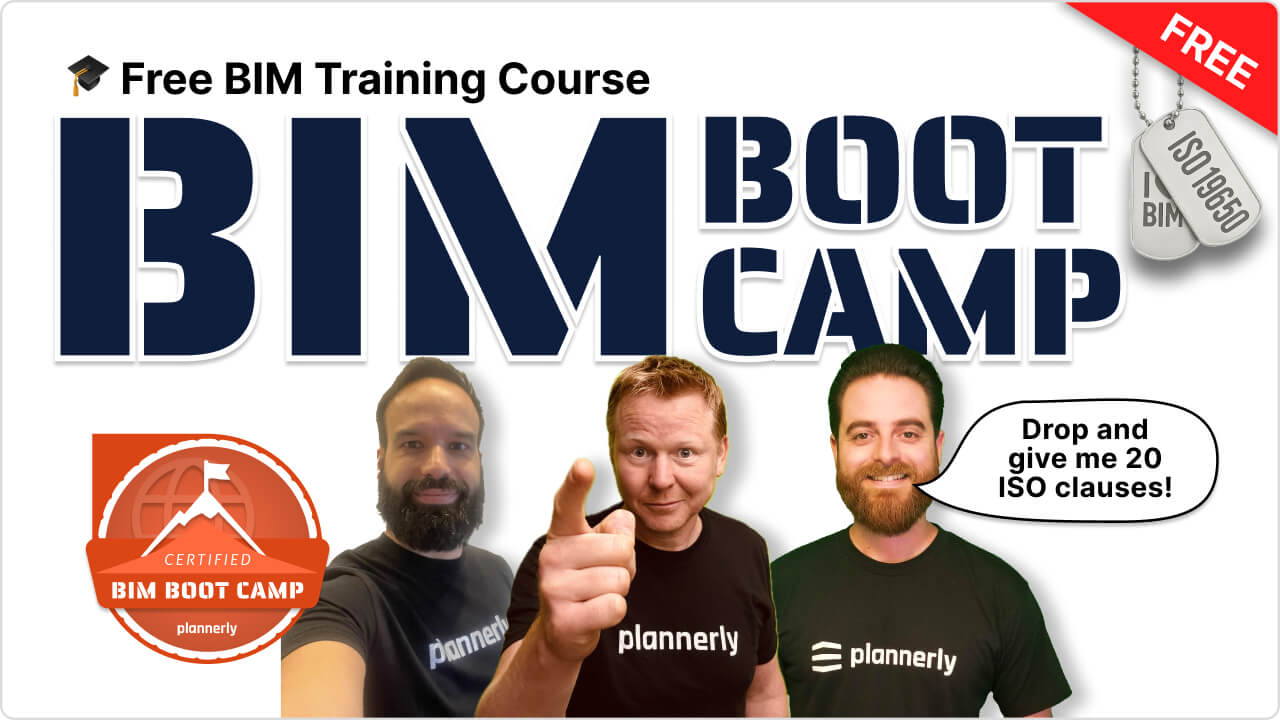 BIM Boot Campaccelerated practical training for teams ready to transform their workflows (opens in a new tab)
Finished this lesson?Mark it complete to save your place, take the quizzes and earn your free certificate. It's your Plannerly account - no new one needed.
Discussion
1 comment
Sign in to read the 1 comment and join the conversation.
Sign in