
Use case - MIDP and TIDPs
Run the MIDP without becoming the reminder system
A master information delivery plan (MIDP) is the ISO 19650 plan of all the information a delivery team will produce: who produces each deliverable, when it's due and what it must contain. It combines every task team's TIDP. In Plannerly you list it, agree it with each team, get it signed and track it in one place.
See every appointed party's plan agreed and tracked. Each task team's TIDP rolls up into one MIDP you can open any day: every deliverable named, owned, signed for and dated, without waiting for someone to re-issue a spreadsheet.
Stop chasing subcontractors for dates. Paste the lists you already have, give each line one owner who said yes, and send each subcontractor a contract with only its own deliverables to sign. Then watch the files arrive against the plan.
Get the design programme out of your inbox. Every consultant's TIDP in one MIDP: each model and drawing named, owned and dated, agreed in the open and signed for.
Stop rebuilding the MIDP for every client. Set it up once, bring in every task team at no cost to them, and hand your client a plan that's agreed, signed and tracked - the same way on every project.
Teach it with a live plan, not a diagram on a slide. Students build a real MIDP from each task team's TIDP, agree it, sign it and track it - ISO 19650 as working practice.
Free plan, no card. Task teams never pay to join your project.
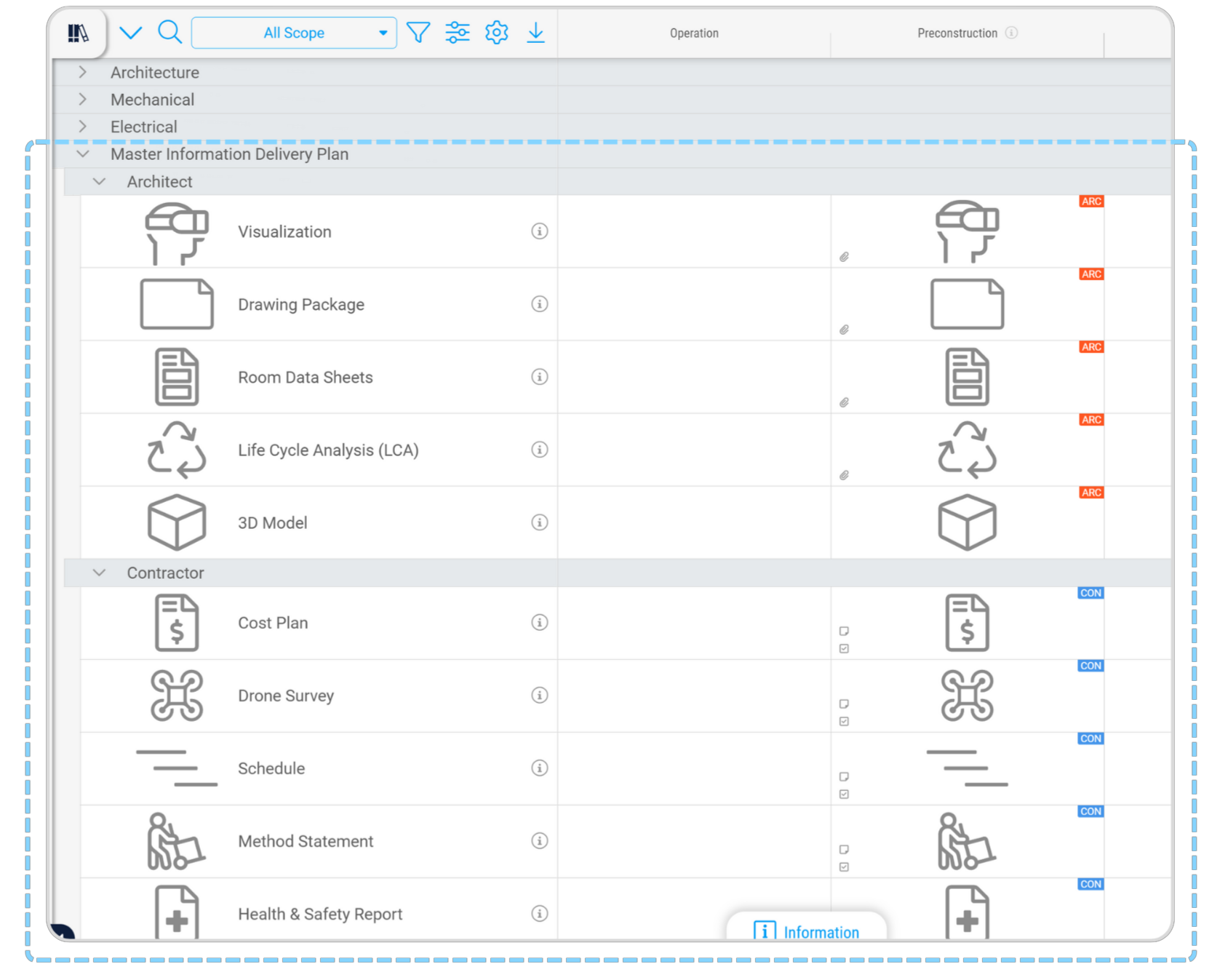
The problem
Why the MIDP spreadsheet dies in week three
How it works
Stop chasing task teams: list every deliverable, agree who does it, get it signed, then track it
-
List every deliverable
Your deliverables are scattered across drawing registers, spreadsheets and emails. Paste them in: every line becomes a named file request, with your naming convention applied, ready to give to a task team.
Every required file named, by team and milestone -
Agree who does what
Nobody remembers agreeing to their row. Give each deliverable one accountable team and a responsible person, set dates on the timeline, and settle objections in comments on the line itself.
Each task team's TIDP agreed, on the record -
Get each team to sign
Nobody reads a contract full of everyone else's work. One click makes each team a contract with only its own deliverables, RACI and timeline, sent for e-signature, with every signed version kept.
Every team signed for its own part -
Track what arrives
No more Friday afternoons chasing. Delivered files fill their requests, reminders go out before starts and deadlines, and the progress charts update automatically - click any segment to see the files behind it.
Progress you can show without building a report
- List: paste your lists, get every file named
- Agree: Build Scope, owners, timeline and RACI
- Sign: the contract document and e-signatures
- Track: CDE Connect and dashboards that build themselves
24 chapters
Skip to the step you're stuck on
- Welcome - where is everyone joining from?00:00
- Sneak peek: CDE Connect and the new File Manager02:16
- The job nobody signed up for03:10
- What ISO 19650 actually asks for03:35
- Why the MIDP spreadsheet always dies04:44
- The four steps07:37
- Live build - starting from an empty project09:50
- Paste your list, get every file11:50
- Automatic file naming16:30
- SmartFolder sets18:33
- Build Scope - planning the deliveries21:15
- Teams, owners and assignment23:41
- Timeline, dependencies and critical path25:10
- RACI and multi-party assignment26:56
- Agreeing it on the record27:38
- The contract document28:20
- E-signatures30:14
- CDE Connect - why "common" data environments aren't32:23
- Connecting and syncing your CDEs33:32
- Mapping folders and keeping files in step38:30
- Dashboards that build themselves41:05
- Recap - stop chasing, start managing44:45
- Next time: Surviving the RACI45:36
- Thanks and close47:02
Free download
Don't start from a blank spreadsheet: get Episode 1's MIDP starter project and three ISO 19650 PDFs, free
MIDP Survival Kit: a starter project and three ISO 19650 PDFs
Start your MIDP from the project Episode 1 built instead of a blank spreadsheet, with three PDFs from our free ISO 19650 training: the MIDP step, the detailed responsibility matrix and the whole process on one page.
- 1 starter project
- 3 PDFs
- Free
MIDP starter project
Episode 1's MIDP as a project of your own: task teams, milestones and deliverables in Scope, ready for you to paste in your own lists.
Free live webinar · Episode 4
Surviving the seven CDEs
Connect them. Keep them in step. Stop re-uploading. Most projects run more than one common data environment, so the single source of truth quietly becomes several and you spend your week re-uploading. How to keep every CDE in step with the agreed plan, so delivered files check themselves off and the dashboards move on their own.
Free webinar on Zoom · 45 minutes · How to survive as a BIM Manager
Thursday 5 November 2026
You'll leave with
- Every CDE on the project connected to one plan
- Delivered files matched to the request they fill
- Dashboards that move as files arrive
Case studies
Teams that took the MIDP out of spreadsheets
Teams that took delivery planning out of spreadsheets: 50 companies coordinated on one development, cross-company conversations months before they would have caused problems, and a design firm that went from Excel chaos to ISO 19650 at scale.
For owners the payoff is earlier conversations: on one $130M project the process prompted cross-company conversations months before they would have caused problems.
Contractors get every company agreeing its part up front: one team coordinated 50 companies and 45 BIM models on one of Portugal's largest developments.
Design teams trade Excel for a structure where every consultant knows what it has to deliver - BuildEXT did it while growing from 6 people to 50+ engineers.
Consultants run the same agreed, tracked plan for every client: LIMSEN coordinated 50 companies and cut BEP planning from 100+ hours to under 30.
These are the workflows your students will meet on real projects: the same plans, the same agreements, the same evidence.
-
 Portugal

$4.5M / €4M
Saved · 310,000 sqm project
How one team saved over $4.5 million
LIMSEN Consultants · BIM management
Coordinated 50 companies and 45 BIM models on one of Portugal's largest mixed-use developments. BEP planning time dropped from 100+ hours to under 30.
Using Plannerly was a cornerstone for us. There is no going back.
Filipe Lima, Managing Partner · LIMSEN -
 United States
53% fewer clashes
$130M residential project
53% fewer clashes on a $130M project
Major Real Estate Developer · 800+ O&M team
A $130M apartment project achieved 16.5% time savings and 53% fewer clashes, with 98% of constructability issues solved vs 31% on the control project.
The Plannerly process prompted critical cross-company conversations months before they would have caused problems.
-
 Hungary

8x growth
6 → 50+ engineers · −10% costs
From Excel chaos to ISO 19650 at scale
BuildEXT · General design firm
Grew from 6 employees to 50+ engineers across 4 departments. Now handles projects 30x larger with 10% lower construction and FM costs.
I cannot imagine using Excel or Word to start writing a BIM contract anymore.
András Ábele-Nagy, Head of BIM · BuildEXT

See all case studiesOwners, design teams, contractors, consultants and educators - filter them by your kind of organisation.
What owners say
Owners on getting every company to agree
5 out of 5
Plannerly makes our conversations easier, it makes buy-in easier. It's a great basis of conversation and agreement.
Jeff ThompsonAssistant Director · Broward County 5 out of 5
Our design teams, PMs, and Clients love the clarity that Plannerly brings!
Matthew FullerBIM Program Lead · Texas Instruments


What contractors say
Contractors on planning delivery with every company
5 out of 5
Plannerly is both a tool and a process. It gives my teams an advantage over the competition.
Chris EveristBIM Manager · BNBuilders 5 out of 5
Plannerly cut the time we spent tracking scope and verifying models by 60%.
Jonathan GriffithsSenior VDC Engineer · reiSource


What design teams say
Design teams on knowing who delivers what
5 out of 5
It gives structure. It restructures everything. Everyone knows what they have to do.
András Ábele-NagyHead of BIM · BuildEXT 5 out of 5
Everyone was able to work from different countries in a collaborative way online.
Sean PillanRegional Design Technology Manager · Gensler

What consultants say
Consultants on running the plan for their clients
5 out of 5
Plannerly cut the time we spent tracking scope and verifying models by 60%.
Jonathan GriffithsSenior VDC Engineer · reiSource 5 out of 5
I feel like I work at Disneyland when I show off Plannerly. It's so simple and visual!
Cindy BaldwinPresident · VDCO Tech

What educators say
Educators on teaching ISO 19650 on live projects
5 out of 5
Many software companies get this wrong. They don't create content or videos. You can't ask me to bring your tool into my curriculum when there's nothing for students to learn from. Plannerly has all of that.
Dr. Zulfikar AdamuAssociate Professor · London South Bank University 5 out of 5
Students love Plannerly and it makes my life so much easier!
Petro KaranxhaProfessor · George Brown College


Setup guides
Set up your MIDP in Plannerly, step by step
Short Help Center guides that walk you through each step in Plannerly. Open one beside the app and follow along.
Start here
List
Agree
Sign
Track

Learn it properly
Level 3 - ISO 19650 Expert
Creating the Master Information Delivery Plan MIDP / TIDP
What learners say
Rated 4.9 out of 5 from thousands of ratings: learners on our free ISO 19650 training
5 out of 5
Clear, practical lessons I applied the same day to BEP and MIDP. ISO 19650 finally feels usable.
Adel MoustafaManager 5 out of 5
Well delivered with practical examples and real project scenarios.
Philip O'ConnorICT Systems Mobilisation Lead · CIMIC Group Limited 5 out of 5
Extremely detailed and practical. It breaks down the core principles of ISO 19650 and gives the steps to implement it effectively in real projects.
Karim MachouchArchitect · Atelier Malik Aljane

Free lessons
Learn the MIDP properly, one short lesson at a time
 Level 3 lesson - agree
Creating the Detailed Responsibility Matrix
Who delivers what and when: the matrix every TIDP is built from.
 Level 3 lesson - sign
Creating the Information Protocol + eSign Contract
How the agreed plan becomes appointment documents each party signs.
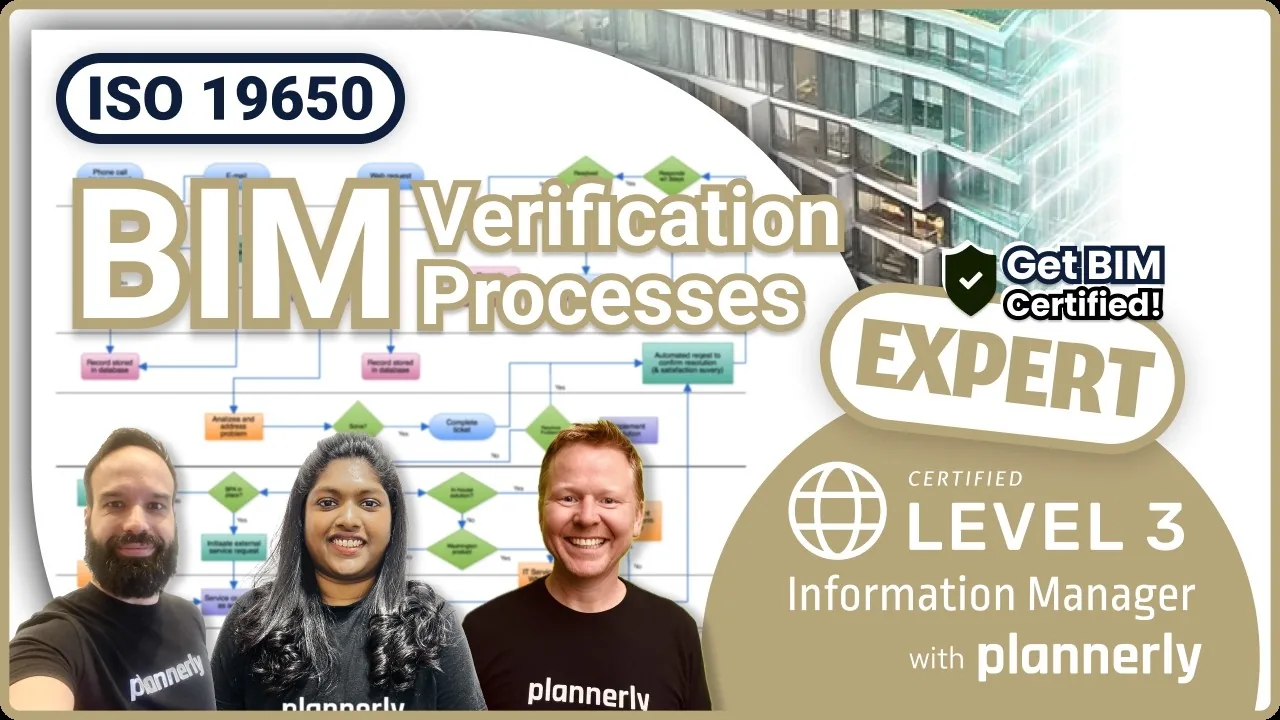 Level 3 lesson - track
Information Verification, Project Tracking, Compliance and Lessons Learned
Checking what arrives against what was agreed, through to close-out.
Level 3 - free certificate
ISO 19650 Expert
The whole ISO 19650 process, the MIDP included, with a free certificate. 16,600+ people have taken our free training.
Read more
MIDP and TIDP guides, templates and diagrams
MIDP and TIDP, explained
Who owns each, what goes on every line, and why most go stale by week three.
GuideISO 19650 in one diagram
The whole information management process on one page, with the PDF to download.
Free PDFThe BIM execution plan template
The BEP your MIDP belongs to, already structured for ISO 19650.
TemplateCreating a responsibility matrix
The matrix that tells each task team what goes in its TIDP.
GuideISO 19650 templates for OIR, EIR and BEP
The requirement documents your MIDP has to answer, as templates.
TemplatesLearn ISO 19650 step by step
Free PDFs and videos for every step of the process, the MIDP included.
FreeQuestions
MIDP and TIDP questions, answered
What is a MIDP (master information delivery plan)?
What is a TIDP?
What's the difference between a MIDP and a TIDP?
Who is responsible for the MIDP under ISO 19650?
When is the MIDP produced and updated?
Is the MIDP being renamed?
Is there a free MIDP template?
What does a MIDP example look like?
Do my task teams need to pay for Plannerly?
Will Plannerly chase task teams for me?
Can I export the MIDP to Excel or PDF?
Can I run the MIDP on the Free plan?
Pricing
Start free, then pay per project when you're ready
- Five projects included
- The account owner edits; everyone they invite can view
- 100 MB of project files
- Explore Docs, Scope and Verify
- You build the MIDP, and everyone you invite can view and comment
- Five projects included
- Unlimited editors and viewers
- 50 GB of project files
- Your branding on everything you export
- Each project beyond five: $49 a month
- Every task team edits its own lines, at no cost to them
- Unlimited e-signatures, so each team signs its own contract
- Try every Pro feature free for 14 days, model checking included, no card
Prices in US dollars. You'll see the price for your country in the app.